

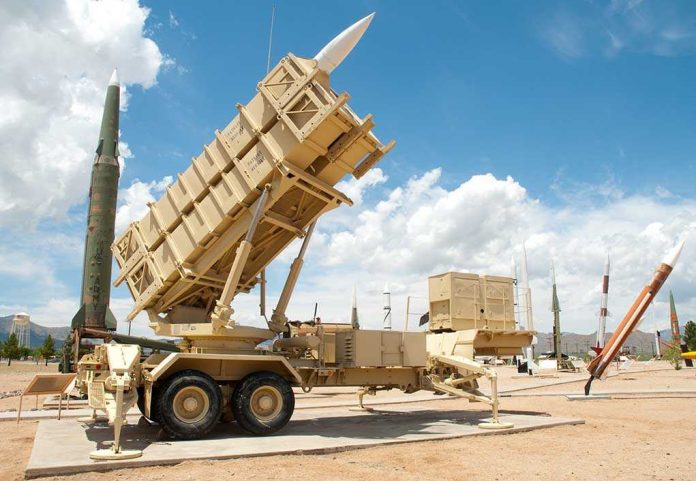
Washington’s approval of up to 500 PAC-3 MSE Patriot interceptors for Ukraine is not a political flourish; it is a concrete move to preserve Ukraine’s ability to stop ballistic missiles, financed by partners and allies rather than U.S. taxpayers, and executed through the well-worn machinery of the Foreign Military Sales system.
At a Glance
- The State Department approved a possible sale of 500 PAC-3 MSE interceptors to Ukraine, an estimated $2.1 billion package.
- The package is explicitly aimed at sustaining and improving Ukraine’s integrated air and missile defense against ongoing Russian aerial threats.
- Funding is to come from allies and partners, including contributions channeled via European mechanisms, not direct U.S. appropriations.
- PAC-3 MSE is the most advanced Patriot interceptor variant and among the few fielded systems designed to engage ballistic missiles.
What the approval actually does in the U.S. arms transfer system
The State Department’s determination clears a procedural gate in the Foreign Military Sales (FMS) process: it authorizes a possible sale and transmits a formal notification to Congress. For major defense equipment, this notification starts a statutory review window under the Arms Export Control Act; if Congress does not block the case, the government can proceed to negotiate a Letter of Offer and Acceptance (LOA) with the buyer. Only an accepted LOA creates a binding obligation and a production or delivery profile. In other words, approval enables the deal; it does not itself ship a single interceptor. That sequence—notification, potential congressional review, LOA, contracting, production—has governed U.S. government-to-government sales for decades.
In this case, the notification covers 500 PAC-3 Missile Segment Enhancement (MSE) interceptors and associated support at an estimated total value of $2.1 billion. The State Department’s release aligns with independent reporting on both quantity and cost; this internal and external consistency is a hallmark of a standard FMS notification rather than a one-off pledge. The transaction is structured to improve and sustain Ukraine’s existing Patriot defenses—an operationally specific purpose, not a generic transfer.
Why PAC-3 MSE matters: mechanism, role, and scarcity
PAC-3 MSE is the Patriot family’s hit-to-kill interceptor optimized for ballistic missile defense; it uses active radar guidance and kinetic impact to defeat high-speed, high-g maneuvers in the terminal phase. This is the interceptor a commander chooses against threats that stress altitude, velocity, and maneuver envelope—ballistic missiles and certain advanced air-breathing targets—where blast-fragmentation from older variants becomes less reliable. The “MSE” upgrade expands the missile’s kinematic reach and engagement battlespace, extending defended footprints and shot opportunities, which is vital when batteries must protect critical infrastructure and population centers under salvo attack. It is, in short, the Patriot round that changes the calculus of ballistic attack.
Scarcity is the constraint everyone in this ecosystem contends with. PAC-3 MSE production supports the United States and a large cohort of international users; demand surged as Russia’s war forced Europe to harden its air defenses. Analyses by congressional researchers and independent think tanks have repeatedly underscored how limited magazine depth and manufacturing throughput—not technical capability—set the ceiling on operational coverage. That context explains why an approval for 500 interceptors is strategically meaningful: it programs future inventory against a finite industrial base and queues Ukraine in a crowded line without forcing immediate diversion from U.S. stocks.
Who pays, and why that structure matters
The State Department’s notification specifies that the estimated $2.1 billion will be funded by partners and allies. Public reporting points to a mix that includes contributions from Canada, Germany, and Norway through allied initiatives such as JUMPSTART, augmented by resources tied to the European Union’s Ukraine Support Loan. The effect is twofold: it preserves U.S. budget headroom while aligning transatlantic priorities around a concrete deliverable—ballistic missile defense capacity in Ukraine. For readers tracking U.S. fiscal exposure, that delineation is not semantic; it’s the difference between a U.S.-financed drawdown and a coalition-financed FMS case.
This model also distributes political and administrative risk. Multiple funding streams require coordination across parliaments, ministries, and EU instruments, but they also embed broad ownership of the outcome. In practice, that arrangement can smooth procurement by allowing European governments to translate political commitments into hardware, while using the U.S. FMS pipeline and contracting apparatus to move high-end munitions that Europe does not produce at scale.
Timelines, expectations, and the production reality
As with any FMS approval, neither the State Department notification nor early reporting specifies a delivery schedule; those details live in the LOA and follow-on production awards. That absence of a public timeline does not make the step symbolic. It reflects how the system sequences work: the buyer accepts terms; the U.S. contracts with the manufacturer; production slots align with factory capacity and prior commitments; deliveries phase accordingly. Given the demand signal across NATO and Indo-Pacific operators, the pacing item is not export authority—it’s the industrial base’s ability to produce interceptors fast enough to meet allied commitments while sustaining U.S. readiness.
This is also why allies sometimes execute a “transfer now, backfill later” play: a country with existing PAC-3 MSE stocks can surge rounds to Ukraine and then receive replenishment from new production once contracts flow. Nothing in the approval obliges that approach, but the structure keeps the option open. Meanwhile, Ukraine benefits from predictable pipeline planning: commanders can budget interceptors—how many shots per threat type, which defended asset priority lists to sustain—around known incoming lots rather than sporadic emergency transfers.
https://twitter.com/SamsonNyimu5/status/2116300120341836042
Operational implications in Ukraine’s integrated air defense
Missile defense is an ecosystem problem: sensors, command-and-control, launchers, reload capacity, and interceptor stocks must all be managed as a single magazine. Ukraine already fields Patriot batteries and has demonstrated the ability to integrate Western and legacy systems under sustained pressure. An additional 500 PAC-3 MSE rounds, once on contract and delivered in tranches, extend that endurance and raise the penalty for Russian ballistic salvos aimed at energy infrastructure, industrial nodes, and urban centers. That is the core outcome the approval is designed to enable: sustained, credible ballistic defense over time, not a one-off surge.
Quantifying the precise effect—how many defended assets, what leakage rates, how long magazines last at current expenditure—is a classified exercise. What can be said confidently is that PAC-3 MSE is a scarce resource tailored to the most consequential threat class, and that 500 interceptors comprise a strategically material increment for a country fighting through repeated ballistic and cruise missile campaigns. The decision to route financing through allied channels deepens that bench, aligning logistics with politics—exactly how durable coalitions provision wars of attrition.
The bottom line
The United States has authorized a possible sale of 500 PAC-3 MSE interceptors to Ukraine—an estimated $2.1 billion package explicitly built to sustain and improve Kyiv’s air and missile defenses. It leverages allied funding, uses a mature FMS channel, and targets the scarcest, most decisive layer of the air-defense problem set: ballistic missile defeat. The approval is not delivery; it is the indispensable first step that makes delivery possible. In a conflict where magazine depth is strategy, putting 500 high-end interceptors into the production queue is strategy made tangible.
Sources:
insidedefense.com, state.gov, kyivindependent.com, breakingdefense.com, united24media.com, payments.jpost.com, en.apa.az, csis.org