

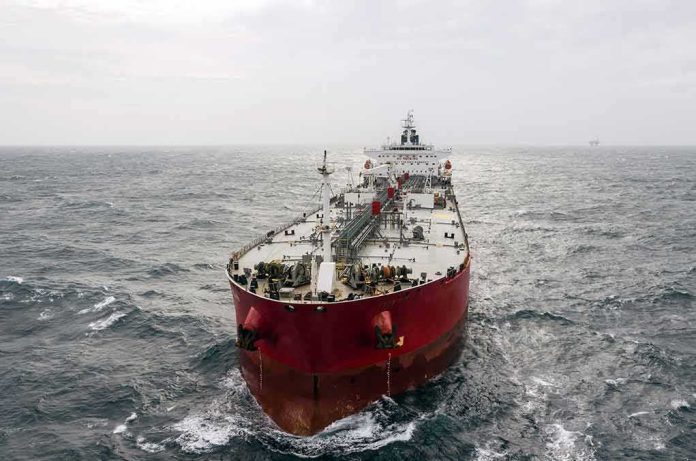
Two Saudi oil tankers turned back in the Red Sea after a Houthi warning, showing how a threat alone can move ships in one of the world’s most sensitive waterways.
Quick Take
- Two tankers carrying Saudi crude reversed course and headed for the Suez Canal after Houthi threats.
- The tankers were bound for China and India, and the cargo totaled millions of barrels of oil.
- The move is the first clear disruption tied to the new Houthi maritime embargo on Saudi Arabia.
- Saudi shipping has shown resilience before, but this episode shows how fast fear can disrupt trade.
Tankers Turn Back After Warning
Shipping data and news reports say the Xin Long Yang and Rodos changed course on Tuesday after warnings from the Houthi movement. Both ships had loaded Saudi crude and were headed toward markets in Asia. Instead, they turned away from the Bab el-Mandeb area and moved toward the Suez Canal route. That shift made the event the first concrete disruption since the blockade announcement.
The timing matters because the Houthis said their maritime embargo would take effect at once and cover Saudi shipping. They framed the move as retaliation for Saudi action against Yemen and used blunt language in public statements. Even without a missile strike or drone attack, the warning changed ship behavior. That is the core reason this story now matters far beyond one set of tankers.
Why the Red Sea Route Matters
The Red Sea and Bab el-Mandeb Strait sit on a critical path for global trade and energy flows. Saudi crude moving through this corridor can reach Asia and Europe faster than many alternate routes. When tankers hesitate, traders see the risk right away. News reports said the two ships were carrying millions of barrels, which shows why even a short pause can ripple through oil prices and shipping plans.
This is not happening in a vacuum. The Houthis have spent months using threats and attacks to make shipping costlier and less predictable. Reports from research groups and international bodies say their campaign has already complicated navigation in the Red Sea. That larger pattern helps explain why shipping firms react fast when the group issues a new warning. The goal is not only damage. It is also to create doubt.
Saudi Shipping Still Has Backup Options
Saudi Arabia is not helpless. Reports from earlier this year said crude loadings at Yanbu continued even after an attack on the East-West Pipeline, and other accounts say Saudi Aramco has used spare capacity and overseas inventories to cushion shocks. Those steps show the kingdom can reroute some flows and keep exports moving. That said, these backups do not erase the risk when a major sea lane becomes unstable.
That is why the tanker reversal should be read as a warning, not proof of total shutdown. The facts show disruption, not a full blockade of Saudi exports. At the same time, the reaction reveals how a non-state group can pressure commercial traffic without matching a navy ship for ship. For critics of global institutions, the episode also feeds a familiar complaint: governments and armed groups keep pushing risk onto ordinary trade.
What Comes Next
The next test is whether more ships turn around, keep going, or wait for escorts and better intelligence. The United States Department of Transportation says vessels in the area face increased risk and should treat the corridor as dangerous. That guidance does not settle who is in control, but it shows how seriously officials take the threat. If more tankers divert, the market will treat this as more than a one-day scare.
At least one of the oil tankers that yesterday U-turned in the Red Sea has performed a 2nd U-turn, heading again toward the Bab el-Mandeb controlled by the Houthis.
The vessel, carrying Saudi oil, is signalling "CHINA CREW & OWNER." At current speed, she will cross the strait in…
— Javier Blas (@JavierBlas) July 22, 2026
For now, the clearest fact is simple. The Houthis did not need to fire a shot to force a costly change in shipping behavior. That alone gives the episode outsized importance. It suggests the battle over Red Sea routes is being fought as much through fear and signaling as through weapons. In a system already strained by war, inflation, and fragile supply chains, that is a problem with broad political and economic reach.
Sources:
19fortyfive.com, straitstimes.com, youtube.com, en.wikipedia.org, reuters.com, marinelink.com, turkiyetoday.com, bloomberg.com, news.futunn.com, discoveryalert.com.au, instagram.com, nllp.jallc.nato.int, hornreview.org