

When a French diocese closes a church and schedules a Mass of reparation, it is not a gesture of wounded feelings — it is the activation of a centuries-old legal mechanism built into the Code of Canon Law, one that treats a desecrated sacred space the way civil law treats a crime scene: off-limits until formally remedied.
Key Points
- A viral video showed teenagers inside the church of Saint-Hilaire-de-Soullans, in the Vendée, dancing and rapping to music referencing terrorist Mohamed Merah, Bataclan attacker Salah Abdeslam, and the 2015 Paris attacks.
- The Diocese of Luçon closed the church and publicly called the episode a “grave violation” of sacred space, announcing a Mass of reparation.
- The response follows Canon 1211, which lets a local bishop suspend worship in a church until a penitential rite repairs the “scandal” caused by a gravely injurious act.
- France’s Interior Ministry has logged hundreds of anti-Christian acts annually in recent years — 857 in 2021, 923 in 2022, 854 in 2023 — making reparation Masses a recurring, not exceptional, feature of French church life.
- The incident sits inside a longer national conversation about the shrinking footprint of French Catholicism alongside a visible wave of attention to sacred-space violations.
What happened at Saint-Hilaire-de-Soullans
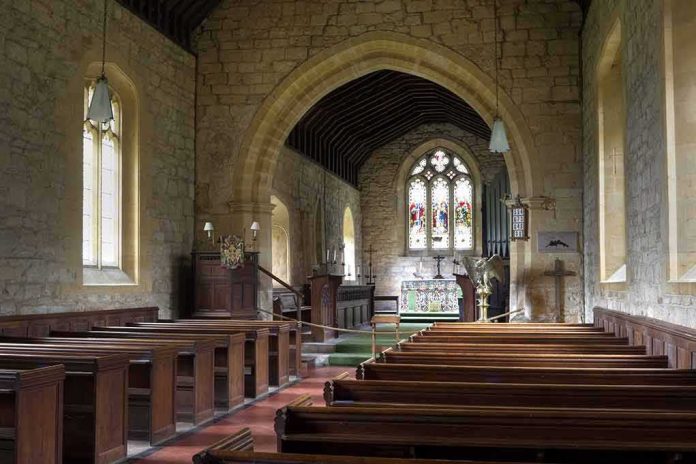
The footage that circulated widely on social media showed a group of teenagers inside the parish church of Saint-Hilaire-de-Soullans, a small commune in the Vendée department on France’s Atlantic coast, dancing and performing to rap lyrics invoking Mohamed Merah — the gunman behind the 2012 Toulouse and Montauban shootings — along with Salah Abdeslam and the November 2015 Bataclan massacre. Reporting on the video described its content as amounting to an apology of terrorism, a specific and serious characterization under French law, not mere teenage misbehavior. The Diocese of Luçon responded swiftly: it closed the church to worship and issued a statement describing the episode as a “grave violation” — atteinte grave — of the building’s sacred character, and announced that a Mass of reparation would be celebrated before regular worship resumed.
That sequence — closure, formal denunciation, scheduled reparation rite — is not improvisation. It is the standard institutional playbook the French Church has used repeatedly over the past decade whenever a church has been subjected to what canon law defines as a gravely injurious act.
The canonical machinery behind a reparation Mass
Canon 1211 of the 1983 Code of Canon Law gives the local ordinary — the bishop of the diocese — explicit authority to declare a sacred place violated when “gravely injurious actions” occur there that scandalize the faithful and, in the bishop’s judgment, are so serious that worship cannot resume “until the damage is repaired by a penitential rite.” This is centuries of ecclesial jurisprudence distilled into a single operative rule: a church is not simply a building with furniture arranged for liturgy, it is a consecrated space whose sanctity can be legally and spiritually breached, and whose restoration requires a defined liturgical act, not just a cleaning crew. The French term for that act, messe de réparation, describes a penitential Mass specifically structured to address scandal and restore the space’s fitness for worship. The bishop’s declaration is therefore a legal finding as much as a pastoral one — closer to a formal judicial determination than an emotional reaction.
This framework explains why dioceses move quickly and publicly when such incidents occur. A bishop who does not invoke Canon 1211 after a sufficiently grave incident risks allowing worship to continue in a space the faithful may regard as compromised — a pastoral problem of its own. The reparation Mass is thus as much about restoring the congregation’s confidence as it is about theological repair.
A pattern, not an anomaly
France’s bishops have invoked this mechanism with some regularity in recent years, a reflection of a documented rise in incidents targeting Catholic sites. The Conference of French Bishops recorded 228 violent anti-Christian acts in just the first three months of 2019 alone. France’s Interior Ministry later tallied 857 anti-Christian acts in 2021, 923 in 2022, and 854 in 2023 — the overwhelming majority property offenses such as vandalism and theft rather than attacks on persons. Individual episodes have drawn national attention: the 2019 arson at the Cathedral of Saint-Alain in Lavaur, where intruders burned an altar and inverted a crucifix; the theft of consecrated hosts from a tabernacle at Saint-Germain church in Deux-Sèvres, which prompted its own Mass of reparation; and the tabernacle break-in at St. Michael’s Church in Morangis, condemned by Bishop Michel Dubost. Each followed the same institutional logic now on display in the Vendée.
Why the terrorism references sharpened the Church’s response
What distinguishes the Saint-Hilaire-de-Soullans incident from routine vandalism is the specific content of the video: lyrics invoking named terrorists and attacks that killed 130 people in Paris in 2015 and seven in Toulouse and Montauban in 2012. That content, described in coverage as constituting an apology of terrorism, moves the episode beyond disorder into territory French authorities treat as a distinct criminal category. For the diocese, the combination of location — inside a consecrated church — and content — glorification of mass-casualty attacks on French soil — justified language stronger than a rebuke of youthful carelessness. The most severe precedent for this kind of response remains the 2020 beheading attack inside the Basilica of Notre-Dame in Nice, after which Bishop André Marceau led a Mass of reparation joined by two archbishops, a case the Church still cites as the template for how a diocese responds when sacred space and public violence intersect.
What this episode signals going forward
Reparation Masses will keep recurring in France for a structural reason: the legal tool exists, the incidents keep happening, and dioceses have learned that silence invites more of both. The broader backdrop — a Church whose number of parishes and priests has contracted sharply over the past four decades even as individual incidents draw outsized public attention — means each publicized desecration lands against a thinner, more anxious institutional base. That makes the swift, procedural response at Saint-Hilaire-de-Soullans less a one-off controversy than a case study in how an old legal instrument continues to do real work in a modern, secular France.
Sources:
washingtonpost.com, wral.com, video.lefigaro.fr, intoleranceagainstchristians.eu, ncregister.com, france24.com, rtrunews.com, catholicphilly.com, x.com