

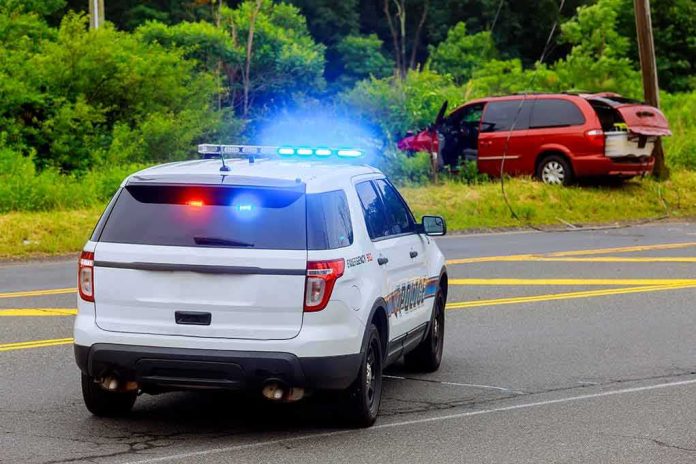
Opioid-settlement dollars were created to remediate a public health crisis, yet in one New Jersey township they underwrote police SUVs and automated license-plate readers—a revealing case study in how mission-drift happens when flexible rules meet local budget pressures.
The Short Version
- Washington Township in Gloucester County used opioid-settlement funds to buy two Chevrolet Tahoe police SUVs and a network of Flock license-plate cameras, totaling roughly $268,000 across 2024–2026.
- Payment records attribute multiple camera installments directly to the township’s opioid account, including hardware, renewals, and data retention contracts.
- New Jersey’s own guidance says opioid funds must support prevention, treatment, recovery, and other evidence-based or evidence-informed remediation—not general purposes.
- The township’s state expenditure certification reportedly matched, dollar for dollar, police-equipment spending while describing the outlay as school-based narcotics work and drug education.
What happened in Washington Township
According to published reporting and an itemized civil-society audit, Washington Township in Gloucester County paid for two 2024 Chevrolet Tahoe police SUVs and a suite of Flock automated license-plate readers with money from the national opioid settlements. Across 2024–2026, the combined purchases approached $268,000, with the Flock system acquired in tranches—ten cameras in April 2025, two more in February 2026, and five additional units later, alongside associated data-retention and renewal fees. The Opioid Audit’s breakdown places these payments in the township’s dedicated opioid account and traces multiple disbursements to Flock Group Inc. for equipment and services.
One detail has drawn particular scrutiny: the township’s report to the state reportedly certified $170,446.70 as funding a “school-based narcotics and education program” and “drug education,” the very amount records show spent on the Tahoes and the initial 15 Flock readers. While a municipality can lawfully run school drug-education efforts, the one-to-one correlation between the certification total and police-equipment invoices has fueled questions about whether the description matches the actual use of funds.
How opioid-settlement funds are supposed to work
The opioid settlements require participating governments to use the vast majority of proceeds for “opioid remediation”—a term of art encompassing prevention, harm reduction, treatment, recovery support, and closely related strategies that demonstrably address opioid-use disorder (OUD) and overdose risk. New Jersey’s official FAQ and the State Comptroller’s guidance repeat the point with clarity: these dollars may not be diverted to unrelated purposes; they must pay for evidence-based or evidence-informed approaches tied to OUD and overdose. Practically, that has meant naloxone distribution, medications for opioid use disorder (MOUD), recovery housing, peer support, data systems for overdose surveillance, and training for responders engaged in overdose care.
There is a narrow but real lane for law-enforcement involvement—programs like pre-arrest diversion, co-responder models pairing clinicians with police, and transportation to treatment can qualify when they are designed and documented as opioid interventions. New Jersey’s legal analyses emphasize that the allowable-use schedules are not exhaustive; the test is whether the spending supports a bona fide remediation program, not whether the asset wears a police decal. A vehicle assigned to a dedicated overdose-response team is different, in compliance terms, from a general patrol SUV.
Why cameras and cruisers trigger pushback
Automated license-plate readers (ALPRs) like Flock are, by design, law-enforcement surveillance tools that log vehicle plates, times, and locations. As Rutgers public-health scholar Rafael E. Pérez-Figueroa put it, ALPRs are not an “evidence-based public health intervention for addressing opioid use or preventing overdose deaths”. That judgment captures the core tension. Even if police argue that stolen cars, drug markets, and diversion crimes intersect, ALPR deployment is fundamentally a broad public-safety infrastructure—not a targeted OUD intervention backed by outcomes research.
The SUVs invite a similar analysis. If assigned to a police-assisted addiction recovery program, a co-responder team, or overdose transport with documented protocols and metrics, a vehicle can be an eligible expense; standing up a treatment-linked unit often requires mobility. But when records, public explanations, and certifications instead lean on generic “drug education” labels while the equipment functions as standard fleet, the spending looks indistinguishable from routine policing—exactly what opioid funds were meant to avoid.
The reporting record to date
Local reporting and the Opioid Audit surface four material facts. First, the township’s opioid account paid for multiple Flock installments across 2025–2026, with itemized amounts and timing that align with vendor charges for hardware and data services. Second, two 2024 Chevrolet Tahoe patrol SUVs for the police department were also paid through the settlement-funded account. Third, the state-facing certification cites school-based narcotics programming and drug education in the exact amount spent on the SUVs and initial ALPR units. Fourth, camera counts and roll-up totals vary slightly across outlets depending on whether renewals and retention are included, but all accounts agree that opioid dollars financed the readers and vehicles in material sums.
Washington Township’s police leadership has framed ALPRs as tools to disrupt “addiction-related crime,” emphasizing a public-safety angle. That is a coherent policing rationale; it is not the same as an evidence-based overdose or treatment intervention. New Jersey’s framework rewards specificity: programs, protocols, data, and reporting that tie a purchase to OUD outcomes are what separate compliant remediation from generalized enforcement gear.
Washington Township spent opioid settlement funds on license plate cams, police SUVs, according to https://t.co/L0lJyHE8sK investigation https://t.co/AO2ZKFFDkz pic.twitter.com/OC2gEhc4PC
— The Philadelphia Inquirer (@PhillyInquirer) October 9, 2026
The broader pattern this fits
Disputes like Washington Township’s are not parochial. Across the country, settlement spending has tilted heavily toward a catchall “other” bucket that often includes law enforcement, jail costs, and emergency medical services. One legislative analysis tallied about $2.19 billion in reported spending through 2024, with roughly 41% labeled as “other”—a category so expansive it blurs the line between remediation and routine government operations. States are experimenting with different guardrails: some channel a defined share to behavioral health systems, others permit a wider lane for sheriffs and police, and oversight quality varies dramatically by jurisdiction.
Where oversight is strong, programs are named, contracts are posted, and performance metrics—overdose reversals, treatment initiations, retention in MOUD—anchor spending decisions. Where it is weak, generic descriptions and equipment purchases crowd out care capacity. New Jersey’s own enforcement history has already flagged out-of-bounds uses, such as entertainment spending masquerading as awareness; the state’s published guardrails are explicit, but they still rely on local governments to design, document, and report with discipline.
What good governance looks like for contested categories
Three practices prevent drift. First, program-first budgeting: define the OUD intervention—diversion, co-response, recovery navigation—then buy the minimum equipment the program needs. Second, documentation that travels: resolutions, legal memos tying the purchase to a specific allowable category, MOUs with providers, and public-facing metrics. Third, narrow tailoring: ALPRs, if used at all, would need a written opioid use case (for example, time-bound deployment around overdose hot spots) with access controls and outcome reporting—not general crime control. Vehicles would be assigned to named OUD units, not pooled patrol, with logs that corroborate purpose.
The settlements will deliver funds for years. Every dollar steered into durable treatment capacity, naloxone, housing supports, and workforce builds pays compound dividends in lives saved. Every dollar drained into generalized enforcement gear is a missed opportunity. Washington Township’s choices, as documented to date, illustrate the difference vividly—and why the letter and spirit of the opioid agreements converge on the same principle: spend to remediate the disease, not to paper over unrelated budget needs.
Sources:
nypost.com, inquirer.com, nj.com, hoodline.com, opioidaudit.com, sherafy.com, reddit.com, nj.gov