

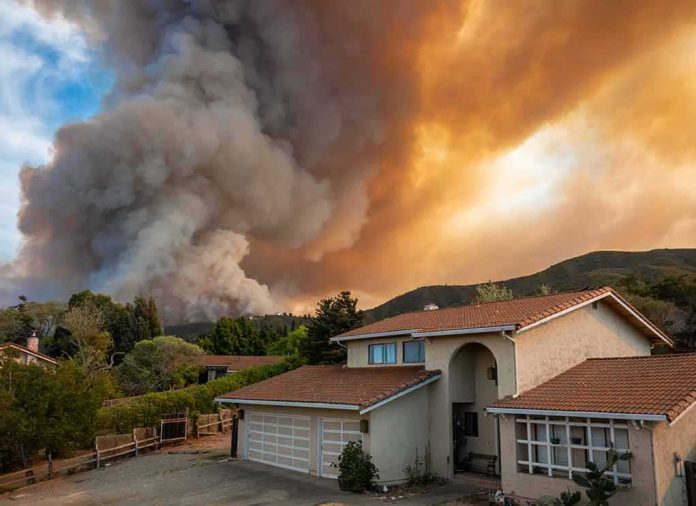
Wildfire prosecutions turn on a simple chain: ignition, causation, and intent; in the Bouquet Fire case, federal prosecutors say they can run that chain end to end, anchored by the defendant’s own alleged admission and a fire scene that points to fireworks as the spark.
The Short Version
- Federal prosecutors charged a Santa Clarita man with arson after a blaze scorched roughly 1,048 acres of Angeles National Forest.
- A DOJ complaint alleges he admitted flicking a cigarette onto fireworks at his property, triggering an explosion and the wildfire.
- Investigators with the U.S. Forest Service concluded the fire was probably caused by fireworks after excluding other sources.
- Items consistent with that account were recovered at the residence; jurisdiction stems from the burn on federal land.
What prosecutors say happened — and why they brought a federal case
The Justice Department filed a federal arson complaint alleging that a Santa Clarita resident, Saba, started the Bouquet Fire on October 3, 2026, when a cigarette he threw from his porch landed on fireworks and set them off. According to the complaint, the reported ignition point was directly behind his home on Bouquet Canyon Road at about 2:13 p.m., aligning with early 911 and witness activity in the area. The U.S. Forest Service investigation concluded the blaze was probably caused by fireworks after alternative sources such as lightning, debris burning, and campfires were ruled out. The charging decision is federal because the fire burned approximately 1,048 acres of the Angeles National Forest, which is federal property, giving federal authorities clear jurisdiction over the offense.
Prosecutors attribute a direct statement to Saba acknowledging the cigarette-on-fireworks sequence. While complaints are not verdicts, an on-record admission—if obtained lawfully and presented in context—typically forms the backbone of a cause-and-origin narrative at this stage. The complaint also references items seized from the residence consistent with that account, including cigarettes, a lighter, shotgun ammunition, and an aerial mortar firework. NBC Los Angeles reporting adds local texture: neighbors described a shotgun-like blast, heard an explosion, and then heard Saba calling for help—sensory cues that mirror what igniting fireworks can sound like in confined or semi-confined outdoor spaces.
How wildfire origin-and-cause investigations build a case
Wildland origin-and-cause work is reconstructive science. Investigators narrow to the most plausible scenario by locating the area of origin, reading burn and heat patterns, assessing fuel beds, and then excluding alternative ignition mechanisms systematically. The Forest Service states that lightning, campfires, and debris burning were excluded in the Bouquet Fire; after this culling, fireworks emerged as the likely cause. That “probable” label is consistent with accepted practice in wildland investigations, which rely on multiple converging indicators rather than a single dispositive artifact. In the field, the scientific method—hypothesis, testing against scene evidence, and elimination of inconsistent explanations—governs the process more than any single “smoking gun” fragment.
Large-sample research underscores why “probable cause” language is standard in wildfire work. A Forest Service modeling study that classified ignition causes across western fires found high accuracy at distinguishing human versus natural starts, but substantially lower accuracy across specific human sub-causes; in short, the closer you get to the precise human act, the more the analysis depends on scene-specific, corroborative facts. In a prosecution, those facts include witness statements, physical items consistent with the mechanism, timelines, and—when available—statements ascribed to the suspect. The Bouquet Fire complaint presents all four categories coherently: place, time, mechanism, corroborative physical context, and an alleged admission.
Where the legal standard sits: ignition, causation, and intent
Charging arson is not merely an exercise in fire science; it is an exercise in mens rea. Federal arson statutes require proof that the defendant acted willfully and maliciously—legal terms that, in this context, boil down to intentionally setting a fire without lawful justification. Courts have long articulated that standard in wildland arson prosecutions. The physical act of flicking a cigarette onto fireworks can satisfy the ignition-and-causation elements if the government proves the chain from act to wildfire; the harder question, often, is whether that act was done with the intent the statute demands. Prosecutors typically meet that burden through circumstantial evidence and admissions; the complaint’s attribution of a direct admission helps address both causation and state of mind in one stroke.
Jurisdictionally, the case’s federal posture is straightforward. The burn scar encompassed lands of the Angeles National Forest, bringing the alleged conduct within federal jurisdiction. When a wildfire crosses or consumes federal property, federal charges become available even if the initial spark occurs on private land; the rationale is simple: the protected resource and firefighting liability are federal, and so is the forum for accountability when the government can tie the ignition to unlawful conduct.
Santa Clarita man charged with federal arson in the Bouquet Fire. Prosecutors say he flicked a cigarette onto fireworks. Full story:https://t.co/TBlatMPPJR
— The Southbound 105 (@Southbound105) October 11, 2026
Why fireworks plus a cigarette can be a deadly combination
Fireworks contain pyrotechnic compositions designed to ignite under heat and flame; even a smoldering ember can be enough to start a fuse or set off exposed powder, particularly in dry, windy conditions common in Southern California’s shoulder seasons. A lit cigarette tip can exceed 400 degrees Fahrenheit during a puff; in contact with pyrotechnic fuse or unpackaged consumer mortars, it can supply sufficient energy to ignite. Once a device deflagrates, ejecta can disperse burning material across receptive vegetation, creating multiple spot ignitions coalescing into a fast-moving fire front, especially along canyon topography like Bouquet Canyon, where slope and wind can align to accelerate spread. This is why even consumer-grade fireworks are restricted or banned in many jurisdictions during high fire danger periods—and why negligence around them can scale catastrophically.
Consequences and next steps: what to watch in a prosecution like this
In a federal wildfire case driven by an alleged admission and a fireworks mechanism, two questions typically shape the road ahead. First, the admissibility and context of the defendant’s statement—Miranda compliance, voluntariness, and consistency with other evidence—often become pretrial battlegrounds. Second, the government will consolidate its origin-and-cause proof with scene documentation, witness timelines, and any laboratory or residue analysis connecting recovered fireworks to the ignition area. If the case advances to indictment and trial, jurors will be asked to evaluate not only whether the cigarette-on-fireworks chain occurred, but whether it was an intentional act that satisfies the willful-and-malicious standard for arson on federal land.
Sources:
nypost.com, justice.gov, hometownstation.com, nbclosangeles.com, rollingout.com