

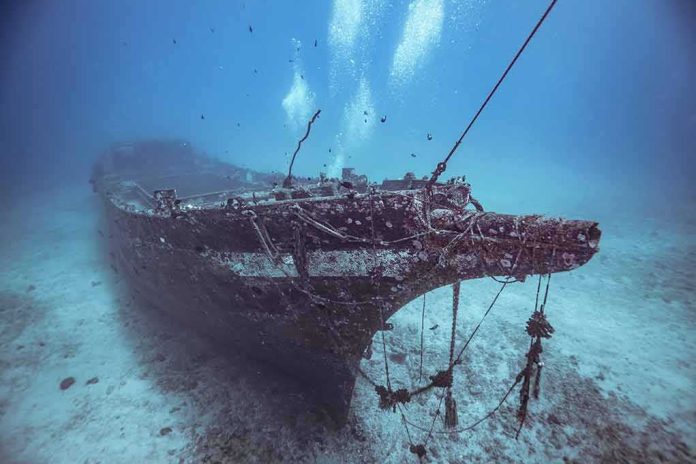
The Komsomolets wreck demonstrates a hard truth about marine nuclear hazards: a source can leak demonstrably radioactive water for decades while the broader sea remains largely unaffected; the signal is real at the vent, the dose is negligible at distance, and responsible policy lives in that tension.
At a Glance
- Direct sampling at the wreck in 2019 found cesium-137 in a ventilation pipe at levels orders of magnitude above ambient seawater, confirming ongoing reactor-related leakage three decades after the sinking.
- The highest measured sample near the duct was roughly 800,000 times normal Norwegian Sea levels; outside that microenvironment, rapid dilution at 1,700 meters depth keeps concentrations low.
- Norwegian authorities judge the leakage poses no demonstrated risk to people or fisheries today, and no weapons-grade plutonium has been confirmed in surrounding waters.
- The wreck still contains a reactor and two nuclear warheads, so long-term monitoring—and sober engineering analysis of future options—remains warranted.
What the data actually show: confirmed leakage, contained impact
In July 2019, a joint Norwegian-Russian cruise sent a deep-ROV to K-278 Komsomolets on the Norwegian Sea floor, about 1,700 meters down. Researchers sampled directly from a known ventilation pathway on the wreck and recorded cesium-137 activity ranging from less than 8.0 to 857 Bq/L—levels consistent with internal reactor contamination reaching the external environment via the duct. Their own conclusion was explicit: releases from the reactor are still occurring, decades after the loss of the submarine. The single most striking figure—a sample approximately 800 Bq/L—has been widely compared to the roughly 0.001 Bq/L background in the Norwegian Sea, yielding the “hundreds of thousands of times higher” headline ratio. That ratio is numerically correct for the vent-proximate sample; it is not a proxy for the wider sea.
The same expedition reported that other samples in and around the duct were lower, and that the plume diluted rapidly in the overlying water column. Norway’s marine research institute and the radiation authority both said the measured release posed no risk to Norwegian seafood or the public because of that fast dilution at extreme depth. This is the core of the Komsomolets paradox: narrow, reproducible evidence of leakage at the source coexists with a weak signal beyond the immediate structure. For informed risk management, both are true at once.
How we got here: a deep, damaged hull with a reactor and warheads
Komsomolets was a single-hull, deep-diving titanium submarine carrying a pressurized-water reactor and two nuclear-armed torpedoes when a 1989 onboard fire led to its sinking and 42 fatalities. In the early 1990s, Russian expeditions documented hull damage and attempted partial mitigations—sealing measures and coverings on forward openings—while Western and Norwegian scientists began periodic radiological surveys. The 2019 cruise, drawing on that history, specifically targeted the ventilation trunk where earlier Russian observations in the 1990s and 2007 suggested releases could occur, and found again that reactor-derived cesium is present at that outlet. The physical pathway matters: internal contamination can be “breathed” out of a wreck via vents, cracks, or interfaces as currents shift. The mechanism does not require catastrophic failure; slow corrosion and complex internal hydraulics are enough.
Critically, the warheads are a separate inventory and a separate question. The 2019 plan called for laboratory analysis of plutonium isotopes to test for weapons-related leakage, but the public record around that cruise centers on cesium-137 from the reactor. Multiple reports since have underscored the absence of confirmed weapons-grade plutonium in nearby seawater and sediments, which is consistent with the lack of a demonstrated weapons-source signal to date.
Where experts genuinely disagree: severity today versus risk over time
The disagreement is not about whether leakage exists. It does. The live debate is about its meaning. Norwegian authorities have been clear that the detected cesium release does not translate into a present danger for fisheries or human health because of dilution at depth and the very low ambient background in the region. Russian designer Igor Spassky, who has commented on the wreck for decades, has likewise resisted catastrophic framing and argued corrosion in the near-freezing deep sea proceeds slowly; by his account the situation requires prudence, not panic.
Environmental advocates and some analysts counter that “no demonstrated risk now” is not the same as “no problem,” particularly with a reactor core and two warheads on the seabed. They point to the documented, vent-localized spike and the history of intermittent releases as reasons to keep the site under close watch, to characterize potential pulse events, and to understand structural deterioration that could change the release profile in the future. On the core facts, the Norwegian data carry the most weight: cesium is leaking at source; seafood-scale exposure is not evidenced. The responsible path is continued measurement matched to credible failure modes.
How to read the numbers: ratio headlines versus dose reality
Cesium-137 is a fission product; in seawater it is conservative—chemically mobile and not strongly particle-reactive—so it is a useful tracer of reactor leakage. A measured 800 Bq/L in a duct is diagnostically powerful: it pins the source. But a ratio like “800,000 times normal” is a function of a vanishingly low background. The more policy-relevant questions are mass and time: how much is leaving the wreck, over what interval, and where does it dilute to what concentration. The 2019 cruise report itself states releases vary in amount and duration and does not claim an annual discharge estimate or a geographic spread; it documents a leak pathway, not ecosystem-scale contamination. Norwegian agencies, drawing on that and other data, communicate the reasonable conclusion: dilution at 1,700 meters keeps exposures negligible for people and fish today.
The absence of confirmed strontium-90 and weapons-grade plutonium in surrounding media further constrains the risk picture at present. It does not, however, settle the long-term question. Corrosion, structural shifts, or mechanical failure could alter pathways and rates; only repeated measurements paired with hydrodynamic modeling will resolve whether the system stays benign at distance or delivers episodic pulses that momentarily change local conditions.
What responsible stewardship looks like from here
Three priorities are clear. First, continue targeted sampling at the ventilation duct and immediate near-field under varied current and seasonal regimes to quantify release dynamics—intermittent spikes versus sustained seeps—and derive defensible flux estimates. Second, advance laboratory work that closes the isotope ledger: high-sensitivity analyses for strontium-90 and plutonium isotope ratios in seawater, sediments, and biota around the bow and along likely plume paths. Third, pair structural surveys with scenario modeling: corrosion mapping, hull imagery, and stress assessments tied to credible engineering options—from continued monitored natural attenuation to remote sealing or encapsulation—each evaluated for failure modes and comparative risk. The case for lifting the wreck remains weak given depth and uncertainty; the case for transparent, methodical monitoring is strong.
Sources:
19fortyfive.com, dsa.no, themoscowtimes.com, hi.no, bbc.com, rferl.org, usni.org