

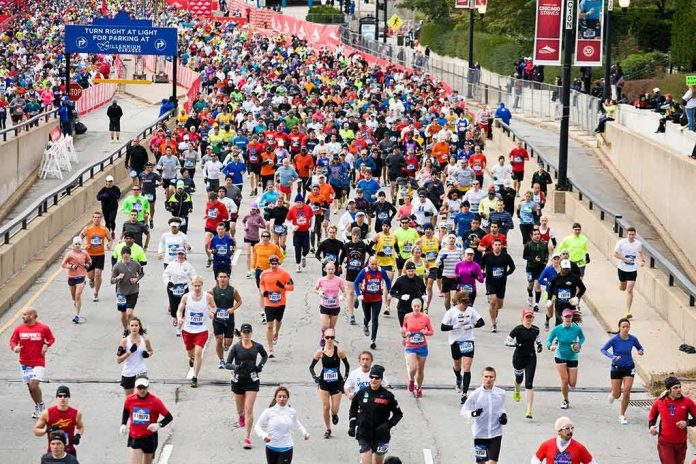
A 24-year-old runner collapsed near mile 24 of the New York City Marathon and later died after rapid on-course care and hospital treatment, officials said.
Story Snapshot
- Organizers said bystanders and medical staff gave CPR and used a defibrillator before transport.
- Police placed the collapse near the 24-mile mark; the runner died that night at a hospital.
- Her father said rhabdomyolysis, a rare muscle breakdown, caused her death.
- Texts showed she felt pain late in the race, according to reporting.
Collapse Near Finish And Immediate Medical Response
New York Road Runners said a bystander began cardiopulmonary resuscitation after a runner collapsed close to the 24-mile point in Central Park. Event medical staff arrived, continued lifesaving efforts, and used a defibrillator. An ambulance then took the runner to a Mount Sinai hospital, where she died later that evening. The New York City Police Department placed the incident near the 24-mile mark, about two miles from the finish line on Fifth Avenue by the park’s east side.
Organizers described a swift response that followed the race’s established medical plan. Reports set the collapse around early afternoon, with medical crews arriving within minutes and transport following shortly after. Coverage noted that she was running her first New York City Marathon and that she had trained and competed as a former field hockey player. The death prompted condolences from race officials and the broader running community as investigators recorded the circumstances and timeline.
Family’s Stated Cause And What Rhabdomyolysis Means
Her father, Steve Apa, told national outlets that rhabdomyolysis caused his daughter’s death. Reports described rhabdomyolysis as a breakdown of muscle that can release harmful proteins into the blood and can lead to kidney failure and heart rhythm problems. News coverage emphasized that heavy exertion can trigger this condition in rare cases. Medical guidance explains that doctors confirm the diagnosis with blood tests, urine tests, and heart monitoring in a hospital setting.
Published reports did not include an autopsy, hospital records, or a medical examiner ruling. The family’s account therefore stands as the public explanation, while officials have not released clinical documents cited in those reports. Coverage presented general medical background on the condition and stressed that fatal cases are uncommon. Readers should understand that hospitals and families often face privacy rules that limit what details can be shared beyond next-of-kin statements.
Texts, Timing, And The Race’s Risk Profile
Reporting said the runner texted her father during the race that she was in pain, including messages around mile 19. She later collapsed near mile 24, where bystanders, including reported physicians, started care before race medics arrived. Outlets placed the hospital death that night. These specific time and place details align with typical race tracking and emergency response logs seen in large city marathons, though not all underlying records are public in news accounts.
Rachel Apa, former Red Land and Bucknell field hockey player, dies after NYC Marathon collapse — Female Athlete News – https://t.co/SLTTUnPCW5
— FemaleAthleteNews (@Female_FANews) November 3, 2026
Large studies show that life-threatening events in long-distance races are very rare, but they do occur. Research across millions of entrants has found cardiac arrest rates around one half per 100,000 participants. A major registry reported about 3.35 life-threatening events per 100,000 runners in long races. These figures help explain how a single tragedy can happen even with strong planning and on-course medical teams in place.
Why This Matters For Runners, Families, And Organizers
Race organizers in big cities prepare for worst-case events with trained staff, automated defibrillators, and ambulance staging. This case shows why that planning matters and how bystander cardiopulmonary resuscitation can buy time before medics take over. Conservative readers value personal responsibility, and this story also shows the power of community action when seconds count. Quick help from citizens and trained crews gives the best chance for survival in a sudden collapse on a crowded course.
What Runners Can Do Before Race Day
Doctors advise runners to listen to warning signs, hydrate, and adjust pace when pain or heat stress builds. Medical guidance for suspected rhabdomyolysis includes checking electrolytes, kidney function, and heart rhythm. Runners with chest pain, severe cramps, confusion, or dark urine should seek care fast. Families can also set a contact plan and use tracking apps on race day. Simple steps can help turn scattered information into quick action if trouble strikes on the course.
Sources:
people.com, espn.com, boston.com, abc6onyourside.com, cbsnews.com, jamanetwork.com