

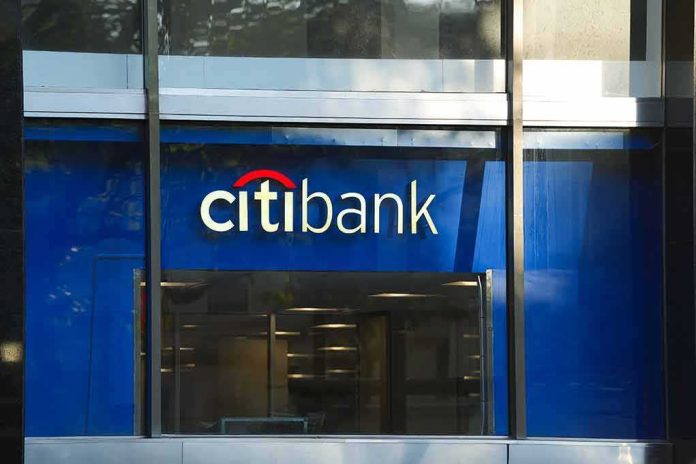
When violence strikes a workplace, seconds—not slogans—decide outcomes; in Tampa, a rifle-wielding attacker killed a woman at a busy office campus before a company security guard engaged and shot him within minutes, a sequence that tracks with how these events escalate and, on rare occasions, are stopped.
At a Glance
- Authorities say the attacker crashed a sedan into an outdoor seating area, exited with a rifle, and fatally shot a woman before moving toward a cafeteria.
- A Citibank security guard confronted the gunman inside the building within minutes and shot him; the suspect later died at a hospital.
- Hillsborough County received 911 calls at roughly 12:11 p.m.; the security engagement occurred around 12:15 p.m., amid a response that deployed 367 deputies across a multi-building campus.
- Four additional people sustained non-life-threatening injuries; approximately 3,200 employees were on site as deputies cleared the complex over about two and a half hours.
- Security interventions like this remain uncommon nationally, even at commercial sites where most active-shooter events occur.
What Authorities Say Happened in Tampa
According to detailed briefings from the Hillsborough County Sheriff’s Office, the sequence began around lunchtime when the suspect drove a small four-door sedan across medians and through a secure fenced area at a Citibank office campus near Tampa. The car crashed into an outdoor seating area crowded with employees. The man exited with a rifle and shot a woman. He then moved into the cafeteria, where an armed private security guard confronted him and fired. Deputies reported that the suspect was transported to Tampa General Hospital and later pronounced dead. The woman died at the scene. Four other individuals were treated for non-life-threatening injuries, either at local hospitals or on site. The sheriff’s office said 911 calls began at approximately 12:11 p.m.; the guard’s engagement occurred around 12:15 p.m. as the first wave of law enforcement arrived and expanded perimeter control across the campus.
The scale of the response matched the size and complexity of the site. The agency deployed 367 deputies, including tactical elements, to secure and clear multiple three-story buildings. With roughly 3,200 employees on campus, evacuations, interviews, and evidence preservation unfolded in parallel. Authorities reported clearing the complex in about two and a half hours, a brisk pace given the sprawling footprint and the investigative need to treat both the outdoor seating area and the cafeteria as active crime scenes.
Mechanics and Timing: Why Minutes Matter
Violence of this kind tends to unfold in bursts. Vehicle-borne entry collapses standoff time; a car through a fence or across medians turns layered access control into a single failure point. Once the attacker exits with a rifle in a crowded commons—an outdoor lunch space or cafeteria—the window for intervention is measured in minutes, sometimes less. Here, the initial shot that killed the woman occurred outside. The gunman then moved toward the cafeteria, where a staff security officer, armed and on site, closed distance and fired. The reported four-minute gap from first 911 call to armed confrontation aligns with the upper end of “immediate responder” doctrine inside private campuses, where security patrols can be closer than off-site police but still must navigate crowded corridors, identify the threat, and avoid blue-on-blue confusion as deputies arrive.
Large campuses complicate this choreography. Radios across private security, 911 dispatch, and incoming deputies must stitch together a coherent common operating picture in real time. The sheriff’s office described a rapid, layered response that pushed resources simultaneously toward the threat, casualty care, and building-by-building clearance—tactics that preserve lives by isolating the shooter while compressing the overall incident timeline.
How This Fits National Patterns
Workplace attacks at commercial sites are not rare in the national tally of active-shooter incidents, but lethal intervention by on-site security is. FBI reporting shows that commerce locations are a frequent setting for active-shooter events; yet, across recent years, private security personnel intervened in only a small fraction of incidents, and in even fewer did they stop the attacker by force. The Bureau’s 2025 summary notes three security interventions that year, with a similar low-single-digit count the prior year; taken together, security intervention occurred in roughly 4% of incidents across the preceding five-year span.
That baseline matters when interpreting a highly visible outcome like Tampa’s. The presence of armed private security can be decisive at a given site—especially when they are close, trained, and prepared to move toward gunfire—but national data do not support a generalized claim that guards usually end workplace shootings or reliably prevent fatalities. Most incidents still end through other pathways: the attacker flees, is engaged by law enforcement, or dies by suicide before intervention. The Tampa case belongs to the much smaller subset in which a trained on-site guard mounted a timely armed response and stopped further harm.
Complex Questions Investigators Work Through After the Scene Is Safe
Once the threat is neutralized, investigators map what professionals call the “mechanics of harm.” That includes the path and speed of the vehicle, points of breach, muzzle-to-victim distances, direction of travel into the cafeteria, and the arc of the security guard’s movement. They will reconcile 911 logs, radio traffic, entry-badge data, and time-stamped video to confirm the minute-by-minute sequence and to attribute the fatal round with confidence. Autopsy findings, projectile recovery, and weapon serial numbers are part of that chain. While those granular details are not yet public, the authoritative bones of the case—the outdoor killing of a woman by a rifle-armed attacker, the guard’s engagement in the cafeteria minutes later, and the suspect’s subsequent death at the hospital—are consistent across agencies’ briefings and multiple outlets’ contemporaneous reporting.
Two clarifications commonly arise in the first days after such an attack: motive and targeting. In Tampa, the sheriff initially described the incident as appearing targeted, while the chief deputy emphasized that determining any prior relationship between the suspect and the victim would require further investigation. That distinction is routine. “Targeted” describes the shooter’s apparent intent at the scene; confirming a relationship requires documentary and testimonial proof. As identities are formally released and next-of-kin notifications completed, investigators will align communications records, employment information, and witness statements to reach a firm conclusion.
🚨 Shooting at Citibank's office complex in Tampa, Florida 🇺🇸
2 dead including the suspect, 4 hurt (non-life-threatening). 367 deputies cleared the building. Police call it "a targeted incident." 🙏
When will this stop?#Tampa #Citibankhttps://t.co/bbbaYTUTE0
— Keiwai_C (@keiwai_c) November 5, 2026
What Prudent Organizations Can Learn
Three elements stand out. First, layered access control cannot rely solely on vehicle barriers; medians and fences slow ordinary traffic, not a determined driver. Harder perimeter design—bollards, reinforced planters, intelligent gate controls—forces a crash to occur away from soft congregating spaces like lunch terraces. Second, the guard’s proximity and training mattered. An armed professional who knows the terrain, carries appropriate equipment, and has rehearsed interior movement with law enforcement can compress the response interval by precious minutes. Finally, communications resilience is a quiet lifesaver. When employees evacuate without phones, family reunification and roll calls can bog down; site plans that designate rally points, paper rosters, and radio-equipped floor wardens pay off when bandwidth and batteries vanish.
The Bottom Line
The Tampa attack moved fast: a breach by car, a rifle, a woman murdered at lunch, then a decisive confrontation inside minutes. The guard’s intervention stopped the gunman and, by all reasonable inference, reduced further loss of life. That outcome aligns with the best-case version of a bad day—and with the national record that shows such security interventions are possible, powerful, and rare.
Sources:
washingtontimes.com, cnn.com, tcpalm.com, wtsp.com, fbi.gov, ucr.fbi.gov