

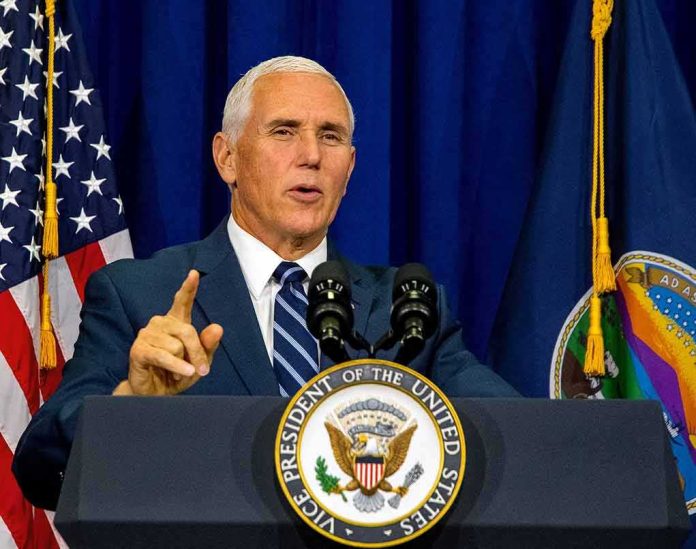
Mike Pence says the Republican Party “lost its way,” and he’s not ruling out trying to fix it from the Oval Office in 2028.
Quick Take
- Pence told Fox News Digital he’s open to a 2028 run, just two months after saying he had “no plans” to seek office again
- He blames Trump’s tariffs, foreign policy, and “perception of self-dealing” for the GOP’s midterm losses
- Pence calls for a return to limited government, fiscal restraint, and the right to life
- Critics note his 2024 campaign collapsed before Iowa, and GOP primary voters still favor Trump-aligned candidates
Pence Reopens The Door He Once Closed
Former Vice President Mike Pence told Fox News Digital on November 12 that he’s been “very humbled” by people urging him to run in 2028, and he doesn’t know what the future holds. That’s a notable shift. Just two months earlier, Pence told the Economic Club of Washington, D.C. he had “no plans” to run for president or any other office. The flip-flop gives skeptics plenty of ammunition.
Pence frames his potential bid as a course correction. He says Republicans must get back to “the principles of a strong defense, limited government, fiscal responsibility and the right to life,” calling it the “broad mainstream conservative agenda”. He’s made versions of this argument for months, telling NBC News in May that the Trump administration had “departed” from conservative principles tied to limited government and free markets.
Pence directly ties his diagnosis to the GOP’s midterm beating. He blames Trump’s tariffs, foreign policy moves, and what he calls a “perception of self-dealing and corruption” for handing Democrats their gains. That’s a serious charge from a man who spent four years as Trump’s own vice president, and it raises an obvious question: why speak up now, after the votes were counted, instead of during the administration he served?
A Diagnosis Without Much Data Behind It
Pence’s electoral autopsy sounds confident, but the reporting behind it doesn’t include a poll, a precinct analysis, or any independent study isolating tariffs or “corruption perception” as the actual cause of GOP losses. It’s his read on the results, not a proven finding. Conservative voters who back Trump’s trade and foreign policy may reasonably ask for more than a vice president’s opinion before accepting it as fact.
The policy vision itself stays vague too. Strong defense, limited government, fiscal responsibility, and the right to life are phrases every Republican can nod along to. But Pence hasn’t laid out where he’d land on tariffs, entitlement spending, immigration enforcement, or how to handle Iran and Russia. Without specifics, “traditional conservatism” risks sounding like a slogan rather than a plan voters can actually evaluate.
The 2024 Record Looms Large
Pence already tested this exact message once. His 2024 presidential campaign launched explicitly against Trump, struggled with fundraising and polling, and folded before the Iowa caucuses while he carried more than $1.3 million in unpaid debt. That track record matters. A second attempt built on the same principles, aimed at the same voters, invites a fair question about why the outcome would differ this time.
Pence himself seems to grasp the uphill climb. He’s acknowledged that Republican primary voters want candidates aligned with Trump, not candidates positioned against him. That’s a remarkable admission from someone contemplating another run. It suggests Pence understands his lane is narrow, even as he keeps the door open rather than closing it for good.
Loyalty, January 6, and the Weight of History
Pence’s break with Trump traces back to January 6, 2021, when he refused to reject electoral votes during certification, a decision that permanently strained his relationship with Trump and much of the base. That history colors everything he says now. Supporters who view that moment as a betrayal of Trump are unlikely to hear Pence’s current critique as principled; they’ll hear it as the same old grievance repackaged for a new election cycle.
MIKE PENCE HINTS AT POSSIBLE 2028 PRESIDENTIAL BID AS SUPPORTERS URGE ANOTHER RUN
Former Vice President Mike Pence says he is hearing from supporters nationwide about another presidential campaign following the 2026 midterms. Pence declared that “this version of republicanism… pic.twitter.com/CQMVPiEgCS
— Sergeant News Network 🇺🇲 (@sgtnewsnetwork) November 13, 2026
History offers one more sobering data point. Vice presidents have ascended to the presidency nine times in American history, but almost always through death or resignation, not through winning an open election on their own merits. Pence would be charting rarer territory: a former vice president trying to beat his own former boss’s movement at the ballot box, armed with principles many Republicans already associate with the status quo they just voted against.
Sources:
thegatewaypundit.com, thehill.com, bostonherald.com, clashreport.com, gazette.com, nbclosangeles.com, foxnews.com, congress.gov