

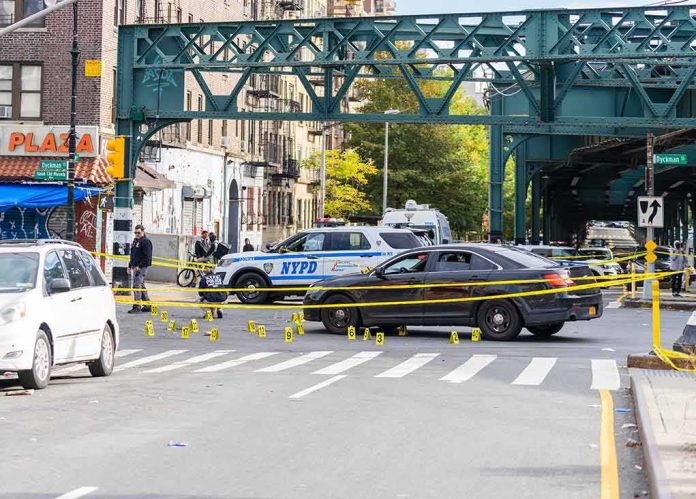
Two 911 calls about a screaming person in a white van set off a highway stop that ended with New York Police Department officers shooting the driver on the Belt Parkway in Brooklyn.
Story Snapshot
- Two separate 911 callers reported someone screaming, “Let me go,” inside a white van.
- Officers stopped the van on the Belt Parkway; pepper spray and a Taser failed, police said.
- Police said the driver rammed police and civilian cars before officers fired.
- Investigators later found the woman from the van unharmed; no child was involved.
What set the response in motion
Two people dialed 911 around early evening and described a possible abduction in a white van near West 22nd Street and Surf Avenue in Brooklyn. One caller said a girl was “kicking and screaming.” Another said she heard, “Let me go.” Dispatchers put out the alert. Officers spotted the van and moved to stop it on the eastbound Belt Parkway near Coney Island Avenue. Traffic was heavy. Drivers watched as police formed a quick containment on the shoulder and in a travel lane.
Officers approached the van with commands to show hands and exit the vehicle. Police said the driver did not comply. Officers broke the front passenger window to gain a line of sight into the cabin. They used pepper spray into the compartment. They then used a Taser. The New York Police Department said both measures failed to move the driver or stop the threat. The standstill shifted fast as the van’s engine revved and tires scraped for position in tight traffic.
Why officers fired on the Belt Parkway
Police said the driver used the van as a battering ram. The vehicle struck police and civilian cars during the effort to break free. In that tight space, a two-ton van can become a weapon in a split second. Officers then fired and stopped the driver. Officers pulled him out, performed CPR, and took him to NYU Langone Hospital—Brooklyn, where he died. No officers reported gunshot injuries at the scene. The stop closed lanes and jammed the Belt Parkway for hours.
Deadly force law turns on an immediate threat to life. Courts have held that an officer may shoot to end a dangerous pursuit or stop a driver who turns a vehicle into a weapon. In Plumhoff v. Rickard, the United States Supreme Court said officers can fire to halt a motorist whose driving puts others at grave risk, even if the stop began with a lesser offense. The rule centers on the threat in front of the officer at that moment, not the label of the underlying call.
What the abduction claim looks like now
Investigators found an adult woman who had been inside the van and said she was unharmed. Early reports now describe the event as linked to a domestic dispute rather than a child abduction. The 911 callers used the word “girl,” which often means a female of unknown age in the heat of a crisis. That mismatch fueled early headlines, but the core emergency remains the same: callers heard a woman screaming for release inside a moving van. Police must treat that as real until facts prove otherwise.
🚨SHOCK FOOTAGE: NYPD officers fatally shot a 26-year-old kidnapping suspect on Saturday night in Brooklyn on the Belt Parkway near Coney Island Avenue after he rammed police cruisers and civilian vehicles while fleeing.
Police first used pepper spray and a Taser before opening… pic.twitter.com/DHi0C78XuD
— Moshe Schwartz (@YWNReporter) November 15, 2026
Reports state the driver had prior domestic abuse matters tied to the same woman. That background explains the urgent police posture but does not decide the shot-by-shot analysis on the highway. The key question is whether the driver posed a deadly threat when officers fired. The New York Police Department said the driver rammed vehicles after less-lethal tools failed. If body-worn camera video shows that sequence, the force-escalation track will match both training and common sense about cars used as weapons.
How to judge the highway tactics
Urban stops on limited-access roads compress time and space. Officers must box a suspect in, warn drivers behind, and prevent a new pursuit. A pinned vehicle that surges can crush an officer or fling into live lanes. The New York Police Department described a ladder of force: commands, window breach for access, pepper spray, Taser, then gunfire once the van hit cars. That model tracks standard doctrine: start low, move up if the threat grows and puts others at risk.
One clear takeaway for public safety
Two people called 911 because they heard a woman in crisis. Officers found the van, tried lower-force tools, and fired only after the van became a moving threat, according to the New York Police Department. The woman survived. Bystanders on a Saturday night Belt Parkway did, too. That outcome matters. When seconds count and a vehicle turns into a weapon, stopping it fast can keep a bad scene from turning into a pileup or a roadside funeral.
Sources:
thegatewaypundit.com, nytimes.com, themirror.com, fox5ny.com, nbcnewyork.com, pix11.com, law.cornell.edu