

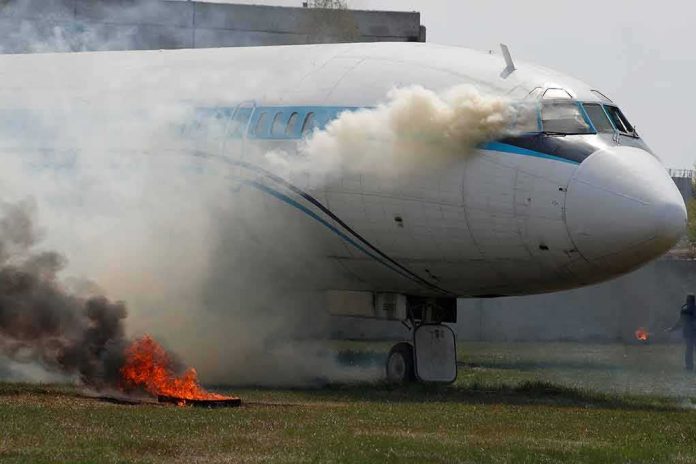
When a plume of black smoke rises beside a capital city’s main airport, it is not just a local emergency; it is a test of national resilience, air-defense credibility, and the stability of global energy flows. Riyadh’s September incident — flames and smoke near King Khalid International Airport after overnight danger alerts — was exactly that kind of stress test.
The Short Version
- Black smoke and flames were seen near King Khalid International Airport in Riyadh after overnight alerts warned of a hostile aerial threat; flights were disrupted as civil defense later issued an all-clear.
- Imagery and eyewitness accounts pointed to fire in or near fuel storage infrastructure serving the airport, with reporters on the ground seeing firefighters at a tank displaying Aramco branding.
- The incident occurred amid a renewed Houthi campaign that has targeted Saudi energy and aviation assets in recent weeks, including claimed strikes on Aramco sites and airports across the south.
- Air and energy infrastructure sit at the center of modern deterrence — damage or even disruption can ripple through aviation operations, domestic confidence, and oil market psychology.
What happened near Riyadh’s main airport
The sequence was stark and familiar to anyone who has watched this conflict’s escalatory cycles: night-time warnings of danger to the capital, booms audible across parts of the city, then daylight images of a column of black smoke rising near King Khalid International Airport. Reporters and residents described visible flames; airport operations slowed as carriers delayed or canceled flights. By later in the day, Saudi civil defense sent an all-clear, but only after the emergency response had been underway and the travel disruption was already real.
The visual evidence matters because aviation hubs are as much fuel farms and logistics nodes as passenger terminals. Photographs and video framed the smoke against airport approaches and highways; journalists near the scene reported firefighters working around a fuel tank bearing the Aramco logo — consistent with a blaze affecting aviation fuel storage serving the airport complex. Even when quickly contained, a fuel fire at an airport compels operators to suspend or reroute movements until they are confident in safety margins, which explains the documented delays and cancellations.
How this fits the Houthi-Saudi conflict’s targeting logic
From a purely operational perspective, this incident sits squarely inside the Houthis’ established playbook: threaten the Kingdom’s airbases, civil airports, and energy infrastructure to exert pressure, complicate air operations, and raise the perceived cost of Saudi action in Yemen. In the weeks preceding the Riyadh blaze, Houthi military spokesmen boasted of strikes on Aramco facilities and airports in southern Saudi Arabia, with parallel reporting chronicling new waves of drones and missiles penetrating deep into the Kingdom’s airspace. The logic is cumulative — hit nodes that are hard to fully harden and whose partial disruption has immediate signaling value.
The Riyadh episode also tracks with the broader tactical pattern that characterizes this conflict’s information environment: rapidly emerging imagery of smoke, flashes, or debris comes first; official forensic attribution often follows hours or days later, if at all. That gap has structural causes. Saudi authorities juggle aviation safety, public assurance, and market optics; the Houthis weigh the propaganda value of claims against operational security and escalation control. In the space between, the most plausible belligerent often becomes the working assumption — especially when the target set matches prior campaigns.
Mechanics: why airport fuel depots are tempting and vulnerable
Fuel farms are indispensable, spatially exposed, and mechanically fragile. Jet-A storage sits in large above-ground tanks linked by manifolds, valves, and pump houses that feed hydrant systems to gates. Even well-protected sites present a generous thermal and visual signature; a small warhead igniting a vent, roof seam, or exposed piping can drive a fire that generates the kind of towering black plume seen in Riyadh. Modern depots employ floating roofs, foam suppression, inert gas systems, and dike containment, but those controls aim to keep a tank fire from becoming a conflagration; they do not render the site invulnerable to precision or saturation attacks. From an attacker’s perspective, the payoff is asymmetric: a single successful ignition can force airport-wide operational constraints, even if the physical damage is limited to one tank.
For a defender, layered air and point defenses degrade but cannot eliminate risk. Patriot or THAAD batteries are built for high-end ballistic and cruise threats, not the full spectrum of small, low-RCS drones and loitering munitions; counter-UAS systems improve the local picture but can be saturated or deceived. The result is a statistically thin but persistent chance of leakage — one or two threats getting through in a complex volley — and in infrastructure defense, one leakage event can be enough to create operational consequences.
Operational impact: aviation, energy, and signaling
Even short-lived fires at airport depots impose a cascading series of decisions: stand up emergency services; isolate tanks; depressurize segments of the hydrant network; and, critically, meter airfield movements until responders declare a reliable safety perimeter. That is why flight-tracking services and carriers quickly reflected delays and cancellations around Riyadh during the episode. The disruption window may be measured in hours, but to airlines — and to passengers watching travel plans evaporate — that interval is consequential.
Energy markets respond more to perceived risk than to precise damage tallies. A visible fire next to the capital’s main airport at a time of declared hostile aerial threats feeds a straightforward narrative: critical Saudi infrastructure remains within reach of a determined adversary. In recent months, Houthi statements, corroborated in part by external reporting, have emphasized attacks on Aramco sites across multiple provinces; even when production remains steady, the drumbeat of claimed strikes chips away at the image of impermeability that underpins price stability and investor confidence.
Escalatory backdrop: why the timing raised the stakes
The Riyadh fire did not happen in a vacuum. The weeks around it saw a marked intensification in cross-border action: Houthi operations described as deep strikes into Saudi territory, Saudi retaliatory sorties in Yemen, and a diplomatic environment in which regional talks were delayed or reframed amid security concerns. In such cycles, each incident at a high-visibility node — an airport, a base, a fuel depot — does double duty: it is a tactical event and a strategic message about costs and capabilities. For policymakers, the practical problem becomes managing simultaneous imperatives: reassure domestic audiences and markets, maintain operational tempo, and calibrate responses to avoid uncontrolled escalation.
History suggests these episodes produce policy aftershocks. Civil aviation authorities harden perimeter approaches and refine ground-movement contingencies; energy operators revisit physical protection and redundancy; air-defense commands re-tune sensors and engagement rules to better catch small, slow, and low-flying threats. None of that makes headlines, but over time it changes the risk calculus — attackers must work harder to achieve the same effect, and defenders trade some convenience for resilience.
Yemen’s Houthis Claim Attack on Saudi Capital After Fuel Depot Burns at Airport (targeted with ballistic missiles – 24°58'50.0"N 46°40'50.7"E).
King Khalid International Airport, Riyadh Saudi Arabia.#KingKhalidInternationalAirport#Riyadh #SaudiArabia#Yemen #Houthis#IRGC pic.twitter.com/Ls8jR4SIZ8— Comte de Saint Germain (@StGermain1776) September 19, 2026
The durable lesson: infrastructure resilience as deterrence
Modern deterrence is not just about intercept rates and punitive raids; it is also about how quickly critical systems absorb a hit and return to service. The Riyadh episode underscores that truth. A visible fire near a flagship airport invites scrutiny of everything from foam stockpiles and hydrant isolation drills to airspace management during civil-defense alerts. The faster operators contain flames, protect fuel integrity, and resume safe movements, the less strategic value attackers wring from a strike. Conversely, if each incident produces outsized disruption, the incentive to repeat it grows.
Sources:
thegatewaypundit.com, reuters.com, straitstimes.com, english.ahram.org.eg, france24.com, timesofindia.indiatimes.com, indiatoday.in, ajkerpatrika.com