

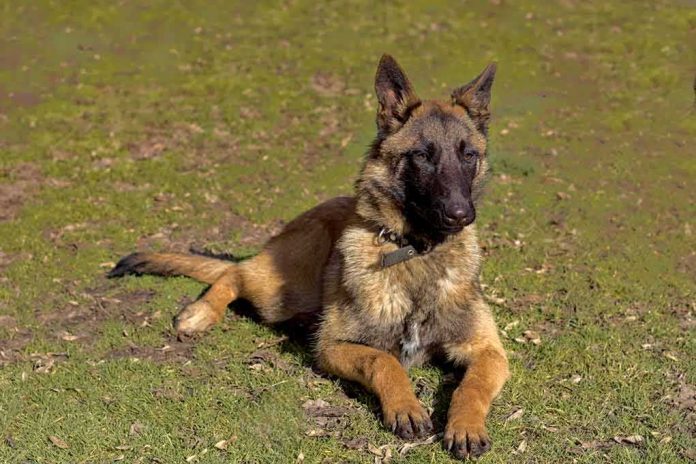
In avalanche country, survival is measured in minutes; LouLou’s two-day return from the Alaskan backcountry shows how modern searchcraft—volunteers, aircraft, and a humble Bluetooth beacon—can stretch those minutes into a rescue window that would have been unthinkable a decade ago.
At a Glance
- A 4-year-old poodle–husky mix named LouLou survived roughly 50 hours after an avalanche in Alaska’s Chugach State Park before being found alive.
- Searchers used aircraft, drones, and signals from an Apple AirTag on LouLou’s collar to narrow the search area in rugged terrain.
- The mountaineers with LouLou were swept about 500 feet by the slide, rescued, and began coordinating efforts to find the missing dog.
- The case illustrates both the promise and limits of consumer trackers in sparse, high-alpine environments where the “Find My” network can be intermittent.
What happened: a high-consequence search in avalanche terrain
On October 10, near Alaska’s Eklutna Lake in Chugach State Park, an avalanche swept two experienced mountaineers roughly 500 feet off a ridge, separating them from LouLou, the 4-year-old poodle–husky mix hiking alongside them. The men were rescued and treated for injuries, but the dog vanished into a sprawl of early-season snow, talus, and timber. For approximately 50 hours, volunteers and friends rallied a search that mixed backcountry craft—helicopter overflights, drones, grid sweeps—with a new variable: intermittent location pings from the Apple AirTag clipped to LouLou’s collar. On October 13, searchers located her alive and largely uninjured, a result multiple outlets documented with consistent dates, location, and timeline details.
Accounts agree on the essential sequence: avalanche on October 10; prolonged gap in contact; AirTag signals that were at times vague or delayed; and a final visual acquisition from the air that put rescuers on the ground with a dog alert, sitting upright, and—remarkably—no worse for two nights of exposure. The line between luck and method is always fuzzy in wilderness rescues, but here the method matters. The AirTag did not act like a GPS collar with continuous telemetry; rather, it furnished just enough coarse data to focus human eyes and rotorcraft where the dog plausibly remained.
How it worked: AirTags, the Find My network, and why mountains are different
AirTags ride piggyback on Apple’s “Find My” network: the tag itself broadcasts a low-power Bluetooth signal; any nearby Apple device that hears it updates the tag’s approximate position in the owner’s iCloud account. In cities crowded with iPhones, the result is near-real-time breadcrumbs; in thinly peopled mountains, updates can be stale, sparse, and imprecise. Reviewers and technical guides are candid about this asymmetry: AirTag performance depends on the density and proximity of other Apple devices, with location precision degrading as that density falls.
In practical terms, LouLou’s team leveraged a patchwork of “last seen” positions that, while not surgical, were strategically useful. A coarse dot on a ridgeline can justify a helicopter sweep over one drainage instead of another; a new ping can shift drone pilots to a wind-sheltered bench more likely to hold tracks or a curled-up animal. AirTags do not yield path history, geofences, or continuous tracks in the way a satellite GPS collar does; what they can do is shorten the number of wrong places a crew needs to look when time, weather, and daylight conspire to narrow the safe search window.
Why a 50-hour canine survival is plausible when human burial windows are not
Avalanche medicine draws a stark distinction between fully buried human victims—whose survivability drops off a cliff after the first 15 minutes due to asphyxia—and those who are not encased or who self-extricate and move downslope. Wilderness Medical Society guidance and avalanche education emphasize this “minutes, not hours” truth for burial rescues; dogs, probes, and transceivers are all tools that matter because oxygen does not wait.
LouLou’s case fits a different profile. Reports do not describe her as buried; she was separated and lost after the slide, then spent two nights exposed. Healthy, double-coated canids manage cold better than humans, especially if uninjured and able to find a lee or tree well to break the wind. The hazard set is still severe—hypothermia, trauma, disorientation, predators—but survival over 48 hours is within canine physiological range. That is precisely why the search’s center of gravity moved from companion-rescue urgency to backcountry missing-dog tactics: scan likely cover, follow tracks where possible, and use any electronic hint to prioritize terrain.
Searchcraft in practice: volunteers, aircraft, and narrowing the cone of uncertainty
Rescues like LouLou’s rarely hinge on a single tool. Reports describe a coordinated volunteer effort: friends and community members flying drones, a helicopter crew sweeping high-probability terrain, and ground searchers ready to move once a sighting was made. The AirTag’s intermittent pings acted as a probabilistic guide rather than a dot-to-dot trail. That hybrid model—technology for coarse direction, humans for detection and recovery—tracks with how avalanche programs deploy trained dogs in human rescues: canines cover ground orders of magnitude faster than probe lines, yet they still rely on handlers, teams, and aircraft to vector them into the right basins and keep the tempo high when minutes matter.
Here, minutes mattered differently. Exposure risk accumulates—storm cycles, falling temperatures, and nocturnal cold sinks can turn survivable conditions lethal by the second night. Each airborne pass that exonerates a gully and each fresh ping that tightens a search box buys probability. Ultimately, LouLou was spotted from the air and retrieved alive, a finish that validates the layered approach and underscores the value of any low-friction signal that trims uncertainty when terrain hides a hundred nooks.
A dog survived an avalanche and 50 hours alone
LouLou, a poodle–husky mix, disappeared after an avalanche in Alaska swept away two mountaineers. More than 50 hours later, a determined rescue team found the dog alive and largely uninjured. pic.twitter.com/D9FpHpHc5o
— Soul Pearls 🪷 (@SoulPearlsss) October 16, 2026
What this means for backcountry dog owners
Two practical conclusions follow. First, fit your dog for the environment: double-check collar security, add an insulated vest for cold seasons, and condition recall in noisy, chaotic settings—slab fractures and moving snow can scatter a team fast. Second, choose the right tracker for the right place. AirTags are inexpensive and nearly maintenance-free; in wilderness zones with sparse device traffic, they are best understood as coarse locators that sometimes light up, not as continuous trackers. For alpine travel, a dedicated GPS/satellite collar with its own uplink remains the gold standard for live positioning, at the cost of battery management, subscription fees, and bulk.
Why the story resonates: technology as an amplifier of community effort
Human-interest rescues follow a recognizable arc because the ingredients are durable: a high-stakes setting, an animal with a name and a face, and a community that refuses to let probability dictate the outcome. What is newer is the subtle way consumer technology augments volunteer will. A $29 Bluetooth tag cannot conjure cell towers onto a glacier, but it can hand a helicopter pilot a better first guess and keep a drone operator from wasting a battery on the wrong bowl. In LouLou’s case, that was enough to stack the deck until eyes on snow closed the loop.
None of this subtracts from the baseline realities of avalanche country. For people, burial remains a suffocating clock; for both people and dogs, terrain choice, timing, and weather discipline outrank any gadget. But when the improbable happens and the search turns long, the blend that saved LouLou—volunteers, aviation, and a modest signal bouncing through the Find My network—shows how small tools, used intelligently, can bend outcomes in hard places.
Sources:
facebook.com, people.com, alaskasnewssource.com, lastampa.it, tag24.de, podroze.onet.pl, ilfattoquotidiano.it, pcmag.com, hotairtag.com, greenlight.com, hubble.com, seattletimes.com