

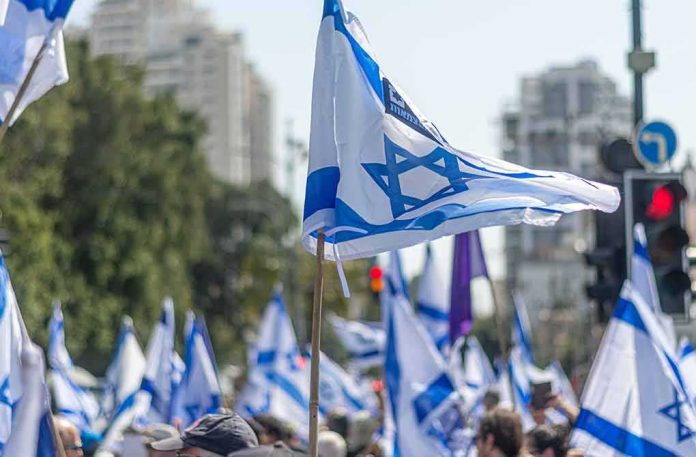
The pro-Israel lobbying giant AIPAC is giving up something it has used for decades to shape Congress: the power to formally endorse candidates and hand them campaign cash.
Quick Take
- AIPAC told members it will end candidate endorsements, direct PAC contributions, and earmarking after the 2026 midterms.
- The group plans to push individual donors to give straight to candidates instead of routing money through its own PAC.
- AIPAC’s affiliated super PAC, the United Democracy Project, will keep spending without limits on election ads.
- The change reverses a political strategy AIPAC built starting in 2021 ahead of the 2022 midterms.
What AIPAC Told Its Members
AIPAC leaders sent a letter to members laying out the plan in plain terms. “Endorsements, direct PAC contributions, and earmarking will no longer be part of our approach,” the group wrote, with the shift kicking in once the 2026 midterm elections wrap up. That is a clean break from how AIPAC has operated for years, when its formal nod carried real weight with candidates chasing pro-Israel support and campaign money.
In place of endorsements, AIPAC says it will lean on its members directly. The group plans to “expand individual giving,” pointing supporters toward specific candidates and helping them put their own money to work using what the Washington Examiner reported as “new tools”. AIPAC told Jewish News Syndicate that members had already poured more than $90 million straight into candidate campaigns this cycle, and that this kind of organized personal giving will keep growing.
A Strategy Five Years in the Making Gets Reversed
This is not AIPAC’s first approach to electoral politics, it is a reversal of one. The Jewish Telegraphic Agency reported that AIPAC PAC and its super PAC partner, the United Democracy Project, launched in 2021 to gear up for the 2022 midterms. That buildup turned AIPAC into one of the most aggressive outside spenders in American politics, pouring tens of millions into primaries to back allies and sink critics. Five years later, the group is stepping back from the direct-contribution playbook it built.
The dollar figures involved are not small. CNBC’s review of Federal Election Commission filings found AIPAC has moved about $105.1 million through its traditional PAC and the United Democracy Project this cycle alone, with the super PAC reporting $53.4 million in independent spending. That kind of money buys serious influence in close races, and it explains why candidates in both parties have paid close attention to where AIPAC’s checks land.
The Super PAC Isn’t Going Anywhere
Here is the part voters should not miss: AIPAC is not leaving campaign politics, it is changing lanes. The United Democracy Project will keep operating as a super PAC, free to raise unlimited money and spend it attacking or boosting candidates, separate from AIPAC’s own PAC. Formal endorsements and direct PAC checks are ending, but the bigger spending vehicle keeps its full legal freedom to influence races.
That distinction matters under federal election law. A traditional PAC like AIPAC’s can give candidates money directly but only up to strict limits. A super PAC like the United Democracy Project cannot hand cash straight to a campaign, but it faces no cap on what it raises or spends independently on ads. Dropping the PAC-and-endorsement model while keeping the super PAC trades one kind of leverage for another, not less leverage overall.
Why the Timing Raises Eyebrows
The announcement lands after a stretch of public friction over AIPAC’s role in primaries, including high-profile campaigns to unseat sitting lawmakers critical of Israel policy. Jewish Insider reported the policy shift as part of a broader rethink of how AIPAC engages with candidates heading into 2026. Whatever the internal reasoning, ending formal endorsements removes a visible target while leaving the financial muscle largely intact through the super PAC structure.
For conservatives who value transparency in how outside money moves into elections, this split system deserves a hard look either way. Routing influence through individual donor networks and an unrestricted super PAC instead of a traditional PAC does not reduce the money in politics, it just changes which door it walks through. Voters deserve clarity on who is funding their candidates, regardless of which organizational label sits on the check.
If AIPAC is ending candidate endorsements and direct fundraising but continuing political spending through other channels, what has really changed?
Americans deserve transparency about who is financing political campaigns and influencing elected officials. U.S. interests should…
— Bluegrass Fair Minded (@AkBluegrass3) October 21, 2026
AIPAC’s own words frame this as an upgrade in strategy, not a retreat from politics. But with the United Democracy Project still free to spend without limit, the real test will be whether AIPAC’s footprint in the 2026 midterms actually shrinks, or simply moves to a different part of the ballot sheet.
Sources:
pjmedia.com, cnbc.com, wsj.com, kpbs.org, washingtonexaminer.com, jta.org