

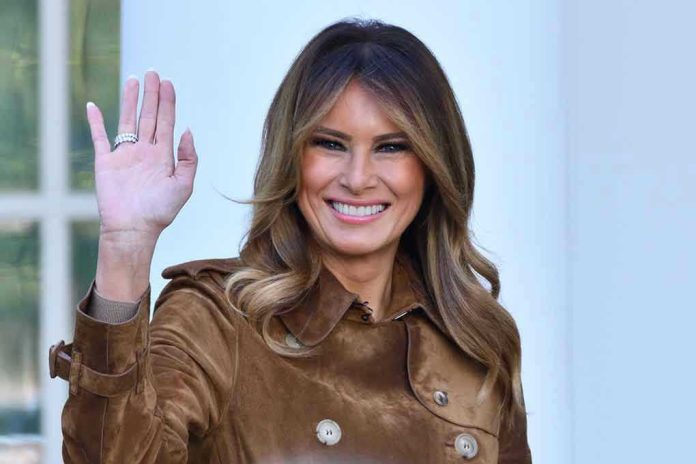
The loudest critics of the “Melania” documentary didn’t stop it from doing the one thing that matters in a theater: selling tickets.
Story Snapshot
- The Amazon-backed documentary “Melania” posted roughly $8 million in its opening weekend across the U.S. and Canada, a rare breakout for a non-concert documentary.
- Amazon reportedly spent $75 million on distribution rights and marketing, signaling a strategy aimed beyond theaters and into streaming scale.
- The audience skewed heavily older: 78% of ticket buyers were over 55, with women 55+ making up 72%.
- Rural markets drove an outsized 46% of revenue, with Florida, Texas, and Arizona leading sales.
A box-office surprise that exposes how America buys media now
“Melania” opened in late January 2026 after a Washington, D.C. premiere, and the numbers landed like a splash of cold water on the commentariat. About $8 million in its first weekend made it the strongest theatrical opening for a non-concert documentary in more than a decade. That doesn’t happen by accident, and it doesn’t happen because people on social media approve. It happens when a specific audience feels personally summoned.
The mockery online became part of the fuel, not a firebreak. That dynamic makes traditional “buzz” metrics look dated: a trending joke can coexist with sold-out screenings if the joke feels like a sneer aimed at the ticket buyer. For older Americans who already believe elite institutions treat them as disposable, buying a ticket can function as a small act of defiance. The marketplace reads behavior, not hashtags.
The real headline is who showed up, not what critics said
The opening weekend audience profile tells you more than any review. Reports put 78% of ticket buyers over age 55, with women 55+ accounting for 72% of the crowd. That is a demographic that still likes the shared ritual of a theater and still values biography, decorum, and family imagery. In other words, this was not a film “for everyone.” It was a film for someone, precisely.
Geography sharpened the picture. Rural markets reportedly generated 46% of opening weekend revenue, a striking share for a documentary. Florida, Texas, and Arizona led in ticket sales, aligning with states where conservative politics and cultural pushback already run hot. Hollywood often markets as if the coasts define national taste; this opening suggested the opposite. Theaters don’t run on blue-check consensus. They run on who drives in, pays, and sits down.
What the film actually sells: access, control, and a curated biography
The documentary reportedly follows 20 days in Melania Trump’s life ahead of President Donald Trump’s second-term inauguration, with Melania serving as an executive producer through her late-2025 production company, Muse Films. That matters because the film isn’t positioned as an interrogation; it’s positioned as a presentation. Critics described it as polished, orchestrated, and stage-managed, and that critique may be fair as a matter of style—but it’s also a clue to the product.
A tightly controlled narrative can look like propaganda to detractors, yet it can read as dignity to supporters. Many Americans over 55 grew up on public figures who guarded their private lives, not influencers who monetize them. They don’t necessarily demand “messy authenticity” on camera; they want coherence, order, and a sense that the subject isn’t apologizing for existing. From a conservative, common-sense lens, people aren’t obligated to self-flagellate to earn basic respect.
Amazon’s $75 million bet signals a bigger play than theatrical glory
The business angle looks even stranger: Amazon reportedly spent $75 million on distribution rights and marketing, with the film described as the most expensive documentary ever produced. No documentary reliably earns its way back through theaters alone. That means Amazon likely treated the theatrical run as a visibility engine—proof of life, headlines, and momentum—before the real value drop: streaming. In that model, opening weekend is less a finish line than a receipt.
This is also where critics can miss the point. If you judge “success” by universal acclaim, the project looks vulnerable. If you judge by audience activation, it looks designed. A theatrical opening that puts a politically charged documentary third at the box office—behind major genre films—signals something about modern media consumption. People increasingly buy stories the way they buy brands: to declare who they are, and who they aren’t.
The applause moments reveal why “online ridicule” failed as a veto
Reports from screenings described applause during the swearing-in sequence and even chants of “Trump 2028!” That behavior sounds theatrical, but it’s actually clarifying. Viewers didn’t treat the film as neutral entertainment; they treated it as a communal gathering, something closer to a rally than an art-house event. A Staten Island moviegoer reportedly framed his ticket purchase as a way to “kick Hollywood’s a–,” which is not subtle—and it doesn’t need to be.
That kind of audience motivation makes negative reviews less predictive. When a consumer buys a product to make a statement, the purchase becomes the point. For decades, gatekeepers could punish a project by denying it “seriousness.” Now the audience can punish the gatekeepers by ignoring them. Conservative voters have watched legacy institutions dismiss them on faith, so the idea that the same institutions would fairly assess a film about a Trump-era figure strains credibility for that crowd.
The bigger consequence: documentaries may stop chasing consensus
Documentaries traditionally fight for relevance in theaters, with only rare outliers breaking through. This opening weekend suggests a new path: build a film for a clearly defined audience, give them a reason to show up physically, then convert that energy into streaming demand. It’s the opposite of the old “four-quadrant” fantasy. Limited data exists on where this model peaks, but the early signal is strong: identity-driven viewership can outperform prestige.
‘Melania’ documentary delights audiences, foils naysayers with successful opening weekend https://t.co/NJEMIiSeYj pic.twitter.com/qD3KhGWOLs
— FutureTrump2️⃣⏺2️⃣4⃣🍊 (@RealTrump2020_) February 1, 2026
The question now isn’t whether everyone loved “Melania.” The question is whether the entertainment industry has fully accepted that mass culture has splintered, and that people happily pay for work that affirms their worldview. That shift can be healthy when it breaks monopolies and forces accountability, but it also raises the stakes: creators will aim for loyalty over persuasion. The “Melania” opening weekend didn’t just beat expectations—it showed exactly how expectations get set wrong.
Sources:
Despite memes and mockery, Melania Trump documentary broke this remarkable box office record
Melania documentary earns $8M opening weekend, marking best documentary debut in over 10 years