

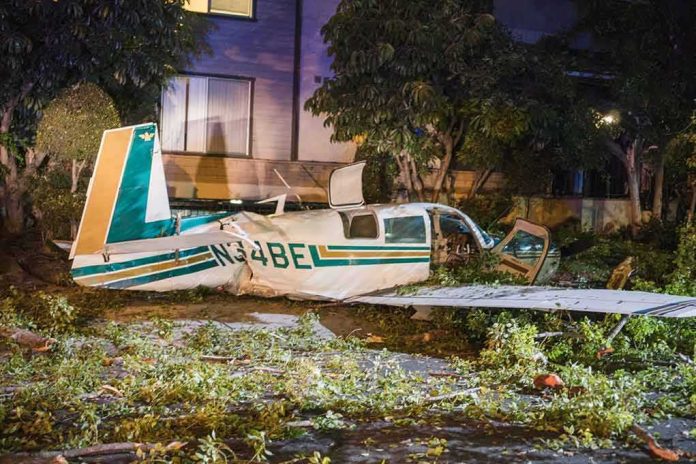
A small plane collided with a hovering state police helicopter near Carlisle Regional Airport, killing the airplane’s pilot and injuring two troopers, as federal investigators now work to learn why.
Story Snapshot
- Federal Aviation Administration (FAA) confirmed a Cessna 150 and Bell 407 collided near Carlisle, Pennsylvania.
- The airplane’s pilot died; two Pennsylvania State Police aviators were injured, officials said.
- Investigators from the FAA and National Transportation Safety Board (NTSB) are leading the probe.
- Most midair crashes occur near non-towered airports at low altitude, safety guidance shows.
What Happened Near Carlisle Regional Airport
Federal Aviation Administration (FAA) officials said a Cessna 150 airplane and a Bell 407 helicopter collided in midair near Carlisle, Pennsylvania, around 7:50 p.m. Wednesday. Pennsylvania officials reported the small-plane pilot was killed. Two state police aviators in the helicopter were injured and taken for treatment. The FAA said both it and the National Transportation Safety Board (NTSB) will investigate the crash. Authorities have not released a cause. Investigators will collect wreckage, radar, radio calls, and witness accounts.
Pennsylvania leaders described the helicopter as a state police aircraft on a training flight when the collision happened. Local outlets reported the crash occurred on or near the approach to the runway at Carlisle Regional Airport. The airport does not have an air traffic control tower, which means pilots coordinate by radio and by watching for other aircraft. That setup is common across the country and requires strict “see and avoid” discipline from every crew in the pattern.
Why Non-Towered Airports See More Midair Collisions
National Transportation Safety Board (NTSB) reports and Federal Aviation Administration training material show most midair collisions happen in the traffic pattern at non-towered airports, usually below 1,000 feet. Pilots often are not on a flight plan and must scan for traffic and make clear radio calls. The Airplane Flying Handbook explains that failure to “see and avoid” is the most common factor in these crashes, which can involve straight-in approaches, pattern laps, or training flights that hold in place.
Past NTSB investigations at similar airfields found that a simple miss in visual scanning can be enough to set up a fatal event. Board findings also point to radio use, pattern entry, and altitude discipline as key contributors in some cases. The lesson is not blame before facts are known. The lesson is that low-altitude, close-quarters flying demands tight habits from everyone in the mix. That is why investigators study both aircraft paths and pilot communication in depth.
How Investigators Will Build the Timeline
Investigators will map each aircraft’s route, speed, and altitude, then sync that with radio calls and any camera footage. The FAA and NTSB typically interview pilots, controllers if any, and witnesses. They check aircraft condition, lighting, and training records. They also assess weather, sun angle, and blind spots in the cockpit. The goal is to learn who saw what and when, and how the two aircraft ended up in the same place at the same time.
SHOCKING: New footage captures the exact moment a Cessna 150 single-engine plane PLOWED into a hovering Bell 407 Pennsylvania State Police helicopter at Carlisle Airport on Wednesday evening.
The midair collision killed the plane’s pilot and injured the two troopers on board. pic.twitter.com/SqpDUXU3aL
— Denn Dunham (@DennD68) August 21, 2026
Federal safety teams often use prior cases to guide questions. Reports on midair collisions stress recurring risk points: straight-in approaches that do not mesh with the pattern, aircraft that hold or hover near the runway environment, and missed calls on the common radio frequency. In a shared sky, one error can cascade into tragedy. That is why the probe will look at both crews’ choices and the airport flow to prevent the next crash.
Why This Matters to Flyers and Families
Families want clear answers and safer skies. Pilots want practical steps they can use tomorrow. The Carlisle crash fits a hard truth: safety at non-towered airports depends on people, not structures. Better scanning, clearer position calls, standard pattern entries, and respect for training operations all reduce risk. When the NTSB finishes, expect concrete lessons. Until then, local airports can review briefings, pattern diagrams, and radio phrase guides from the FAA to tighten habits now.
Sources:
independent.co.uk, 6abc.com, wgal.com, instagram.com