

The dividing line in sports marketing isn’t nudity; it’s narrative—whether an image centers athletic competence or repackages women as décor around men’s games. That is why the Sydney Sweeney–Novig campaign triggered a wave of athlete pushback: its visual grammar reads as “sports as props,” not “athleticism as subject.”
At a Glance
- Multiple Olympians and world-class athletes condemned the Novig ad as objectifying, arguing it centers women’s bodies over sporting achievement.
- The campaign’s composition—near-nude poses with sports gear as strategic cover—mirrors decades-old tropes that historically sidelined women athletes.
- Sweeney and Novig insist the concept was playful and sports-first; they deny any intent to depict or diminish women’s sport.
- Intent is secondary in reception: in sports contexts, audiences infer meaning from framing, not disclaimers—especially when gambling brands and male-skewed audiences are in the mix.
What the ad does on screen—and why athletes read it as sexualization
Marketing lives or dies by the cues it sends in a fraction of a second. The Novig spot features Sydney Sweeney largely unclothed, covering herself with equipment from mainstream men’s sports—footballs, tennis rackets, hockey pads—while hammering a “just sports” refrain. That composition is not a neutral design choice; it is a textbook arrangement where the woman’s body is the narrative center and the sports artifacts function as fig leaves and signifiers. Athletes responded accordingly. Australian Olympic champion Ariarne Titmus called it a “kick in the face,” labeling the approach “bulls**t” marketing; water polo Olympian Tilly Kearns described it as a step backwards that evaluates “the desirability of me” rather than skill. Variety and other outlets documented similar reactions from Olympians including Amy Hunt and gymnast Gracie Kramer, whose counter-video—game footage captioned “this is what a woman in sports looks like”—made the contrast explicit.
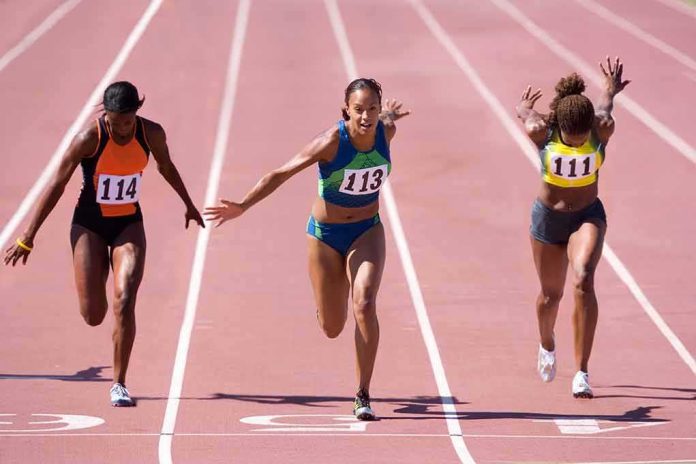
Critics are not merely policing taste. They are flagging a representational pattern with a long half-life in sports media: when women appear adjacent to sport but not performing sport, audiences learn—again—that women belong as visuals, not competitors. That inference is baked into the mise-en-scène; swapping in a “sports-only” tagline does not reverse it.
How we got here: the history and mechanics of the “sports-as-props” trope
Women’s sports coverage has spent decades clawing away from a framing that reduced female athletes to bodies first, performers second. Content analyses across sports media have repeatedly found asymmetric treatment—men shot in action and in uniform; women posed, styled, or decontextualized from play—paired with lower volume and lower seriousness of coverage. That asymmetry is not an abstract complaint; it is the mechanism by which audiences internalize who counts as an athlete and who decorates the scene. The Novig ad lands squarely in that lineage. Its iconography borrows credibility from sport while sidelining any embodiment of athletic performance. It does not show training, impact, sweat, or skill expression; it shows a celebrity body strategically occluded by gear. The message a sophisticated viewer hears is familiar: sport is the set, not the subject.
That is precisely why athlete responses cohered so quickly across disciplines and countries, and why major outlets framed the backlash as multi-athlete, not isolated outrage. The most vocal critiques came from people whose livelihoods depend on being evaluated for performance rather than photogenic value, and who have lived the downstream effects when media reinforces the opposite.
The defense: intent, playfulness, and “sports-first” messaging
Sweeney and Novig offer a straightforward rebuttal: the campaign, they say, was designed to cut through noise, be playful, and signal that Novig is “singularly focused on sports.” Novig’s CEO Jacob Fortinsky has emphasized that the company never intended to portray women’s sports, that Sweeney drove much of the campaign’s visuals, and that the platform is for adults 21 and over; Sweeney similarly framed the concept as a fun, confident execution with a sports-first message. As part of her response, Sweeney shared nude portraits of athletes like Serena Williams and Rob Gronkowski to argue that nudity can highlight athletic bodies rather than reduce women to objects.
Two judgments follow. First, on the narrow question of intent, the record is thin—no creative brief or testing data is public—so we only have stated rationales. Second, and more important for reception, intent does not control interpretation in advertising. Viewers read meaning from context, composition, and category norms. In a gambling promotion adjacent to big-ticket men’s sports, a near-nude celebrity using equipment as modesty props will predictably scan as objectification to athletes who have fought to decenter that trope.
Where the real disagreement lies: empowerment claims versus representational effects
The core dispute is not whether adults may appear nude on camera—of course they can. It is whether doing so in a sports-marketing frame recycles a hierarchy that has historically devalued women’s athletic labor. Proponents of the ad invoke autonomy and audience targeting: sex-forward creative wins attention among a largely male betting market; adults can parse a joke; nudity is not inherently demeaning. Critics counter that when the camera refuses to show sport being performed by a woman while enlisting her body to hype men’s competitions, it revives a specific stereotype—women as accessories to men’s games—that female athletes must then overcome in sponsorship meetings, media slots, and everyday credibility battles. On the available evidence, the athletes’ reading aligns with the image grammar on screen and with the established media-history baseline; the defense relies primarily on asserted intent and a general appeal to playful tone.
Why this matters beyond one ad: consequences for brand strategy and women’s sport
For brands, the lesson is pragmatic, not moralistic. “Sex sells” can deliver awareness spikes, especially in male-skewed categories, but in sports it also triggers a well-understood tradeoff: it cues short-term virality at the cost of reinforcing a message that alienates athletes, federations, and a growing mixed-gender fan base. That cost compounds when the advertiser is a gambling platform—an industry already battling negative sentiment toward its promotions—because critics can stack concerns about objectification on top of skepticism about betting’s social harms.
For women’s sport, representation still functions as infrastructure. Imagery that centers performance—velocity, impact, decision-making under pressure—builds the cognitive association between “woman” and “athlete.” Imagery that uses women to accessorize men’s leagues erodes it. That is why Kramer’s and Kearns’s counter-videos resonated: they restored the missing subject—the sport itself—and reminded audiences what athletic identity looks like when the camera respects it.
SWEENEY BACKLASH: Jillian Michaels told NEWSMAX Wednesday that critics are targeting Sydney Sweeney over her sports-betting ad because she doesn’t conform to progressive politics. pic.twitter.com/sRkPa4No24
— NEWSMAX (@NEWSMAX) September 18, 2026
A constructive standard for sports-adjacent creative
The sustainable path is not puritanism; it is coherence. If a campaign invokes sport, put athleticism at the center of the frame. If the concept is about celebrity, own that and avoid conflating sports signifiers with body-display tropes that audiences reasonably read as objectification. When a brand does choose provocation, it should do so with eyes open about who bears the reputational externalities—especially in a domain where women athletes are still fighting for equal billing and where the history of presentation has rarely been neutral. By that standard, the athlete critique of the Sweeney–Novig ad is well grounded. The ad’s formal choices position women as props to men’s games; no amount of “just sports” copy rescues that reading once the imagery has done its work.
Sources:
theguardian.com, cnn.com, nytimes.com, irishtimes.com, nine.com.au, nypost.com