

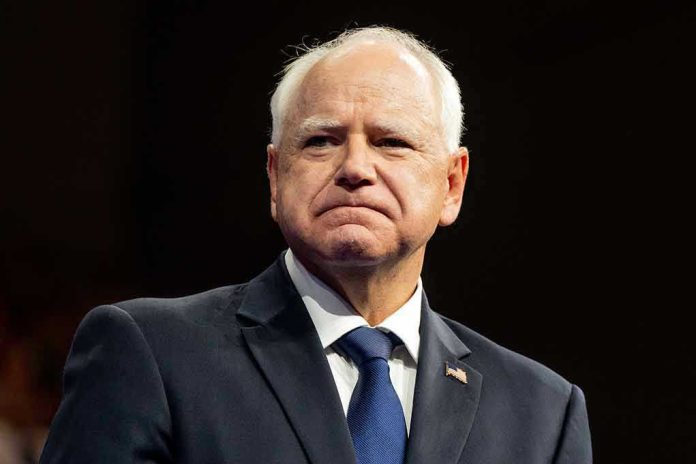
A governor’s emotional response to name-calling raises questions about the boundaries of free speech and the impact of verbal aggression.
Story Overview
- Minnesota Governor Tim Walz reports harassment from individuals driving by his residence.
- Walz labels the derogatory name-calling as a form of violence.
- The incident sparks debate over free speech and emotional impact.
- The broader context of verbal aggression in political discourse is examined.
Governor Faces Verbal Harassment
Minnesota’s Governor Tim Walz recently opened up about a distressing experience involving individuals driving past his home, hurling derogatory remarks. The governor described these encounters as not merely offensive but as a violent form of harassment. Such incidents raise a pivotal question: when does free speech cross the line into aggression? Walz’s emotional response underscores the personal toll such behavior can have, prompting a wider discussion on the nature of verbal violence.
Labeling the act as violence, Walz’s reaction highlights the emotional harm inflicted by derogatory language. This perspective challenges the traditional boundaries of free speech, suggesting that words, particularly when used aggressively, can indeed cause significant emotional damage. The governor’s stance invites a reexamination of societal norms around acceptable discourse, especially in the politically charged environment we find ourselves in today.
Free Speech Versus Verbal Aggression
In the United States, free speech is a fundamental right, yet the line between expressing an opinion and verbal aggression can often blur. The situation faced by Walz serves as a case study in this ongoing debate. Critics may argue that such expressions, no matter how offensive, fall under the protection of free speech. However, supporters of Walz’s view might contend that such behavior seeks to intimidate and harm, thus crossing into aggression.
While the legal system often protects free speech, society must grapple with the moral implications of allowing harmful rhetoric. The emotional distress faced by public figures like Walz, subjected to personal attacks, reflects a broader societal issue where public discourse has devolved into aggressive exchanges rather than constructive dialogue.
Political Discourse and Emotional Impact
The incident with Governor Walz is not isolated but part of a larger trend of increasing verbal hostility in political discourse. This environment can foster a culture where personal attacks become normalized, detracting from meaningful policy discussions. For public figures, such as Walz, the emotional impact of these attacks can be profound, affecting both personal well-being and professional duties.
The situation calls for a reflection on how society addresses and perhaps curbs aggressive speech. While protecting free speech remains paramount, the need for respectful and constructive discourse is equally vital. The challenge lies in balancing these ideals while ensuring that public figures and citizens alike are not subjected to harmful verbal aggression.
Sources:
Wikipedia: 2025 shootings of Minnesota legislators
Beaumont Enterprise: Gov Walz denounces Trump for calling…