

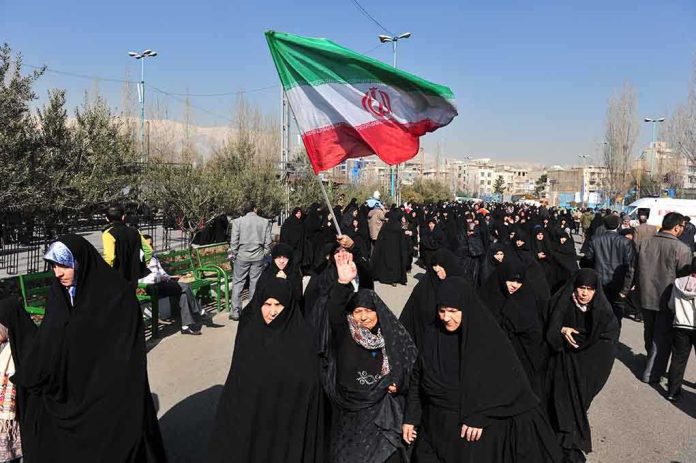
Iranian protesters are chanting “Neither Gaza nor Lebanon, my life for Iran” while their own government opens fire on them in the streets, revealing a regime so consumed with foreign adventures that it’s willing to kill citizens demanding they focus on Iran first.
Story Overview
- Protests evolved from economic strikes to nationwide uprising with 32 confirmed deaths and nearly 1,000 arrests
- Demonstrators explicitly reject regime’s foreign wars through slogans prioritizing Iran over proxy conflicts
- Security forces escalated to live ammunition, tear gas, and hospital raids after Supreme Leader Khamenei’s hardline speech
- Protests span 110 cities across 24 provinces with women and traditional bazaar merchants leading resistance
The Regime’s Fatal Miscalculation
What started as merchant strikes in Tehran’s Grand Bazaar on December 28, 2025, has exploded into the most significant challenge to Iran’s theocratic regime in years. The protesters’ message couldn’t be clearer: stop spending Iranian blood and treasure on Hamas, Hezbollah, and other foreign proxies while Iranians suffer economic collapse at home. This isn’t just another round of unrest; it’s a direct repudiation of the regime’s core strategy of exporting revolution while importing misery.
The regime initially attempted damage control, even shutting down entire provinces under the pretense of weather emergencies. But when Supreme Leader Ali Khamenei delivered his defiant speech on January 4, 2026, security forces abandoned any pretense of restraint. The message was unmistakable: the regime would rather kill Iranians than abandon its foreign adventures.
Death in the Streets, Silence in the Hospitals
Security forces have killed at least 32 protesters and wounded countless others, but the regime’s brutality extends beyond street violence. In the city of Ilam, security forces raided hospitals to arrest wounded protesters, turning places of healing into hunting grounds. This tactic reveals a regime so desperate it violates the most basic humanitarian norms.
The escalation follows a predictable Iranian playbook, but with a crucial difference. Previous protests focused on specific grievances like fuel prices or women’s rights. These demonstrations strike at the heart of the regime’s legitimacy by questioning why Iranian resources flow to Gaza and Lebanon while Iranian families struggle to afford basic necessities. It’s a question that terrifies Tehran’s leadership because it has no good answer.
Women Lead Where Men Fear to Tread
Iranian women have emerged as fearless leaders of this uprising, just as they did during the 2022 Mahsa Amini protests. Their prominence signals something profound about Iranian society: a generation that refuses to accept the regime’s priorities. When women lead chants of “This year is the year of sacrifice, Seyed Ali will be overthrown,” they’re not just challenging a dictator; they’re rejecting an entire worldview that values foreign conquest over domestic prosperity.
The regime’s response reveals its fundamental weakness. Despite controlling vast security apparatus and deploying tear gas, live ammunition, and mass arrests, protests continue spreading. The Islamic Revolutionary Guard Corps finds itself stretched thin, simultaneously suppressing domestic dissent while maintaining foreign proxy networks. This dual burden may prove unsustainable as protesters show no signs of backing down.
The Bazaar’s Verdict
Perhaps most ominously for the regime, traditional bazaar merchants have joined the uprising through sustained strikes. These business leaders historically formed part of the regime’s conservative base, but economic collapse has shattered old loyalties. When merchants in Tehran’s Grand Bazaar stage sit-ins demanding regime change, it signals that even traditional supporters see no future under current leadership.
The regime’s decision to turn commercial districts into “war zones” with tear gas and violence demonstrates how completely it has lost touch with Iranian society. By attacking the very merchants who helped bring them to power in 1979, regime leaders have chosen ideological purity over practical governance. This choice may prove fatal as protests enter their second week with no resolution in sight.
Sources:
Iran shaken by series of protests over past 50 years – ABC News
2025–2026 Iranian protests – Wikipedia
Iran Update January 5, 2026 – Critical Threats
Iran News in Brief January 7, 2026 – NCRI
Iran News in Brief January 6, 2026 – NCRI
2026 Iranian Protests – Britannica
In Iran protests, information spreads faster than organization – Stimson Center