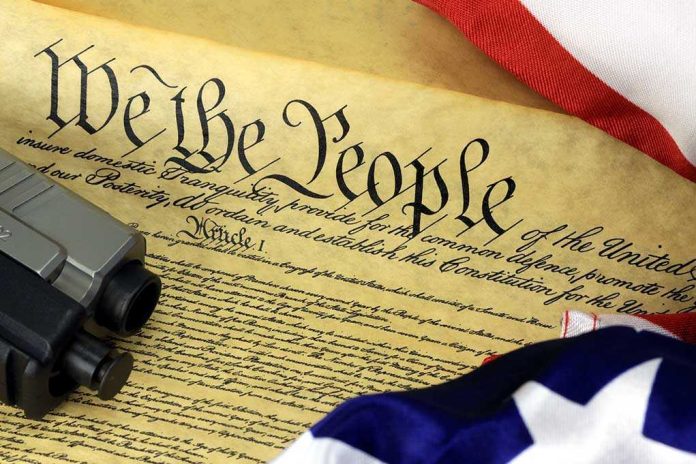
A single metal box—the firearm magazine—just triggered a court ruling that could reshape how “common use” gets measured in America’s gun debate.
At a Glance
- The District of Columbia Court of Appeals struck down D.C.’s ban on magazines holding more than 10 rounds under the Second Amendment.
- The case came from defendant Benson’s appeal after a conviction under D.C. Code § 22-2510.01(b).
- The court treated magazines as protected “arms” because they function as an integral part of many commonly owned firearms.
- The judges applied the Supreme Court’s text-history-tradition framework associated with Bruen, not a modern “balancing” test.
- The ruling lands in sharp contrast to other jurisdictions that have upheld magazine limits by calling magazines something other than “arms.”
The Benson case and the ruling that cracked D.C.’s 10-round ceiling
The District of Columbia Court of Appeals reversed Benson’s conviction for possessing magazines holding more than 10 rounds, finding D.C.’s prohibition unconstitutional under the Second Amendment. The dispute sounds technical until you remember what a magazine does: without it, many firearms don’t operate as designed. The court’s framing matters because it elevates the magazine from “accessory” talk to “protected arms” analysis, where the government carries a heavier burden.
The judges relied on the post-Bruen approach: start with the constitutional text and then test whether the government can justify the restriction through the nation’s historical tradition of firearm regulation. D.C. did not persuade the court that a modern >10-round cutoff fits within that tradition. The decision also left other arguments on the cutting-room floor, focusing the headline on the cleanest issue: whether the ban itself can stand.
Why the magazine argument works now: function, “common use,” and the Bruen era
Magazine bans live or die on definitions. If a magazine counts as an “arm,” a blanket possession ban starts to look like banning a core component of the firearm itself. If it’s merely an optional add-on, lawmakers get more room. Benson’s win reflects a broader post-Bruen judicial impatience with semantic detours that dodge the plain reality of how millions of Americans own and use firearms for lawful purposes.
The common-sense conservative takeaway is straightforward: rights don’t shrink because a city council dislikes how people exercise them. The Supreme Court’s Heller-era “common use” concept forces courts to confront market reality, not policy preference. D.C. labeled these magazines “large capacity,” while challengers called them “standard capacity.” Courts don’t have to adopt either slogan; they just have to decide whether the thing is commonly possessed for lawful ends.
D.C. is not Washington State: the national split hiding behind the same numbers
This decision stands out because other courts have traveled in the opposite direction. Washington State’s litigation over its own magazine restrictions produced rulings that treated magazines as outside the Second Amendment’s core protections, at least as some courts have framed it. That conflict is not academic; it’s the exact kind of split that invites more litigation, more appeals, and eventually pressure for the Supreme Court to clarify whether a magazine is part of the “arm” or something less.
D.C. adds a twist: it isn’t a state, it’s the nation’s capital with a long record of strict gun regulation. When a D.C. appellate court strikes down a gun control measure, it sends a signal that the Bruen test can bite even in places culturally and politically hostile to gun rights. That’s also why the ruling feels bigger than the defendant’s name; it challenges an entire governing style built on restriction-first assumptions.
The enforcement ripple: prosecutors, travelers, and the day-to-day “gotcha” arrest
Magazine limits often function as tripwires. A person can pass background checks, follow transport rules, and still become a criminal because of a spring and follower inside a rectangle of metal or polymer. For D.C. commuters and visitors, that’s not theory—it’s the kind of charge that can stack onto other allegations and raise the stakes instantly. Removing that hook changes the everyday risk calculus for lawful gun owners moving through the region.
Prosecutorial posture matters as much as statutory text. Reports also describe a shift in the U.S. Attorney’s approach to these cases, aligning enforcement decisions with the court’s constitutional direction. When prosecutors pull back, the practical effect arrives faster than the slow grind of legislative cleanup. For Americans who value predictable rules and equal treatment, that’s the real-world win: fewer arbitrary traps and less selective enforcement leverage.
What comes next: the open loop that could pull the Supreme Court back in
The ruling does not automatically rewrite laws in other jurisdictions, but it strengthens the legal playbook for challenging magazine bans nationwide. Opponents of these bans now point to a court treating magazines as protected arms and demanding historical justification, not modern policy arguments. Supporters of bans will keep leaning on public-safety narratives, but Bruen specifically narrowed the space for that style of courtroom persuasion.
Fantastic!
Major Second Amendment Victory: Washington, DC's 10-Round Magazine Ban Ruled UNCONSTITUTIONAL by D.C. Court of Appeals https://t.co/UBkYo6Pys9 #gatewaypundit via @gatewaypundit
— Don Mayes (@DonMayes12) March 6, 2026
The deeper question is whether courts can keep producing opposite answers to the same basic question—what is an “arm”—without higher-court intervention. If “common use” means what ordinary Americans can buy, own, and rely on for lawful defense, then bans targeting widespread equipment will stay legally fragile. If courts redefine the category to save modern limits, expect the fight to escalate quickly and nationally.
Sources:
Judge rules Washington high-capacity magazine law unconstitutional
Another Court Determines Magazines Aren’t “Arms” In Upholding Arbitrary Limits
US Supreme Court rebuffs challenge to Washington, DC’s high-capacity gun magazine ban
High-capacity gun magazines are illegal in DC. Trump no longer wants to prosecute violators.
Washington Supreme Court Hears Challenge to Ban on Large-Capacity Magazines