

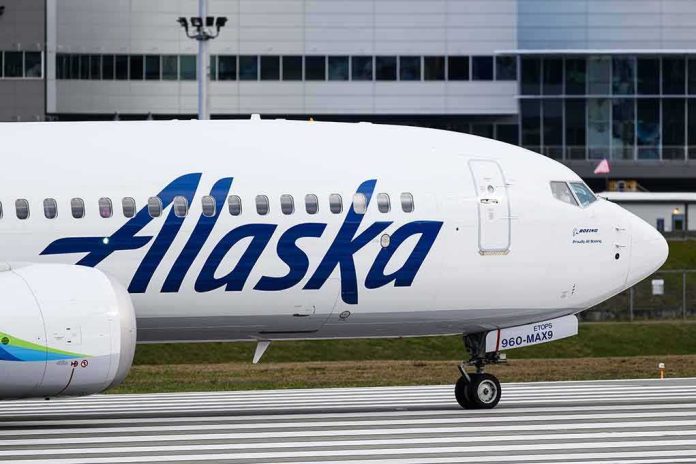
Two passengers were arrested on a crowded jet bridge in Seattle as their Alaska Airlines flight boarded, and the fallout has not slowed since.
Story Snapshot
- Federal immigration officers arrested two people during boarding for Alaska Flight 1306 at Seattle-Tacoma International Airport.
- Airport officials and the airline said they had no advance notice and are reviewing protocols.
- Video described by reporters shows officers restraining at least one person on the jet bridge.
- One arrestee was identified by officials as a visa overstay who failed to depart after a 2019 action.
What Happened On The Jet Bridge
U.S. Immigration and Customs Enforcement officers moved onto the jet bridge at Seattle-Tacoma International Airport around 8 a.m., as passengers boarded Alaska Airlines Flight 1306 to Los Angeles. Witnesses saw masked officers detain at least one traveler and lead the person away before departure. The Port of Seattle confirmed two passengers were arrested and said immigration-enforcement actions occur without the Port’s participation or prior knowledge. Alaska Airlines said officers acted in the jet bridge area during boarding.
Reporters described video that showed officers restraining or dragging at least one individual, and passengers reacting with alarm. The scene delayed boarding and set off a day of tense statements. The Port of Seattle said it was outraged and began reviewing what happened. Alaska Airlines also said it would review whether proper protocols were followed, adding that it received no advance notice from federal officers. These statements focused on process and safety at the gate, not on the immigration files.
Who Was Targeted And Why
One of the arrested passengers was identified as Jasmine Nicolini Alvarez. Reporting attributed to U.S. Immigration and Customs Enforcement stated she overstayed a visa and failed to self-deport after a 2019 authorization or order. She was taken to the Northwest immigration detention facility in Tacoma, according to local reporting. The second individual has not been publicly identified in the same detail. The lack of names or files for the second arrest has fueled questions about how officers chose their targets.
The Port of Seattle and state officials described the operation as unusual because it happened on a domestic flight during active boarding. Immigration officers have authority to conduct arrests away from the border, and airports are not off-limits to federal enforcement by default. The unusual factor here is visibility: a crowded jet bridge, a commercial boarding timeline, and families nearby. That setting turned a routine enforcement claim into a public flashpoint that drew immediate political attention.
Airport Protocols, Public Order, And Common Sense
Airport leaders said they received no warning and raised safety concerns. Gate areas are tight spaces where a sudden use of force can ripple into panic. From a public-order view, advance coordination reduces risk. If officers had to move then and there, they should be able to show why. American conservative values favor the rule of law with order and clarity. Lawful arrests should also be well-planned, so bystanders are safe and airlines can keep schedules.
[MTS]
Washington governor, union denounce ICE arrests of travelers at Seattle airport
— mts markets (@mts_markets) November 22, 2026
The law-and-order test has two prongs here. First, did officers have clear authority to arrest these specific people? Local reporting cites a visa overstay and a failure to depart for one arrestee, which fits a targeted action. Second, did the team choose the safest, least disruptive place and time to act? The Port’s review will speak to that. Process matters because public trust depends on firm enforcement that looks disciplined, not haphazard.
Why This Matters Beyond Seattle
This operation tracks with a broader shift toward mobile arrests in public places. Officers have increased actions outside jails and courthouses, including in transit hubs. That shift can raise the chance of visible confrontations, even when the legal grounds exist. A national debate over enforcement often ignores the practical truth: location shapes perception. An arrest in a holding area reads one way; an arrest with families on a jet bridge reads another, even if the paperwork matches the law.
Officials and advocates in Washington reacted fast, warning about more airport arrests to come. The Port called the scene distressing. Passengers expressed shock. The image of masked officers on a narrow ramp will stick. That is why agencies usually try to minimize spectacle. Strong borders and fair process are not rivals. They reinforce each other when agencies communicate, document authority, and reduce public disruption while carrying out the law.
Sources:
cbsnews.com, seattletimes.com, kark.com, yahoo.com, usnow.us, yakimaherald.com, kfoxtv.com, gao.gov