

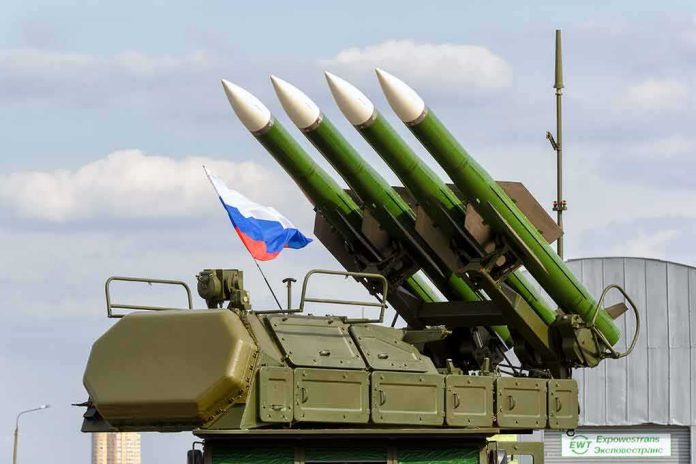
Arms control fails in stages, then suddenly; when it does, military balances do not stand still—capabilities reappear to fill the vacuum. The collapse of the INF Treaty over Russia’s 9M729 cruise missile paved the way for the U.S. Army’s Typhon system, a ground-based launcher returning the 500–1,600+ kilometer strike envelope to American land forces after a 32-year ban.
At a Glance
- The United States determined in 2014 that Russia violated the INF Treaty by developing and fielding the 9M729 (SSC-8) ground-launched cruise missile; allied backing followed.
- Washington lawfully suspended obligations and withdrew in 2019 after years of unsuccessful compliance diplomacy, citing Russia’s continuing material breach.
- The Army’s Typhon Mid-Range Capability adapts naval Tomahawk and SM-6 missiles to mobile land launchers, restoring a ground-based strike tier between short-range fires and hypersonics.
- Russia denies any violation, claiming 9M729 remained within 500 km and accusing the United States of treaty breaches—assertions not corroborated by independent allied assessments.
What the INF Treaty Prohibited—and Why It Broke
Signed in 1987, the Intermediate-Range Nuclear Forces (INF) Treaty eliminated all U.S. and Soviet/Russian ground-launched ballistic and cruise missiles with ranges between 500 and 5,500 kilometers, along with their launchers and support equipment. It was historically intrusive—on-site inspections verified the destruction of 2,692 missiles—and it removed the class of systems that had driven Europe’s early-1980s nuclear crises. The treaty endured well past the Cold War, but by the 2010s, verification transparency had thinned, and strategic incentives had shifted: Russia prized land-based conventional strike reach, the United States emphasized missile defense, and Asia’s missile geography remained outside INF’s bilateral scope. In 2014, the State Department publicly assessed that Russia had violated the treaty by developing and later fielding a ground-launched cruise missile—identified as the 9M729/SSC-8—whose range fell squarely within the banned interval.
Over the next five years, Washington pressed Moscow through diplomatic channels while rallying allies; NATO ultimately concluded Russia had developed and deployed the 9M729 in violation of the INF and backed the U.S. compliance finding. With no demonstrable steps toward Russian compliance, the United States suspended obligations in February 2019 and provided formal six‑month notice of withdrawal under Article XV; the withdrawal took legal effect that August, with Washington explicitly tying the decision to Russia’s continuing noncompliance.
The Russian Counter-Case—and Why It Did Not Carry the Field
Moscow’s public position combined categorical denial with counteraccusation. Russian officials asserted the 9M729 did not exceed 500 km, described it as an upgrade of the 9M728, and claimed testing never violated INF parameters; they also alleged that U.S. missile-defense interceptors in Europe contravened the treaty. None of this addressed the core U.S./NATO charge: that Russia had developed, tested, and fielded a ground-launched cruise missile capability in the prohibited range band, not merely that one demonstration shot had crossed a line. The Director of National Intelligence outlined a multi-year pattern of Russian denial and deflection; allied statements recorded that Moscow provided no credible technical pathway back to compliance. Absent verifiable corrective action, the allied case held and the treaty unraveled.
Seen in the longer arc of arms control, this is familiar. Bilateral regimes degrade when verification access narrows, modernization pressures mount, and one side treats ambiguity as maneuvering room. Disputes rarely resolve in public with schematics and telemetry; they conclude politically, when allied consensus hardens and compliance diplomacy runs out of runway. That is where INF ended up.
Enter Typhon: Rebuilding the Ground-Based Mid-Range Tier
Once the treaty no longer bound U.S. choices, the Army moved to close a standing operational gap between its near-term tactical fires and its emerging hypersonic reach. The Mid-Range Capability—now widely known as Typhon—adapts a naval launcher and fire-control architecture to a mobile, trucked battery that can fire two proven munitions. Tomahawk provides long-range land attack out past 1,000 miles with mature mission planning, terrain-following, and a large conventional warhead; SM-6 brings a versatile, high-speed missile with anti-air and anti-surface profiles, giving land forces a real say in maritime fights across several hundred kilometers. In the Army’s long-range precision fires portfolio, Typhon nests between the Precision Strike Missile and the Long-Range Hypersonic Weapon, offering responsiveness, magazine depth, and logistics that look more like field artillery than a one-off strategic asset.
The appeal is not abstruse. Ground launchers are survivable when dispersed and concealed, cost less to sustain than persistent air patrols or ship days at sea, and complicate an adversary’s calculus by adding another axis of strike. Typhon’s mobility and use of canisterized naval rounds shorten development time and leverage robust supply chains; the system reached initial fielding rapidly precisely because it repurposed components already proven at sea.
Mechanics, Employment, and Deterrence Logic
Mechanically, Typhon fields a mobile operations center and multiple trucked launchers that carry four vertical cells apiece, controlled by an adapted Aegis-derived combat system. Operationally, its value lies in cross-domain leverage. A land-based Tomahawk battery can hold fixed infrastructure and high-value nodes at risk deep in an adversary’s rear without broadcasting a flight deck or risking aircrews; an SM‑6 battery can create local sea denial “from the beach,” forcing hostile surface combatants to respect littoral arcs where air and maritime dominance is contested. Deterrence emerges from a plural strike portfolio—air, sea, land—that overloads an adversary’s planning assumptions, rather than from a single exquisite capability that invites a narrow counter.
None of this duplicates the INF’s specific constraint structure; that regime is gone. But Typhon’s reappearance illustrates a constant: when an arms-control umbrella collapses, the fastest movers are those who can translate existing technology into a new basing mode. In this case, the U.S. simply walked established missiles ashore.
Europe, Asia, and the Return of Geography
The INF ban’s demise matters differently by theater. In Europe, the 500–1,600 km band maps to critical command nodes, air bases, and logistics hubs across the depth of a conventional fight. NATO’s compliance diagnosis, and Russia’s fielding of 9M729 units, catalyzed allied debates that would have been unthinkable under INF, from U.S. deployments to indigenous acquisitions. In the Indo‑Pacific, geography is destiny: ground-based strike rings projected from allied territory compress timelines and complicate China’s operations around chokepoints and near seas, again using mobility and dispersion to gain staying power. The same attributes that maddened planners in the 1980s—road-mobile launchers, ambiguous payloads, short warning—still shape today’s stability tradeoffs. But unlike the Euromissile era, the dominant payloads here are conventional, and the cross-domain architecture is thicker.
Critics worry that returning a banned class of systems will trigger action–reaction spirals; advocates counter that the spiral already occurred, beginning with Russia’s prohibited deployments, and that restoring a missing tier of conventional strike is the least escalatory way to repair deterrence credibility. The allied record—NATO’s endorsement of the U.S. compliance finding—anchors that judgment.
What Endures After INF
Three durable lessons remain. First, verification access is not a luxury—when it ebbs, technical ambiguity becomes political cover, and enforcement becomes performative. Second, once breach hardens, the most credible leverage is the restoration of foreclosed capabilities; adversaries adapt to words, not vacuums. Third, to replace lost ceilings with stability, you need replacement guardrails tailored to today’s force-mix—not a nostalgia play for 1987. Whether future limits emerge bilaterally or as deconfliction mechanisms among multiple missile powers, they will have to accommodate widely fielded conventional systems, regional alliance politics, and the reality that sea-, air-, and land-launch families now blur neat category lines. The 9M729 dispute closed one treaty; Typhon’s fielding is how the U.S. intends to live in the world that followed.
Sources:
19fortyfive.com, 2017-2021.state.gov, armscontrol.org, war.gov, commonslibrary.parliament.uk, congress.gov, nato.int, voanews.com, bbc.com