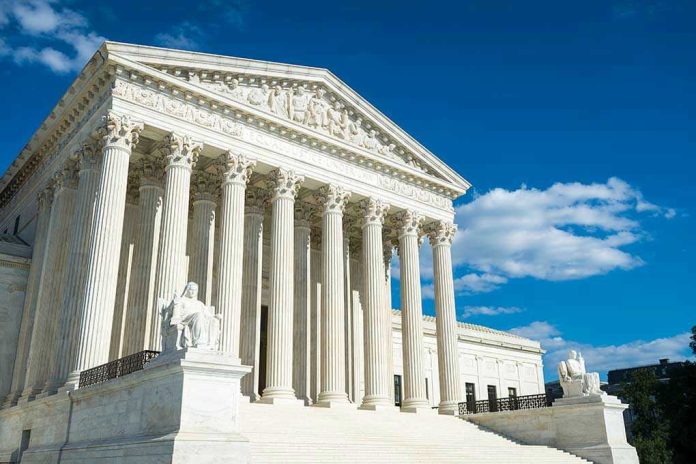
The Supreme Court stands on the brink of potentially dismantling a 150-year-old pillar of American identity, deciding if birthright citizenship survives or crumbles under modern immigration pressures.
Story Snapshot
- Supreme Court hears oral arguments this week on Executive Order 14160 challenging birthright citizenship under the Fourteenth Amendment.
- Order targets children born in U.S. to undocumented parents or those on temporary visas, defying 1898 Wong Kim Ark precedent.
- Federal courts repeatedly block the order as unconstitutional, setting stage for historic ruling.
- Millions of U.S.-born children risk statelessness if precedent overturns, reshaping citizenship forever.
- Scholars warn upending this doctrine invites chaos, while administration claims originalist fidelity.
Executive Order Ignites Constitutional Firestorm
President Trump signed Executive Order 14160 on January 20, 2025. The order denies citizenship to babies born in the United States to mothers present unlawfully or lawfully but temporarily, and fathers who lack U.S. citizenship or permanent residency. Federal courts in Massachusetts, New Hampshire, and the District of Columbia blocked implementation immediately. Judges ruled it violates the Constitution, century-old Supreme Court precedent, and federal statute. This week, the Supreme Court hears oral arguments, marking the first major review since 1898.
Fourteenth Amendment Roots in Civil War Aftermath
Congress ratified the Fourteenth Amendment in 1868 to overturn the 1857 Dred Scott decision denying citizenship to African Americans. Its Citizenship Clause declares: All persons born or naturalized in the United States, and subject to the jurisdiction thereof, are citizens. The Civil Rights Act of 1866 first codified this principle for freed slaves. Lawmakers aimed for broad protection, excluding only children of foreign diplomats. This enshrined jus soli, birthright by soil, shared by about 30 nations including Canada and Mexico.
Wong Kim Ark Sets Unshakable Precedent
In 1898, United States v. Wong Kim Ark affirmed citizenship for all born on U.S. soil. Wong, born in San Francisco to Chinese immigrant parents, faced deportation upon return from China. The Supreme Court ruled 6-2 in his favor. Justice Horace Gray wrote the amendment affirms citizenship by birth within the territory, including children of resident aliens, unrestricted by race or color. This precedent has guided policy for 128 years, interpreting subject to the jurisdiction thereof to cover immigrant children broadly.
Stakeholders Clash Over Jurisdiction Clause
The Trump administration argues the jurisdiction clause excludes undocumented immigrants and temporary visa holders, echoing originalist views. Groups like NAACP Legal Defense Fund, ACLU, and Brennan Center sued to block the order. Constitutional scholars Gregory Downs, Martha Jones, and Kate Masur filed briefs stressing the amendment’s inclusive intent to settle citizenship debates permanently. Lower courts sided with challengers, preserving status quo pending Supreme Court decision.
Common sense aligns with precedent here: presidents cannot rewrite the Constitution via executive fiat. Facts show consistent interpretation across branches favors broad citizenship. Conservative values prize rule of law and precedent stability over unilateral power grabs that risk stateless millions.
High Court Set To Hear Oral Argument This Week On Birthright Citizenship Case https://t.co/KCGLtRZvXx #gatewaypundit via @gatewaypundit
— Jeri2Xtry@Buckeye (@Jeri2Xtry) March 30, 2026
Stakes Threaten Millions and National Fabric
Upholding the order would upend doctrine, creating stateless U.S.-born persons and administrative nightmares for verifying parental status at birth. Millions in mixed-status families, including temporary visa children, face benefit losses, job barriers, and division. Politically, it fuels immigration debates but invites constitutional amendment fights. Scholars note all branches long viewed the clause as expansive. Overturning invites endless litigation, eroding foundational American principles.
Sources:
Origins of Birthright Citizenship in the United States, Explained
A Brief History of Citizenship and the 14th Amendment to the US Constitution
A history of birthright citizenship at the Supreme Court
Birthright Citizenship Under the U.S. Constitution
Protecting The Meaning And Value Of American Citizenship
American University Law Review Article
Know Your Rights: Birthright Citizenship