

Dashcam video doesn’t just show what happened in Dallas—it shows how fast a routine moment can turn into a funeral, a political argument, and a public trust test all at once.
Story Snapshot
- Dallas Police released dashcam footage tied to two separate fatal encounters: an ambush aftermath and a SWAT standoff near a children’s hospital.
- In the ambush case, officers chased a suspect after a late-night attack that killed Officer Darron Burks and wounded two others.
- In the hospital-garage standoff, a suspect wanted for allegedly impersonating an officer exited a barricaded vehicle and pointed a gun at SWAT, prompting deadly force.
- The Crockett-linked angle turned a local police incident into a national debate about vetting, accountability, and security contracting.
Dashcam Footage as a Public Record and a Pressure Cooker
Dallas Police Department dashcam releases now do two jobs at once: they document an officer’s split-second decision and they shape the story before rumors harden into “truth.” In these Dallas cases, the videos land in a country primed to argue about policing. The footage doesn’t replace investigation, but it does narrow the space for fantasy. Viewers can see commands given, distances closing, and weapons presented—details that matter.
Dashcam also forces an uncomfortable honesty about time. People watching from a couch get unlimited replay; officers on scene get fractions of seconds. That gap fuels outrage when the public wants perfect outcomes and it fuels cynicism when officials demand blind trust. The conservative, common-sense lane sits between those extremes: require transparent facts, back lawful orders, and demand consequences when standards fail—whether the failure belongs to a suspect, a supervisor, or a policymaker.
The Ambush Aftermath: Why “Executed” Hits Like a Civic Alarm
The ambush incident, as described by Dallas leadership, began with a distress call around 10 p.m. that an officer had been shot in his patrol vehicle. Officer Darron Burks, a 46-year-old former math teacher who later became a Dallas officer, died. Two other officers suffered gunshot wounds but were expected to survive. Police described the event as targeted violence against the uniform—an attack not just on individuals but on order itself.
The pursuit that followed matters because it shows how quickly clarity evaporates after an ambush. Officers located the suspect, chased him, and confronted him when the vehicle stopped. Reports describe the suspect exiting with hands raised, moving back to the vehicle, retrieving a firearm, and then approaching officers while ignoring commands to drop the weapon. The shooting ends the threat, but it doesn’t end the questions—because the public asks why, how close, and whether anything else could have worked.
The Children’s Hospital Garage Standoff: High Stakes, Tight Space, No Room for Theater
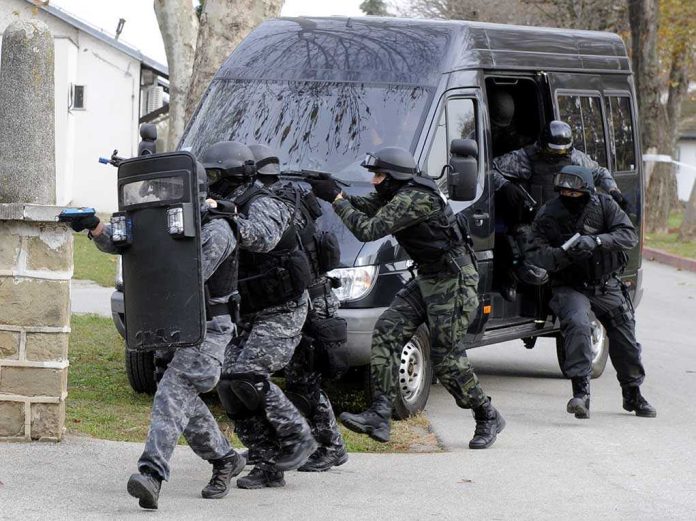
The second fatal encounter carried a different kind of fear: a barricaded suspect in a parking garage at Children’s Medical Center Dallas, where bystanders and patients sit uncomfortably close to police tactics. Officers attempted to serve a warrant, the suspect refused to comply, and SWAT deployed tear gas to force movement. Reports say he then exited the vehicle, pointed a gun at SWAT, and officers killed him. Authorities said he did not fire.
That “did not fire” detail will always tempt people to declare the shooting unnecessary, but pointing a gun at police during a standoff isn’t a debate invitation; it’s an immediate threat. Conservatives tend to view this plainly: lawful commands and lawful warrants mean something, and an armed suspect doesn’t get to dictate terms by creating a hostage-like environment around a hospital. The real policy question isn’t whether officers should hesitate—it’s why people who live by deception can get so close to power.
The Impersonation Thread and the Crockett Connection
Reports describe the hospital-garage suspect as Diamon-Mazairre Robinson, also known as “Mike King,” and link him to Rep. Jasmine Crockett’s security detail through a vendor arrangement. The allegations around impersonation are not minor cosplay; they involve claims of a replica police vehicle, stolen plates, fake uniforms, and a business model that traded on proximity to law enforcement legitimacy. Police reportedly recovered multiple firearms, including at least one stolen gun.
Crockett’s public defense highlighted a review that found no confirmed violent offenses in his history and argued that loopholes in congressional security contracting leave members exposed. That argument has a kernel of truth: vendor pipelines can blur accountability and create incentives to move fast instead of vet deep. Common sense still demands a harder line: impersonation of police should trigger automatic disqualification from sensitive work, period, because it signals the precise character flaw security work cannot tolerate.
What These Videos Teach About Transparency, Deterrence, and Trust
Police video releases often get treated like public relations weapons, but they can also function as deterrence and civic education. They show what lawful orders sound like, what escalation looks like, and how quickly a weapon changes the rules. For law-abiding citizens—especially older Americans who remember when institutions demanded respect—these videos can reaffirm why compliance matters. For critics, the same footage becomes a new exhibit in a broader case against policing itself.
The open loop Dallas can’t escape is simple: transparency helps, but only if it’s paired with competence and accountability upstream. Vetting failures, lax control over impersonation tools, and political excuses all compound the danger officers face on the street. When an officer gets ambushed, or SWAT faces a gun pointed in a hospital garage, the public isn’t watching “a video.” They’re watching whether authority still has the spine—and the standards—to protect the innocent.
Dallas will keep releasing footage, and the country will keep arguing. The smarter takeaway is to focus less on the comment-section trial and more on the pipeline that produces these moments: enforcement that stays within the law, prosecutors and legislators who treat impersonation and illegal weapons seriously, and public officials who stop treating vetting like a paperwork chore. Dashcam is the mirror. The problem is everything that happens before someone ever hits record.
Sources: