

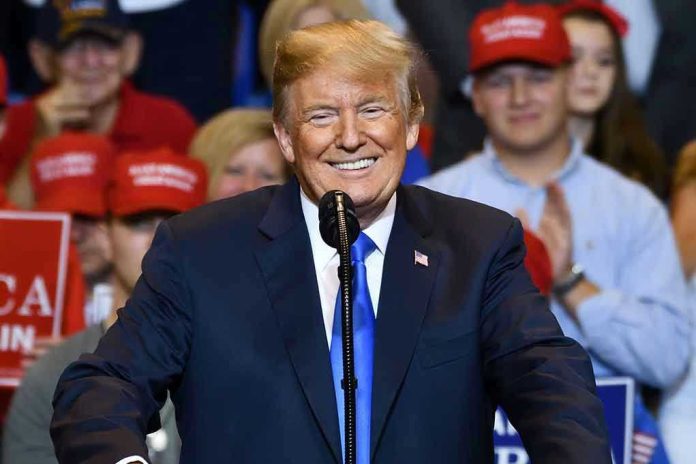
President Trump’s “we’ll be taking over Cuba almost immediately” quip landed like a punchline—yet it arrived the same day his administration tightened sanctions on Havana, raising a serious question about whether the joke was also a message.
Quick Take
- Trump joked at a Florida event that the U.S. could “take over” Cuba quickly, drawing laughter and applause.
- The remark circulated fast online, but it coincided with new May Day sanctions aimed at Cuban regime elites and enablers.
- Secretary of State Marco Rubio’s hardline posture toward the Cuban government adds weight to perceptions of strategic signaling.
- With recent U.S. operations in Iran and Venezuela in the background, the administration’s Cuba rhetoric is being read through a “maximum pressure” lens.
Trump’s Cuba Line: Comedy, Leverage, or Both?
President Donald Trump delivered the remark on May 1, 2026, while speaking to the Forum Club of the Palm Beaches in Florida. He described the USS Abraham Lincoln returning from Iran, suggested it could stop just offshore Cuba, and said Cuban officials would surrender—before adding, “a place called Cuba, which we will be taking over almost immediately.” The room reportedly laughed and applauded, reinforcing the “joke” framing.
Even when delivered with a grin, presidential talk about “taking over” a neighboring country carries real consequences. Cuba sits roughly 90 miles from Key West and has been under communist rule since 1959, with chronic economic strain and a long history of U.S.-Cuba hostility shaping how both domestic audiences and foreign governments interpret American rhetoric. A throwaway line can still function as leverage when it comes from a commander in chief.
Sanctions, Not Stand-Up: The Policy Context Behind the Remark
The more concrete development on May 1 was the administration’s new May Day sanctions, announced by Under Secretary of State for Foreign Assistance Jeremy Lewin. The measures targeted what was described as Cuba’s kleptocratic network, along with military-intelligence elements and financial enablers. The timing matters: sanctions are an actionable tool of state power, and their rollout on the same day as Trump’s “take over” comment invites interpretation that the White House is escalating pressure, not merely joking.
Trump’s broader approach has been described as “maximum pressure,” emphasizing economic constraints—particularly on resources like oil—aimed at squeezing regime capacity. Supporters view that posture as a way to challenge authoritarian systems without immediately committing U.S. troops, while critics tend to argue that embargoes worsen hardship for ordinary Cubans. What can be said from the available reporting is that the administration is pairing sharp rhetoric with tangible coercive measures, rather than relying on diplomacy alone.
Marco Rubio’s Role and the Regime-Change Question
Secretary of State Marco Rubio, a Cuban-American and a central figure in the administration’s Cuba policy, was referenced in the event remarks as someone “waiting” for action. That matters politically because Rubio’s long-standing focus on Cuba resonates with many Cuban-American voters and with Americans who see communist regimes as security threats close to home. It also matters operationally: when a top diplomat is publicly associated with a harder line, adversaries may treat even jokes as signals.
The reporting also frames Cuba’s leadership—headed by President Miguel Díaz-Canel—as a potential target of U.S. pressure that could culminate in leadership change. The evidence available in the provided material does not confirm any imminent military plan, and the “take over” line itself was presented in a comedic register. Still, the combination of sanctions, hostile-regime language, and senior leadership alignment creates the conditions for heightened fear and miscalculation—especially if Havana believes Washington is preparing something more than economic punishment.
Why This Resonates in a Distrustful, Post-“Deep State” Era
For many Americans, the larger takeaway is less about Cuba itself and more about how foreign policy is communicated and executed. Conservatives often want strength and clarity, but they also distrust bureaucracies and open-ended interventions. Many liberals distrust the administration’s intentions and worry about human costs, while also sharing a broader frustration that Washington’s priorities can feel detached from everyday life. In that climate, ambiguity—joke or warning—feeds suspicion on both sides.
https://twitter.com/RedState/status/2050414979547861219
Given the limited public detail in the provided research beyond one primary write-up, the safest conclusion is narrow: Trump publicly ridiculed Cuba’s regime while his administration increased sanctions the same day, and commentators are debating whether the rhetoric was improvisational or strategic signaling. If the goal is deterrence, clarity typically reduces risk; if the goal is domestic applause, jokes can travel faster than policy nuance. Either way, Americans should watch what the administration does next, not just what it says.
Sources:
Trump Drops a Cuba Bombshell — Joke or Warning Shot?