

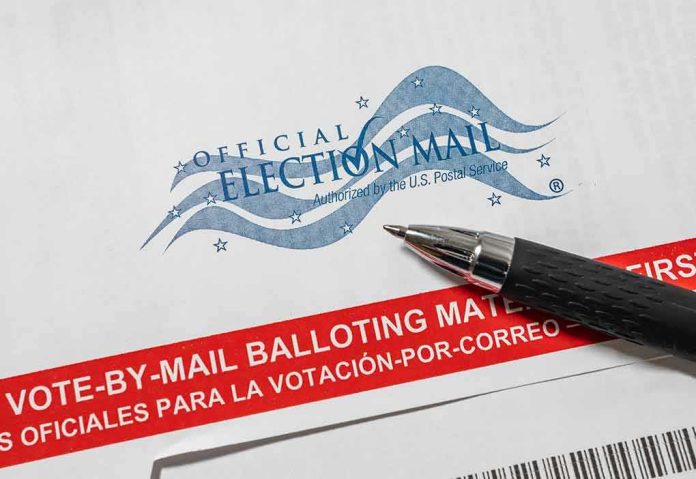
The fight over the U.S. Postal Service’s new mail‑in voting rule is less about barcodes and voter lists than about who gets to decide which Americans receive a ballot at all — states, as they traditionally have, or the federal executive, through an agency that has never before acted as a gatekeeper of voter eligibility.
Key Points
- A federal appeals court has temporarily lifted a block on a USPS rule that would require states to submit voter lists and attach unique barcodes to every federal mail ballot before USPS will carry them.
- The rule implements President Trump’s executive order directing the creation of federal “citizenship‑verified” voter lists and instructing USPS to refuse delivery of ballots to voters not enrolled on those lists.
- Supporters, including senior Justice Department officials, describe the court’s stay and the rule as a “win for election integrity,” arguing barcodes and data sharing will deter fraud and aid law enforcement.
- Opponents — 23 states, voting‑rights groups, and bipartisan election officials — warn it is an unconstitutional federal overreach that could disenfranchise large numbers of lawful voters and give Washington a detailed record of who votes and how.
- The appeals court’s order is provisional; multiple lawsuits, past rulings, and the Postal Service’s own history suggest the ultimate question of whether USPS may decide whose ballots it will carry is far from settled.
What the Appeals Court Just Allowed USPS to Do
The starting point is the decision from the D.C. Circuit Court of Appeals, which issued a stay of a district court ruling that had blocked the Postal Service from moving forward with its proposed election‑mail rule. The lower court, in a case brought by the NAACP, had found the proposal likely violated a 2021 settlement requiring USPS to prioritize and expedite ballot delivery, and therefore halted implementation. The appeals panel did not uphold the rule on the merits; instead, it concluded that USPS met the legal standard for a stay pending appeal, allowing work on the rule to proceed while litigation continues.
In practice, that means the Postal Service can keep developing and preparing to implement a regulation that would fundamentally change how federal mail‑in ballots are accepted and carried. The rule is not yet final. USPS must still complete the rulemaking process — including public comment and any required review by the Postal Regulatory Commission — before it can apply nationwide. But the stay is a concrete, short‑term victory for the Trump administration’s election agenda and for those who want federal agencies more deeply involved in policing eligibility for mail voting.
The Core of the Rule: Voter Lists and Serialized Barcodes
The proposed rule, published in the Federal Register at the end of May, sits at the intersection of postal operations and election administration. It would require every state that conducts federal elections with mail‑in or absentee ballots to submit, in advance of ballot mailing, a “Mail‑In and Absentee Participation List” — a roster of each voter approved to receive a mail ballot for that election. Only ballots addressed to names on that list would be accepted by USPS for mailing and delivery; non‑compliant mailings would be turned back.
Layered on top of that data requirement is a technological mandate: each ballot envelope must carry a uniquely serialized Intelligent Mail barcode, tied in Postal Service records to an individual voter. As USPS itself has stated in the proposal, these barcodes are meant to “facilitate the tracking of individual pieces of Ballot Mail to and from individual voters” as they move through mail processing equipment, providing “visibility into ballot mail transmission based on scan data.” Internal and public statements from USPS describe the combination of barcodes and lists as tools that “assist in ensuring compliance with federal regulations and support law enforcement activities,” and “will facilitate law enforcement efforts” around elections.
This is not the first time USPS has encouraged standardized envelope design, use of its Official Election Mail logo, or adoption of barcodes on ballot envelopes; a voluntary toolkit has recommended such practices for years. What is new is compulsion. Under the proposed rule, voluntary guidance becomes a mandatory condition of service. Ballots without the prescribed envelope format, or addressed to recipients not appearing on the state‑submitted list, would simply not be mailed.
How This Rule Connects to Trump’s Executive Order
The USPS proposal does not exist in isolation. It implements Executive Order 14399, “Ensuring Citizenship Verification and Integrity in Federal Elections,” issued by President Trump in March 2026. That order directs the Department of Homeland Security, working with the Social Security Administration and immigration databases, to build state‑specific lists of verified U.S. citizens eligible to vote, then transmit those lists to the states before every federal election.
The order further instructs the Postal Service that it “shall not transmit” a mail‑in or absentee ballot from any voter who is not enrolled on the federal list. It ties postal operations to a national infrastructure of citizenship and eligibility verification — a role the agency has historically avoided, insisting that it does not decide who may vote by mail, only that it delivers ballots once state election officials accept them.
Postmaster General David Steiner has testified that, under the proposed rule, USPS would refuse to carry ballot mailings from states that decline to share their voter rolls and barcode data. For supporters, this is a necessary enforcement mechanism: a way to ensure that no ballots go to individuals who have not been cleared through the federally backed lists. For critics, it is precisely the point at which postal logistics become federal gatekeeping over state election decisions.
The Case for “Election Integrity” and Fraud Prevention
Supporters frame the appeals court’s stay and the underlying rule as a triumph for election security. First Assistant U.S. Attorney Bill Essayli explicitly hailed the ruling as “a win for election integrity,” capturing a broader narrative on the political right that uses mail ballot reforms as the frontline against fraud and noncitizen voting. The Trump administration has argued that restrictions are needed to combat noncitizen voting, which it describes as a risk to federal elections, even while acknowledging that such voting “occurs very rarely” under current systems.
From this perspective, the rule’s requirements — unique barcodes, federally supported citizen lists, and mandatory state data sharing — are seen as modern safeguards. Serialized barcodes promise a clear audit trail: every ballot can be traced from the election office out to the voter and back again, and anomalies such as duplicate returns or unexplained gaps could, in theory, be flagged quickly for investigation. Tying ballot envelopes to a vetted roster of eligible voters is presented as a way to keep ballots from reaching people who are not entitled to vote, whether due to citizenship status, residence, or other eligibility factors.
The political stakes are particularly visible in states with extensive mail voting, such as California, where universal mailed ballots are now routine. Supporters argue that repeated controversies and claims about ballot handling have eroded public confidence and that a uniform federal overlay on postal procedures will restore trust, especially among voters skeptical of all‑mail systems.
The Evidence Gap: Integrity Claims Without Data
The integrity case, however, rests heavily on assertion rather than documented outcomes. Neither USPS nor the administration has produced primary‑source evidence quantifying election fraud that serialized barcodes and voter‑list gating would have prevented in past cycles. There are no published audit results, pilot program evaluations, or case studies showing that Intelligent Mail barcodes on ballot envelopes have reduced fraud incidents in jurisdictions that already use them.
The same pattern appears in the argument about noncitizen voting. The administration’s own justification acknowledges that such voting is “very rare” under current law and enforcement, yet offers no statistical studies, prosecutorial records, or investigative summaries demonstrating a widespread problem that would require a federal reconfiguration of mail voting. In the absence of such data, the rule is better understood as precautionary policy driven by political concern than as a technocratic response to measured risk.
Equally important, USPS has not documented existing internal infrastructure capable of vetting outbound ballots against voter lists at national scale. The agency’s core competence lies in processing and delivering mail, not in verifying election rolls. There is no clear public record of dedicated systems, staff, or testing that would support its claimed new function as a gatekeeper deciding which envelopes qualify as “ballot mail” entitled to service.
The Constitutional and Practical Objections
Opposition to the rule is broad and unusually bipartisan among election administrators. Twenty‑three Democratic‑led states plus the District of Columbia have filed lawsuits challenging both the executive order and the USPS regulation, arguing that the president has no constitutional authority to direct or control state election rules and that the Postal Service’s proposal unlawfully intrudes into the states’ reserved power to run elections.
In one key case, a federal judge in Boston halted portions of Trump’s order, finding that “the Constitution does not grant the President any specific powers over elections” and siding with the states’ view that federal agencies cannot unilaterally impose voter‑list requirements as a condition of ballot delivery. Another federal judge, Emmet Sullivan in Washington, D.C., ruled that USPS could not carry out the ballot rule because it conflicted with the NAACP settlement obligating timely handling of election mail. These decisions fit a broader pattern: earlier Trump administration efforts to centralize election oversight — such as a directive to build the SAVE database of voters or to require proof of citizenship for federal ballots — were blocked or permanently enjoined by federal courts.
Congressional opposition has also been striking. All Senate Democrats and two independents signed a letter urging Postmaster General Steiner to withdraw the proposed rule, warning that it would impose “significant operational burdens on election mail processing systems” and effectively conscript USPS into a national voter data collection program without legislative authorization. In Wisconsin, the Republican chair of the state elections commission, Don Millis, joined Democratic commissioner Ann Jacobs in a public letter stating the rule would “likely disenfranchise a significant swath of Wisconsin voters” and that some in the Trump administration “just think mail‑in ballots are bad” rather than seeking genuine security improvements.
Legal scholars and election‑security experts echo these concerns. David Becker of the Center for Election Innovation and Research underscores that U.S. mail‑voting systems have existed for more than 150 years, with layered protections including ID checks at registration, address verification, and signature‑matching when ballots are returned. Becker and others emphasize that the president cannot unilaterally rewrite election law, that the federal government “doesn’t run elections,” and that giving any administration a detailed, barcode‑level record of who voted and when would raise serious privacy and civil‑liberties questions.
Privacy, Data Concentration, and the Role of USPS
Beyond constitutional structure, critics focus on what the rule would do to the informational landscape around voting. Under the proposed framework, USPS and federal partners would hold, for every federal election, a rich dataset linking names, addresses, citizenship status, and unique barcodes on ballot envelopes — effectively a record of who is eligible to vote by mail and who actually returned a ballot, “barcode by barcode.”
Attorneys general and secretaries of state who oppose the rule argue that this turns the Postal Service into a central repository of voter participation data, capturing not just whether a ballot was delivered but whether and when a citizen chose to vote, information traditionally managed by state election officials under their own legal safeguards. They contend that the proposal offers no adequate explanation of how USPS would prevent misuse of this capability, whether by political actors seeking to target or intimidate certain voters or by future administrations tempted to cross‑reference ballot activity with other federal databases.
For many voters, particularly those who rely on absentee ballots due to age, disability, or distance, the prospect that the mail system could decline to carry their ballot unless the state successfully uploads their information to a federal portal introduces a new point of vulnerability. Opponents argue that any errors in list data or barcode assignment — inevitable at scale — would not just mislabel a ballot, but stop that voter’s ballot from ever being mailed. In their view, this is not a marginal tweak to postal operations but a structural change in how access to the ballot is controlled.
All states must submit voter lists and serialized ballot barcodes before the USPS will mail federal ballots for the upcoming midterm elections. https://t.co/NJTBBlS0IB
— Paul Gadot (@gadot_paul) July 19, 2026
Where This Fight Fits in the Larger Story of U.S. Elections
Seen in context, the USPS rule is one more iteration of a recurring strategy: using federal administrative agencies, rather than Congress, to pull parts of election administration under centralized control. Over the past several years, executive‑branch efforts to impose new voting requirements through the Postal Service, Homeland Security, or other departments have largely failed in court, with judges pointing back to the Constitution’s allocation of power over elections to state legislatures and to Congress.
The D.C. Circuit’s provisional stay does not break that pattern; it postpones judgment on a specific conflict between a proposed USPS rule and a prior settlement, and it reflects the court’s view that the challenge may have been filed prematurely because the rule is not yet final. Whether the regulation survives full judicial review will hinge on deeper questions: Can an executive order, without congressional backing, authorize USPS to decide which voters receive ballots? Can a federal agency condition its core service — mail delivery — on state participation in a federal data program about voters? And how much risk of fraud must be demonstrated before such a system is justified?
For now, the appeals court’s action gives the Trump administration and its allies a short‑term procedural win and allows USPS to keep drafting the machinery of voter lists and barcodes. It does not resolve — and, given recent legal history, cannot alone resolve — the more fundamental dispute over who controls the rules of voting in a system built on federalism. That resolution will come, as it has in past fights over mail‑in voting, from a combination of courts, Congress, and the states themselves.
Sources:
nypost.com, lynnwoodtimes.com, reuters.com, govexec.com, krishnamoorthi.house.gov, cyberscoop.com, protectdemocracy.org, youtube.com, wpr.org, npr.org, brookings.edu, verdict.news, campaignlegal.org, cnn.com, newsweek.com, facebook.com