

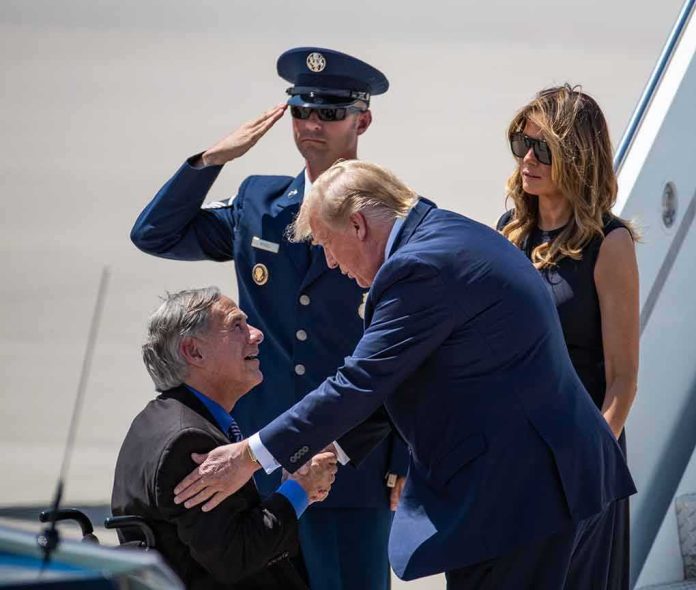
President Trump’s rare tarmac welcome for China’s Xi Jinping signaled hard-nosed, high-visibility diplomacy from the very first moment of the visit.
Story Highlights
- Trump and First Lady Melania Trump flew by Marine One to Joint Base Andrews to greet Xi on arrival.
- The airport greeting marked a break from usual protocol, which reserves full ceremony for the White House.
- The White House outlined a formal State Arrival Ceremony for the next day.
- A long red carpet and military honors framed the high-stakes opening scene.
Trump Greets Xi On The Tarmac In A Rare Gesture
President Trump greeted Chinese President Xi Jinping at Joint Base Andrews on September 23, 2026, in a rare tarmac welcome that set the tone for a closely watched visit. Reporters and photographers documented Trump and First Lady Melania Trump arriving by Marine One before joining the greeting party on the airfield. Xi’s aircraft touched down just after 5:30 p.m. Eastern time, where the leaders met on a long red carpet amid military honors and a brisk schedule that moved straight into motorcades and meetings.
The greeting departed from standard practice. Under normal State Department protocol, a president often reserves full, formal honors for the White House the following day, while senior officials handle airport arrivals. Trump’s choices emphasized visibility and message from the start, with a pageantry-heavy reception that underscored the visit’s stakes after more than a decade since Xi’s last Washington stop. The airfield scene signaled that the administration wanted to shape first impressions in plain view.
White House Schedule And Ceremonial Plans
The White House had telegraphed the plan days earlier. A briefing from First Lady Melania Trump stated that the President would greet Xi and his wife, Peng Liyuan, on Wednesday at Joint Base Andrews, with a State Arrival Ceremony planned at the White House on Thursday. The schedule listed an Armed Forces honor cordon and formal events on the South Lawn, the State Floor, and the Rose Garden, reflecting high honors balanced with a structured agenda for talks and cultural moments.
Photo wires and pool notes filled in the timeline. Images showed the President and First Lady boarding Marine One on the South Lawn and flying to the base to meet Xi’s plane. Captions described the precise sequence on the ground, including the arrival of the presidential helicopter, the handshakes on the carpet, and the move to a waiting motorcade. These standard reporting tools helped confirm the choreography and tempo of the greeting, step by step, in real time for the public.
Why The Airport Welcome Matters
Presidential airport greetings are uncommon and therefore meaningful. The gesture can signal resolve, respect, or urgency, depending on context. Analysts note that foreign leaders coming into Joint Base Andrews typically meet protocol officials or a Cabinet-level representative first. By appearing on the tarmac, Trump made the opening scene part of the message: America sets the terms in public, honors the guest, and keeps pressure visible from the first handshake, rather than waiting until the South Lawn ceremony the next day.
President Donald J. Trump and First Lady Melania Trump greet President Xi Jinping of China and Madame Peng Liyuan upon their arrival in Washington, D.C., ahead of the state visit at the White House. pic.twitter.com/CUvFxU3xM4
— John F Kenndy (@JohnfKennedy218) September 24, 2026
For conservative readers, the stakes are clear. China remains a strategic rival that challenges American industry, steals intellectual property, and tests our military edge. A high-visibility welcome does not soften that stance; it puts strength on display and narrows room for games behind closed doors. Trump’s team framed the visit with formality and accountability. Cameras caught every step. That approach matches a broader push for clear lines: fair trade, strong borders, and respect for American power, without apologies or mixed signals.
Sources:
lusa.pt, washingtonexaminer.com, the-express.com, dallasexpress.com