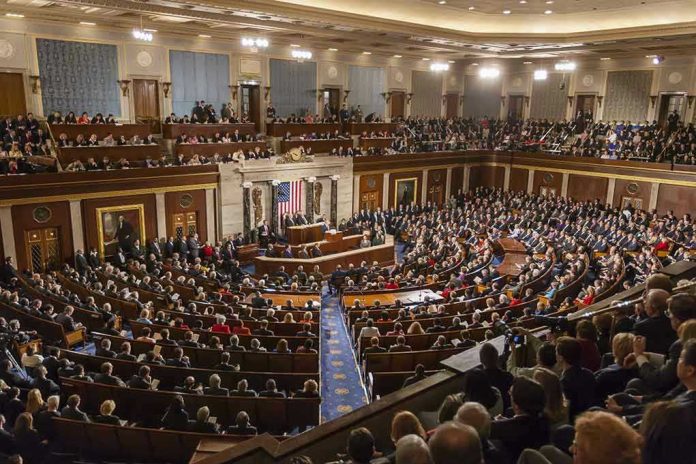
A single refusal to stand turned immigration into a 10-second campaign ad Democrats didn’t get to edit.
Story Snapshot
- Trump put Congress on the spot during the State of the Union: stand if government should prioritize American citizens over illegal immigrants.
- Republicans stood and cheered; most Democrats stayed seated, creating a live, unmistakable visual.
- Trump called the moment “a shame” from the podium, framing Democrats as rejecting a basic obligation of government.
- Schumer defended the sit-down on CNN by attacking ICE enforcement as reckless and harmful, including claims tied to Minnesota incidents.
- The fight isn’t just policy; it’s a messaging trap where optics can overpower nuance in one news cycle.
The SOTU moment that made immigration a loyalty test on live television
President Donald Trump used a classic State of the Union tactic: force a clean, TV-friendly choice. He asked lawmakers to stand if they believed the U.S. government should prioritize American citizens over illegal immigrants. Republicans rose in unison. Most Democrats did not. Trump reacted in real time, calling it a “shame” and scolding those seated. The scene instantly hardened into a symbol, not a debate.
The brilliance of the tactic was its simplicity. “Prioritize citizens” sounds like a foundational promise of self-government, not a legislative proposal. That’s why the camera matters. Viewers don’t see footnotes about due process, asylum backlogs, or employer enforcement. They see standing versus sitting. For voters over 40 who remember politics before everything was a clip, this was still the same old truth: visuals beat white papers.
Schumer’s defense: shift the target from “citizens first” to “ICE gone rogue”
Senate Minority Leader Chuck Schumer chose an aggressive counterpunch in a CNN interview the next day. He argued Democrats were right not to stand because Trump’s immigration enforcement, especially through ICE, fails to protect Americans and instead harms them. Schumer cited claims about reckless actions, including assertions connected to Minnesota and allegations of warrantless raids. His point was clear: protection requires competence and restraint, not slogans.
That defense tries to turn a moral binary into a performance review. If enforcement causes collateral damage, Schumer implies, then “stand for Americans” becomes empty theater. The weakness is that it asks the audience to ignore what their eyes just saw and follow a more complicated argument. Conservatives tend to start from first principles: a nation has the right to borders, laws need enforcement, and government owes special duties to its own citizens. That makes Schumer’s pivot a tough sell.
Why the sit-down landed as a PR blunder even for voters who dislike Trump
Democrats likely thought they were refusing to take Trump’s bait. The problem is that non-participation still communicates a choice. In a chamber built on ritual, standing is shorthand for agreement with a basic value, not necessarily with every implementation. When Democrats stayed seated, critics framed it as picking illegal immigrants over citizens. Stephen Miller amplified that interpretation as an “immortal visual,” the kind campaigns replay until it feels like established fact.
Common sense politics punishes ambiguity. Many Americans can hold two ideas at once: treat people humanely and enforce immigration law. The SOTU question forced an either-or, and Democrats responded with an image that looked like “neither.” Even if their internal logic was “we reject Trump’s framing,” the external read was “we won’t affirm citizens first.” If you hand your opponent a clear story, you don’t get to complain when he tells it.
The deeper fight: enforcement competence versus enforcement legitimacy
Schumer’s argument relies on a serious claim: that ICE actions can be reckless enough to endanger Americans. If true, any conservative should demand accountability, because rule of law includes lawful enforcement. The issue is verification and specificity. Sweeping allegations without a tightly documented chain of facts often function as political cover rather than reform. “ICE bad” becomes a substitute for a more persuasive stance: fix mistakes, punish misconduct, and keep enforcing the law.
Trump’s framing, by contrast, leans on legitimacy: citizens come first, borders matter, sanctuary policies obstruct. That message resonates because it matches what most people think government is for. Polling mentioned in coverage suggests Trump’s handling still faces mixed approval, which matters for midterms. Still, when voters feel disorder, they often prefer a clear promise of control. Democrats can critique tactics, but they risk sounding allergic to the concept of enforcement itself.
What this episode signals for the next election cycle
This is how modern campaigns are built: not with 50-point plans, but with moments that can be replayed on phones between errands. Republicans got a clean contrast shot and will use it to argue Democrats won’t put Americans first. Democrats will try to reframe it as resistance to reckless enforcement. The side that wins is the one that can make its story feel like the obvious one in 15 seconds.
Chuck Schumer Steps in It When Asked About the Refusal to Stand for Americans During the SOTU https://t.co/jwyJPMndFh
— Marlon East Of The Pecos (@Darksideleader2) February 26, 2026
The open question is whether Democrats will adapt by separating “citizens first” from “Trump’s methods,” or whether they’ll keep treating any citizen-priority language as a trap. Conservatives should demand two things simultaneously: moral clarity that citizens come first, and procedural seriousness that enforcement stays lawful and targeted. The country can handle nuance. The camera just won’t wait for it.
Sources:
Schumer Defends Democrats Who Refused to Stand During Trump’s State of the Union