

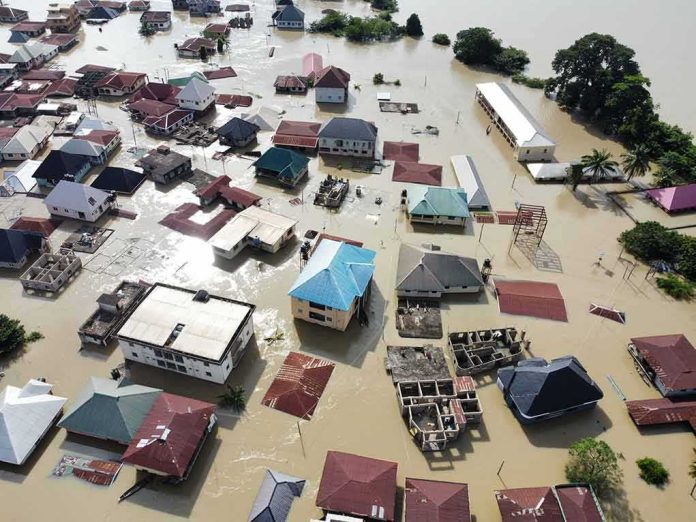
A massive 7.8 offshore quake hammered the Philippines’ Mindanao region and triggered deadly tsunami waves, offering a stark reminder of why secure borders, strong supply chains, and American energy independence still matter to families here at home.
Story Snapshot
- A magnitude 7.8 offshore earthquake struck near Mindanao’s Sarangani coast, generating tsunami waves and regional alerts.
- Dozens are reported dead and hundreds injured as buildings collapsed and coastal communities were flooded.[3][4]
- U.S. Embassy warnings, local evacuations, and regional tsunami alerts show how fast a natural disaster can overwhelm fragile systems.[3][4]
- The quake echoes the historic 1976 Moro Gulf disaster, underscoring why resilient infrastructure and secure energy and food supplies are vital.[5]
A powerful quake off Mindanao shatters communities and tests regional readiness
The Philippine Institute of Volcanology and Seismology recorded a powerful magnitude 7.8 earthquake offshore of Sarangani, at the southern tip of Mindanao, at 7:37 a.m. local time on June 8, 2026.[3] United States Geological Survey readings similarly placed a 7.8 event off Mindanao’s coast, at a depth of roughly 35 kilometers, strong enough to shake cities, buckle structures, and send residents running into the streets.[3] Officials immediately warned of tsunami danger for coastal communities already living with limited infrastructure resilience.[3]
United States Embassy officials in Manila issued an urgent “Natural Disaster Alert” confirming the 7.8 offshore quake near Sarangani and warning Americans in the region to be prepared for aftershocks and potential tsunamis.[3] Philippine disaster authorities and the Office of Civil Defense began mobilizing search and rescue teams as reports came in of collapsed buildings, damaged schools, and businesses in General Santos City and other Mindanao localities.[3][4] Early accounts described residents fleeing to higher ground, echoing painful memories of earlier disasters.[4]
Rising death toll, tsunami waves, and the strain on local systems
By later in the day, disaster officials reported that at least 32 people had been killed and more than 200 injured as a result of the quake and its impacts across southern Mindanao.[4] Video and on-the-ground reporting showed pancaked structures, including a building housing a popular fast-food restaurant and damaged school facilities in General Santos City, a major urban hub of roughly 700,000 residents.[4] Families described desperate searches for loved ones trapped under debris while emergency crews navigated congested, debris-strewn streets to reach those in need.[4]
Tsunami waves followed the offshore rupture, slamming parts of the Philippine coastline and prompting alerts across the region.[3][4] Philippine authorities reported tsunami warnings and evacuations in susceptible coastal areas, while regional centers in other countries monitored sea-level gauges for potential impacts beyond the Philippines.[3][4] For residents in low-lying fishing villages and crowded informal settlements, even a moderate wave height can flood homes, destroy small boats, and wipe out the limited assets that sustain families already living near the edge.[4]
Hard lessons from history: the shadow of the 1976 Moro Gulf catastrophe
For older Filipinos, the Mindanao quake and tsunami alerts revived memories of the devastating 1976 Moro Gulf earthquake and tsunami, which struck near Mindanao and Sulu.[5] That 8.0 magnitude event generated waves reaching as high as an estimated 15 meters in some locations and killed between 5,000 and 8,000 people, injuring 10,000 and leaving roughly 90,000 homeless.[5] Entire coastal communities along the Moro Gulf and the Sulu Archipelago were obliterated when the tsunami roared ashore in the dark, with little warning and no modern communication systems.[5]
The @IFRC and the Philippine Red Cross @philredcross are responding to a powerful 7.8-magnitude earthquake that struck off the coast of Maasim, Sarangani, Mindanao, on 8 June 2026.
📸Philippine Red Cross @philredcross pic.twitter.com/9UFwFFn6KG
— IFRC (@ifrc) June 8, 2026
The historical record from 1976 shows how vulnerable island communities around Mindanao are when major offshore quakes strike and generate tsunami waves.[5] Then, many residents did not yet understand that strong shaking near the coast can be a natural alarm to run for higher ground; thousands were swept out to sea when walls of water arrived minutes later.[5] Today’s 7.8 event drew on those painful lessons, with modern warnings and faster communication, but the basic reality remains: when the earth moves offshore, coastal families have minutes, not hours, to get clear.[3][5]
Why this matters to American readers focused on security and resilience
Events in Mindanao may feel distant, but they carry direct implications for American conservatives who care about secure borders, stable supply chains, and preparedness.[3][4] The Philippines sits on vital sea lanes that carry energy, food, and manufactured goods through the western Pacific, and a major disruption there can ripple through global markets, pushing up prices that American families already straining under past inflation still feel.[4] Just as the 1976 Moro Gulf disaster destabilized local economies, a modern catastrophe can compound existing geopolitical and economic tensions.[5]
For a United States led again by an administration that emphasizes sovereignty and strong borders, this quake is another reminder that global shocks—from wars to natural disasters—can rapidly spill into our own neighborhoods through supply shortages and price spikes.[3][4] Resilient domestic energy production, diversified supply chains, and serious national preparedness reduce our dependence on fragile foreign infrastructure that can be knocked out in minutes by an earthquake or tsunami.[4][5] Mindanao’s tragedy underlines why Americans concerned with family budgets, constitutional freedoms, and national strength watch global instability closely, not as an excuse for endless intervention but as a warning to keep our own house strong.
Sources:
[3] YouTube – Magnitude 7.8 quake hits Philippines, at least 32 killed
[4] Web – Natural Disaster Alert: Magnitude 7.8 Earthquake, Tsunami …
[5] Web – A 7.8 magnitude quake in Philippines kills at least 32, sets off …