

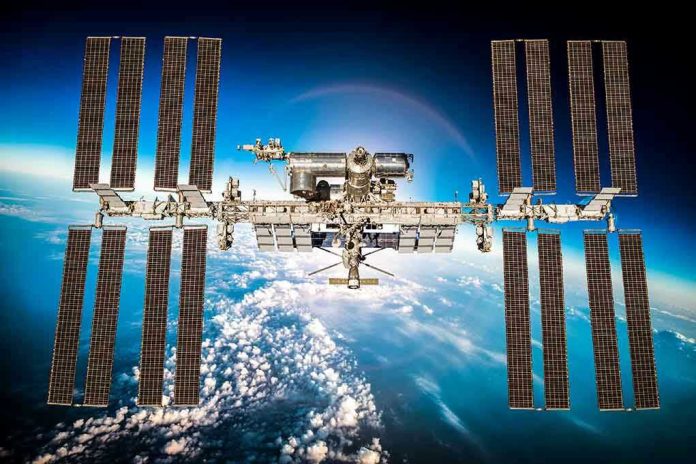
An air leak on the International Space Station has forced astronauts into their docked SpaceX spacecraft, a reminder that space stations still depend on quick decisions when hardware starts failing.
Quick Take
- NASA ordered astronauts aboard the International Space Station to shelter in the docked SpaceX Dragon spacecraft while repairs were underway in the Russian segment.[2]
- Reporting describes the move as a precaution during leak repairs, not as confirmation that the station was in immediate failure.[1][2]
- The latest reporting says the leak was found in the Russian part of the station, adding to longstanding concerns about recurring air-leak problems.[1][2]
- Social media coverage amplified the event with evacuation language, but the available reports mainly support a shelter-and-repair posture.[2][3]
Why the Crew Took Shelter
Fox Weather reported that five astronauts supervised by NASA were ordered to take shelter in the SpaceX Dragon spacecraft docked at the station after a new leak was found in the Russian part of the International Space Station.[1] iHeartRadio reported the same basic sequence, saying astronauts were sheltering in a SpaceX capsule while repairs were made to air leaks in the Russian segment.[2] Those reports point to a protective measure, not proof that the station had lost control.
The practical meaning matters. A shelter order aboard the station is a serious step, but the reporting provided here does not show a full evacuation, a loss of pressure, or a confirmed station-wide emergency.[1][2] Instead, the crew moved into the spacecraft already docked to the station, which is exactly the kind of contingency hardware space agencies keep ready for situations that demand caution without immediate abandonment of the mission.[1]
What the Public Reporting Does and Does Not Show
The available coverage supports one clear fact: the leak was significant enough to trigger a protective response while repair work continued.[1][2] It does not provide the engineering data needed to judge the exact severity of the leak, the rate of air loss, or whether the problem was localized to one compartment or part of a broader structural issue. Without that technical detail, the most accurate description is a contingency response under active repair.
The broader issue is familiar to anyone who has followed modern space policy: official updates are often sparse, and the public is left with headlines that sound more dramatic than the underlying data.[2][3] In this case, the reports say “take shelter” and “prepare for possible evacuation,” but those phrases can cover a range of conditions, from a cautious drill posture to a real but bounded hardware problem.[2][3]
Why the Story Resonates Beyond the Station
For readers who are tired of government systems pretending everything is fine until the moment they are not, the story hits a familiar nerve. The station is one of the most complex machines ever built, yet it still depends on disciplined maintenance, clear command decisions, and backup options when a leak appears.[1][2] That is not a political slogan; it is a reminder that competence, redundancy, and accountability matter more than reassuring talking points.
#BREAKING Astronauts aboard the International Space Station were instructed by NASA to shelter in their spacecraft and prepare for a possible evacuation earlier today as Russian crews worked to address a worsening air leak in the Russian segment of the station, Reuters reports.… pic.twitter.com/1CvmZc5V8u
— Global Report (@Global_ReportHQ) June 5, 2026
The reporting also shows how quickly an operational alert can become a narrative about crisis. Some social posts and live-video titles leaned into evacuation language, while the news summaries themselves emphasized sheltering during repairs.[2][3] That gap is important because the public deserves accuracy, especially when the story involves astronauts, station integrity, and the thin line between precaution and true emergency.[1][2]
Sources:
[1] Web – NASA astronauts are taking shelter inside a SpaceX Dragon spacecraft …
[2] Web – NASA astronauts take shelter after new leak found in Russian part of …
[3] Web – ISS Astronauts Shelter Amid Air Leak Repairs | iHeartRadio