

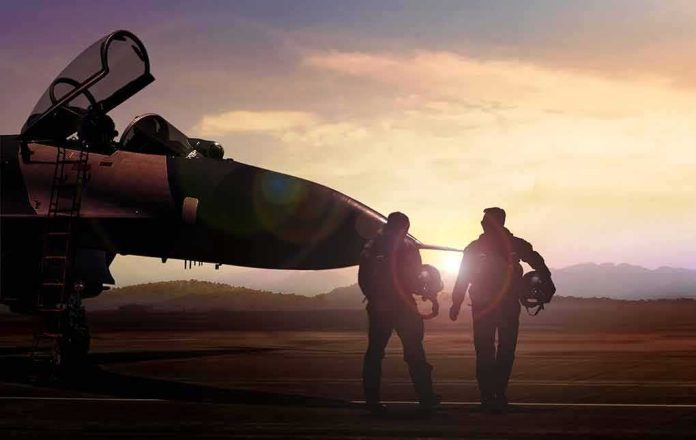
As fighter jets fired warning flares over New Jersey’s World Cup final, many Americans saw yet another sign that everyday systems meant to protect them are breaking down.
Story Snapshot
- More than 10 civilian planes violated restricted airspace near Trump and the World Cup final, with three needing fighter jet intercepts.
- NORAD F-16s deployed flares twice to get pilots’ attention and force compliance with emergency security rules.
- Officials say most breaches were “honest mistakes,” raising questions about pilot training and government communication.
- The incident fits a growing pattern of repeated airspace violations whenever Trump travels, fueling public distrust in security planning.
What Exactly Happened Over New Jersey’s World Cup Final?
North American Aerospace Defense Command (NORAD) reported that more than 10 small civilian planes entered restricted airspace over Bedminster and East Rutherford, New Jersey, on July 19, 2026. This area included Trump’s Bedminster property and the stadium hosting the World Cup final between Spain and Argentina. Three planes came close enough, or failed to respond clearly enough, that NORAD scrambled F-16 fighter jets to intercept them and push them out of the no-fly zone. All violators were ultimately escorted away without any crash or injuries.
NORAD’s statement said that during two of these intercepts, F-16s fired visible flares to get the civilian pilots’ attention and direct them to follow instructions. These flares lit up the sky and were seen by people on the ground, sparking fear and confusion among fans already on edge about security. NORAD stressed that the flares are non-lethal and burn out quickly in the air, saying they pose no danger to people on the ground when used under strict safety rules. The visual shock, however, reinforced how tense the event’s security climate had become.
How Airspace Rules Work When Presidents and Major Events Are Involved
The Federal Aviation Administration sets up Temporary Flight Restrictions, or no-fly zones, around presidents and “Level 1” national events, which is the highest security category in the country. For the World Cup final, NORAD and the aviation authorities issued special notices to pilots explaining that general aviation aircraft could not enter airspace over Bedminster and East Rutherford without clearance. These notices are designed so every pilot planning a flight route in the region has fair warning to stay away. NORAD later said the planes entered anyway despite those clear warnings.
When a civilian plane heads toward restricted airspace and does not respond properly to radio calls, NORAD follows a standard intercept playbook. Fighter jets get close, rock their wings, and use lights, then flares, to signal the pilot to change course and exit the protected zone. If the pilot cooperates, the jet escorts the plane back to safe airspace and the incident ends quietly. That is what happened in New Jersey: once the pilots understood they were in trouble, they complied and were led out, which shows the intercept system itself worked as designed.
Honest Mistakes or System Failure? Why This Keeps Happening
NORAD emphasized that most of the planes that broke the rules were flown by pilots who made “honest mistakes” and simply did not check the latest restrictions. At face value, that sounds reassuring: no sign of terrorists or coordinated attack, just people making errors. But for many citizens, that explanation raises deeper doubts. If over a dozen pilots can miss crucial warnings around a global event and a sitting president, people wonder whether the government’s communication systems and training standards are truly working.
🚨 THE SKYLINE SECURITY SCRAMBLE: NORAD F-16S DEPLOY FLARES OVER NEW JERSEY TO INTERCEPT INTRUDING AIRCRAFT DURING HIGH-STAKES 2026 WORLD CUP FINAL! 🚨
The high-density air defense perimeter over the tri-state area was forced into a dramatic, real-time military enforcement… pic.twitter.com/Mo2aUA4riT
— Boardroom Patriot (@nwmsound) July 21, 2026
This World Cup scare is part of a larger pattern. Since Trump’s inauguration, NORAD has dealt with more than 20 airspace violations near his Mar-a-Lago residence in Palm Beach, Florida, including five intercepts in just one week in March 2025. In one case, an F-16 used a rare “headbutt” maneuver to force a civilian plane away from the resort after it wandered into a restricted zone. Another incident near Palm Beach International Airport led to flares and a temporary ground stop when a plane entered the presidential TFR and stopped responding to radio calls.
Across these events, officials keep repeating the same line: most breaches are accidental, and the response is routine. Yet the frequency of failures around critical security zones undermines public faith that the system can prevent a truly serious threat. Conservatives see repeated rule-breaking as proof that regulators and pilots do not take security seriously enough. Liberals see heavy military measures, like scrambling fighter jets and firing flares over civilian areas, as a sign of an over-militarized state that panics instead of fixing root problems. Both sides agree on a core worry: the people in charge are not learning from these mistakes.
Security Theater or Necessary Protection? The Deeper Tension
Donald Trump’s presence at the World Cup final triggered the highest “Level 1” security designation, meaning thousands of federal agents, snipers, and fighter jets surrounded a soccer game that was supposed to be a joyous global moment. For some Americans, this level of protection feels necessary in a world still scarred by terrorism and facing war flare-ups abroad. For others, it looks like security theater that protects elites and presidents first, while shrugging off the everyday safety and freedom of people below.
The New Jersey intercepts show the tension clearly. NORAD did its job and followed the rules, and there is no evidence the civilian pilots acted with hostile intent. Yet the system relied on last-second military action because basic steps—pilots reading notices, agencies ensuring the message reached every cockpit—failed again. When fans look up and see flares streaking across a World Cup sky, they are not thinking about careful protocols; they are thinking about a country where mistakes keep happening and leaders keep saying, “Everything is under control,” even as fighter jets scramble above their heads.
Sources:
redstate.com, telegraph.co.uk, kp.ru, militaeraktuell.at, newsbreak.com, dotdotnews.com, cbs12.com, military.com, airuniversity.af.edu, usatoday.com, youtube.com, cbsnews.com, faa.gov, cfinotebook.net