

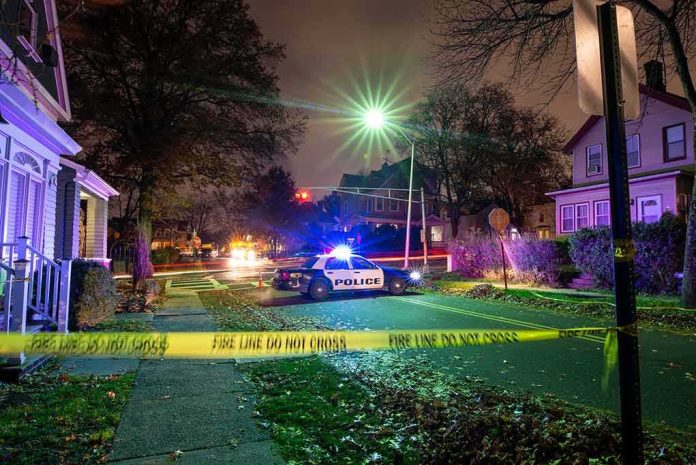
When a man stood on a village high street firing a bow and arrow at passing cars, what unfolded in minutes captured three enduring truths about public safety in Britain: communities often act before police can arrive; modern policing must navigate visible mental distress without inflaming risk; and the legal tools for both citizens and officers to contain a fast-moving threat are well established and frequently used.
At a Glance
- A 68-year-old man in Skelmanthorpe fired a bow and arrow at passing vehicles after erratic driving; villagers restrained him before armed police arrived.
- No injuries were reported, though multiple vehicles were damaged; the man was arrested on suspicion of possessing an offensive weapon in public.
- Police later confirmed use of mental-health detention powers in connection with the case, aligning with established guidance on crisis response.
- The incident illustrates the lawful role of bystanders in preventing a breach of the peace and the routine—if contentious—use of Mental Health Act powers in public-order crises.
What happened on Huddersfield Road
In the late afternoon, reports to West Yorkshire Police described a driver on Huddersfield Road in Skelmanthorpe throwing rubbish and household items from a moving car and driving dangerously. Shortly afterward, witnesses said the same man exited his vehicle, produced a bow, and began firing arrows in the street at passing vehicles. Police arrived to find members of the public had tackled and restrained the suspect, averting further harm. Officers arrested a 68-year-old man on suspicion of possessing an offensive weapon in a public place; several vehicles sustained damage, but no injuries were recorded.
Local coverage and the police statement are consistent on the sequence of events and the outcome: a sudden, visible threat; quick civilian intervention; a rapid police response; and an arrest without reported injury. Subsequent updates indicated that the individual was detained under mental-health powers, a path policing leaders routinely pursue when conduct suggests acute crisis rather than calculated criminality.
Why civilian intervention here was lawful—and decisive
In Britain, you do not need a warrant card to prevent a breach of the peace. Longstanding common law recognizes the right—and, in moral terms, the imperfect duty—of any person to take reasonable steps, including temporary detention, to stop ongoing or imminent violence. Courts have restated the principle for decades, drawing the line at reasonableness and immediacy: act to stop the threat, use no more force than necessary, and hand over to police as soon as practicable.
What villagers did in Skelmanthorpe fits that template. An offender actively discharging a projectile weapon at traffic is the sort of imminent danger the law contemplates; a brief, controlled restraint until armed officers arrive is squarely within the boundary of reasonable steps. This is not vigilantism; it is the citizen’s side of the social contract—contain the harm, then defer to lawful authority.
Police powers and the mental-health dimension
Arrest on suspicion of an offensive weapon addresses the criminal exposure. But when behavior plausibly signals acute mental distress—erratic driving, disorganized actions, indiscriminate aggression—officers also consider powers under the Mental Health Act, particularly Section 136, which allows police to take someone who appears mentally disordered and in need of immediate care to a place of safety. These powers are not rare: in the year ending March 2025, there were 31,779 detentions under Section 136 in England and Wales, underscoring how often frontline officers must thread the needle between crime control and crisis care.
Operational guidance is explicit: restraint of a person in mental-health crisis should be minimized and reserved for emergencies where immediate safety is at stake, because certain restraint dynamics can worsen physiological risk. Safe containment—controlling the scene, limiting stimuli, prioritizing medical assessment—generally takes precedence once the immediate threat is neutralized. In Skelmanthorpe, the sequence—community restraint to halt active harm, armed officers securing the scene, and subsequent mental-health detention—tracks that doctrine.
🇬🇧 Police have arrested a 68-year-old man after a bow and arrow was reportedly fired at passing vehicles in Skelmanthorpe
The man was restrained by members of the public before officers arrived and arrested him at 5.58pm. No-one was injured, although several vehicles were damaged pic.twitter.com/kbbcFQSOMV— DJ CandyMan (@DrCandymn) September 23, 2026
Weapons, risk, and proportional response
A bow and arrow is not a museum curiosity in public-order terms; at short range it can penetrate vehicle panels and cause grievous injury. For police, the presence of a projectile weapon justifies deployment of armed units and elevated containment tactics even if shots are not being fired in the firearms sense. The public-safety objective is twofold: stop the immediate hazard and prevent a cascade—drivers swerving into pedestrians, a panicked crowd, a bystander escalation—from turning a bizarre episode into a mass-casualty scene. That the Skelmanthorpe incident ended without injuries reflects both the speed of civilian action and the disciplined containment by responding officers.
How we got here: a structural, not anomalous, challenge
Cases like this are not merely “odd news”; they sit at the junction where policing, community norms, and mental-health capacity meet. The last decade has seen sustained pressure to reduce reliance on police cells and to shorten detention windows for people in crisis, alongside greater scrutiny of restraint in custody and on the street. Legislation and professional practice have moved accordingly—tightening Section 136 timelines, diverting from cells, and embedding clinical triage—yet the frontline reality remains that the first responder is often a passer-by, followed by officers who must stabilize chaos with imperfect information.
That is why the base rate matters: tens of thousands of Section 136 detentions annually do not mean overreach by definition; they mean the volume of visible crisis in public places is high, and the operational burden on police and communities is chronic rather than exceptional. The Skelmanthorpe episode is a vivid instance of a familiar pattern.
What this means for communities and police practice
For citizens, the lesson is practical: you are lawfully empowered to intervene to stop an imminent breach of the peace, but reasonableness governs. That typically means acting in numbers, avoiding escalation, using only necessary force, and ceding control immediately once police are on scene. Mobile phones are useful after safety is secured; before that, attention belongs on containment.
For police forces, the case validates three priorities. First, maintain rapid armed response capacity for unconventional weapons; a bow on a pavement is not a low-threat encounter. Second, sustain training that operationalizes “safe containment” once the threat collapses, keeping restraint minimal and bringing clinical assessment forward. Third, improve community communications after such incidents—explain what happened, what laws applied, and where to seek support—because clarity cools rumor and anchors public trust in the aftermath.
Bottom line
Skelmanthorpe was not a parable; it was a near-miss resolved by ordinary people acting within the law and by officers applying the right tools in the right order. The combination—citizen restraint to halt active harm, a measured armed response, and the use of mental-health powers once the dust settled—is exactly how the system is supposed to work when danger, disorder, and distress collide in a public place.
Sources:
thegatewaypundit.com, westyorkshire.police.uk, bbc.com, yahoo.com, examinerlive.co.uk, us.headtopics.com, thesun.co.uk, ground.news, hellorayo.co.uk, crimesite.com