

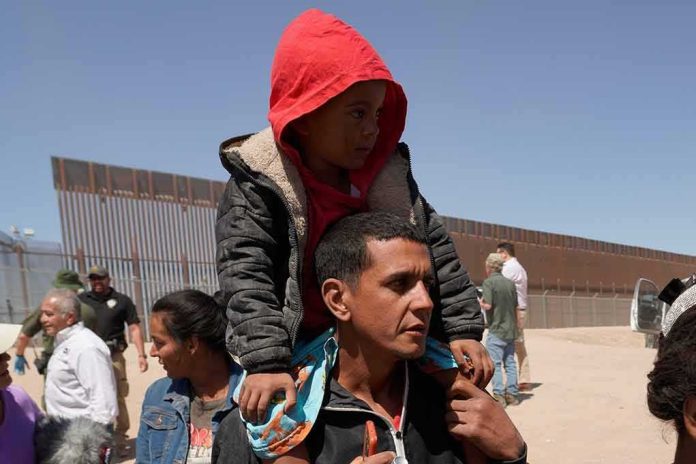
Family separation in interior immigration enforcement is not an anomaly of border policy; it is a recurring domestic consequence of arrests at homes, workplaces, and—in disputed cases—near schools and bus stops. The through-line across credible reporting and child-welfare research is simple and sobering: when an arrest takes a parent out of a household, children bear the shock first and the burden longest.
At a Glance
- Interior raids routinely produce parent–child separations that last from hours to months, with measurable harm to children’s well-being and schooling.
- Documented incidents include arrests timed around school transport and public places, with community-level ripple effects on attendance, trust in authorities, and local economies.
- Public-health and education research links immigration enforcement surges to increased child anxiety, sleep disturbance, and lower academic performance.
- Officials dispute some arrest-location details, but the broader pattern—children left to absorb caregiving and financial strain—is well established in the literature.
What actually happens to children when parents are taken
In practice, an arrest that looks routine on a custody log rewrites a household’s logistics within minutes. A young adult postpones college to keep siblings fed. A second grader stops sleeping through the night. A preschooler suddenly clings at drop-off. These are not rhetorical flourishes; they track with what families and service providers recount after enforcement actions that remove a parent from daily life. The mechanism is straightforward. Detention interrupts caregiving, income, transportation, and school routines at once. Even when separation lasts only a day or two, the uncertainty—where is my parent, who picks me up, what happens tonight—becomes its own stressor. When separation stretches to weeks or ends in deportation, older siblings often assume quasi-parental roles, while younger children experience the psycho-physiological markers of toxic stress: hypervigilance, sleep disturbance, and somatic complaints.
The social science is unambiguous on the direction of effect. Longitudinal and quasi-experimental work links local spikes in immigration arrests to declines in academic performance and attendance among Hispanic and English-learner students; the signal is strongest in districts with larger numbers of mixed-status families. Child-development research and practitioner testimony converge on a similar picture: raids—announced or rumored—elevate anxiety and withdrawal and can trigger regressive behaviors in the youngest children. None of this depends on the legal merits of the underlying immigration case; the child’s body reads the absence more quickly than a docket can be adjudicated.
How we got here: the policy architecture behind separations
Interior enforcement sits at the intersection of federal mandate and operational discretion. Agents must execute removal orders and make arrests for civil immigration violations and selected crimes; they also decide when and where to act, whether to use alternatives to detention, and how to coordinate with local entities. Over the last two decades, those choices have oscillated: worksite raids in one period, home arrests or traffic-stop spin-offs in another, and at times elevated activity around public spaces that families frequent. Independent fieldwork on worksite raids documents a consistent outcome regardless of venue: all arrested parents were separated from their children for some period—from hours to months—and some families never reunified in the same country again.
The rhetoric around “deterrence” has further shaped practice. Senior figures associated with past federal crackdowns have publicly argued that separation can be a tool to discourage unlawful presence or entry, framing it as an inevitable byproduct of prosecution and removal. That argument stands in tension with child-welfare norms and with prior internal advisory recommendations urging that separation be avoided absent safety concerns and that reunification logistics be planned when possible. The current debate is less about whether separations happen—they do—and more about whether operational planning minimizes foreseeable harm to children when they are not themselves targets of any proceeding.
Where the evidence is strongest—and where it is contested
Three strands of evidence carry the greatest weight. First, credible, on-the-record accounts place arrests in contexts where children are likely to witness them—outside homes during morning routines, at community parks, and, in some reports, proximate to school transport. Officials have, in certain cases, disputed the exact locations or intent, but litigation filings and local reporting have at times corroborated operations timed around school hours or in family-dense settings. The core fact—the child’s exposure to parental removal and the ensuing separation—is not in dispute across these cases; only the choreography is.
Second, child-impact research has matured. We now have a stack of consistent findings: enforcement shocks correlate with lower test scores, diminished attendance, and degraded school climate metrics for affected subgroups. Clinical and practitioner reports detail anxiety, depression, and behavioral changes among children in mixed-status households during and after enforcement surges. These are the kinds of results that hold up across methodologies and geographies because they track a common mechanism—disruption of caregiving and routine—rather than a single policy label.
Third, qualitative work from community organizations and service providers captures the economic ripple effects: sudden loss of income, emergency childcare improvisation, and, in some communities, business closures or labor shortages immediately following high-profile arrests. These signals matter because they map the collateral consequences that do not appear in enforcement tallies but define a neighborhood’s lived reality in the weeks that follow.
Schools, bus stops, and “sensitive locations”
Schools and their perimeters occupy a special place in this discussion. For years, guidance around “sensitive locations” sought to reduce enforcement in settings like schools, hospitals, and places of worship. Even without formal protection, common sense recognizes the heightened child impact of an arrest conducted within a child’s daily sanctuary. Recent analyses and testimony suggest an uptick in enforcement actions near or around school routines in certain jurisdictions, accompanied by spikes in absenteeism and withdrawals as families retreat from public view out of fear—sometimes on the strength of rumor alone. When credible local sources describe arrests timed to bus arrivals or departures and federal agencies contest the specifics, the right analytic response is not to flatten the account but to acknowledge the conflict and return to the invariant: any parent removal that collides with a school routine multiplies the harm to the child and the school community, whether or not the tactical decision was to stand exactly at the curb.
What minimizing harm would look like in practice
Child-centered enforcement is not a contradiction in terms; it is operational design. The literature and prior advisory recommendations point to practical mitigations: avoid operations in the immediate orbit of schools and childcare; use scheduled reporting or targeted arrests outside child-centered hours when lawful custody is necessary; employ alternatives to detention, especially when a caregiver’s community ties are strong; and, when detention proceeds, verify caregiving arrangements, enable rapid communication, and coordinate transportation for dependents to minimize unplanned separations. None of these measures nullifies the underlying statute. They reduce predictable, avoidable child harm that enforcement personnel neither need nor intend to inflict to perform their core function.
Data transparency is the second lever. Communities cannot calibrate response—or trust—that harm is being minimized without visibility into arrest locations, timing, custodial transfer distances, and reunification intervals. Researchers, too, need clean event data to continue linking enforcement patterns to child outcomes with precision rather than inference. Education and child-welfare agencies should be at the table, with protocols for attendance monitoring, crisis counseling, and emergency guardianship support when a caregiver is suddenly removed.
The consequence that matters
The law organizes people into categories—citizen, noncitizen, removable, admissible. Children organize their lives around people—mother, father, sibling, teacher. When those organizing anchors disappear without warning, the child’s experience is separation first, legal status second. The best available evidence, across disciplines, says that experience leaves marks: on sleep and attention, on classroom performance, on the shape of adolescence when a teenager trades a dorm room for a timecard to keep siblings housed. An enforcement system worthy of the name does not ignore those marks. It designs around them.
Sources:
hrw.org, clasp.org, ctinsider.com, latintimes.com, k12dive.com, patch.com, theatlantic.com, wonderwall.com