

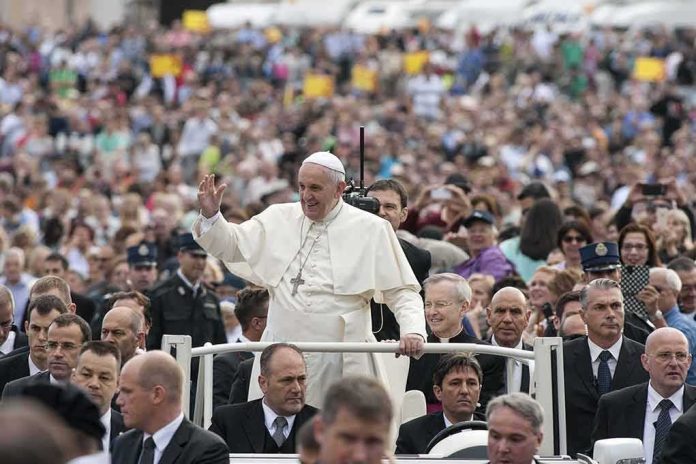
A single afternoon Mass on the Place de la Concorde did something no French institution had managed in nearly two decades: it filled the heart of Paris with a crowd measured in the hundreds of thousands, gathered not for a concert or a protest but for the liturgy of the Catholic Church.
Key Points
- Pope Leo XIV celebrated an open-air Mass at Place de la Concorde on September 26, 2026, drawing an estimated 700,000 to 800,000 people along the Champs-Élysées, according to Vatican and organizer figures.
- Roughly 600,000 people had pre-registered before the Diocese of Paris closed sign-ups a week and a half early, with turnout on the day exceeding that figure.
- The visit was Pope Leo’s first trip to France and the first official papal visit to the country since 2008.
- The Mass followed a broader itinerary including meetings with President Macron, abuse survivors, and vespers at the newly restored Notre-Dame Cathedral.
- Large, uncontested outdoor crowd figures like this one are best understood as estimates within a normal range, not precise headcounts — a fact true of virtually every mass gathering in history.
What Happened at Place de la Concorde
On the afternoon of September 26, 2026, Pope Leo XIV presided over a public Mass at Place de la Concorde, the square where Louis XVI was executed during the French Revolution and now, more than two centuries later, the site of the largest Catholic gathering France has seen in a generation. The Vatican’s official itinerary listed the liturgy plainly: “15:00 — Holy Mass at the Place de la Concorde”. What the schedule could not convey was the scale of what actually arrived. Crowds stretched the full length of the Champs-Élysées and beyond, spilling into overflow zones the Diocese of Paris had prepared in anticipation at Place de l’Étoile and Avenue de la Grande-Armée.
The numbers tell their own story of momentum. Registration for the Mass opened weeks in advance, and by September 16 the Diocese of Paris announced it had reached nearly 600,000 sign-ups — enough that Archbishop Laurent Ulrich made the unusual decision to close the platform ten days before the event itself. On the day, the Vatican’s own estimate put attendance at roughly 700,000, exceeding pre-registration by a comfortable margin, while Reuters and other outlets on the ground reported crowds closer to 800,000 stretching the length of the avenue. Whatever the precise figure, every account converges on the same conclusion: this was the largest single public event of Pope Leo’s four-day journey, and one of the largest religious gatherings France has hosted in decades.
Why This Trip Mattered Before the Mass Even Began
Context matters here as much as crowd size. Pope Leo’s four-day journey, running September 25 through 28, marked the first papal visit to France since Benedict XVI’s trip in 2008 — nearly eighteen years without a reigning pope setting foot in a country that still calls itself the Church’s “eldest daughter”. He arrived September 25 with a pointed message to French civil leaders, meeting President Macron at the Élysée Palace and urging the country not to abandon its duty to protect human life amid ongoing debates over assisted dying, abortion, and surrogacy. That same evening he presided over vespers at Notre-Dame de Paris, the cathedral reopened only in December 2024 after five years of reconstruction following the 2019 fire, where he venerated the relic of the Crown of Thorns and received a faithfully reproduced image of the Virgin Mary lost in the blaze.
The Saturday Mass, then, was less a standalone spectacle than the culmination of a carefully sequenced state and pastoral visit — one built around themes the Pope wove through nearly every appearance: a society’s “spiritual thirst,” the endurance of French Catholic martyrs from Blandina and Irenaeus to Vincent de Paul, and a call for renewed missionary conviction among clergy and laity alike. Organizers mobilized roughly 14,000 volunteers to run communion stations, security, and crowd logistics along the route, according to on-the-ground coverage of the preparations, underscoring how much infrastructure a gathering of this size actually requires.
How a Crowd This Size Gets Counted — and Why the Range Is Normal
Readers accustomed to precise headline numbers may notice that estimates for the day ranged from roughly 600,000 to 800,000 — a spread that can look like confusion but is in fact standard for any non-ticketed outdoor gathering. Crowd science has never produced a perfect instrument for counting open public space; even the most rigorous methods, from aerial-imagery grid analysis to paired counting stations, rely on density assumptions per square foot that shift depending on how tightly people stand and how the space curves along an avenue like the Champs-Élysées. Historic gatherings from Pope John Paul II’s 1979 Chicago Mass to modern mass-pilgrimage events have all produced similarly wide official ranges, simply because there is no turnstile at the edge of a public square. The Concorde Mass fits that long historical pattern rather than departing from it — a wide but internally consistent set of figures pointing to the same conclusion: an extraordinary, historically significant turnout.
NEW: Pope Leo XIV celebrated Mass with an estimated 800,000 people in Paris on Saturday, after spending the morning with migrants, the poor, and adults newly entering the Catholic Church.
At a migrant house, he said the history of the Church and of humanity “is not written by…
— Christopher Hale (@ChristopherHale) September 26, 2026
What the Turnout Signals Going Forward
For the Diocese of Paris and the wider French Church, the practical significance of the day lies less in the exact figure than in what it demonstrates about latent religious appetite in a country long assumed to be secularizing past the point of large-scale public devotion. French bishops have separately pointed to a documented rise in young converts entering the Church in recent years, and the Concorde Mass gave that trend its most visible public expression yet. Whether that momentum translates into sustained parish attendance, vocations, or civic influence is a longer question than any single afternoon can answer. But the image of the Champs-Élysées filled end to end for a papal liturgy — in a square built for revolution, not religion — is one French Catholicism will draw on for years as evidence that its public voice is far from finished.
Sources:
humanevents.com, amp.dw.com, thetablet.co.uk, france24.com, euronews.com, vaticannews.va, npr.org, connexionfrance.com, newsinfo.inquirer.net