

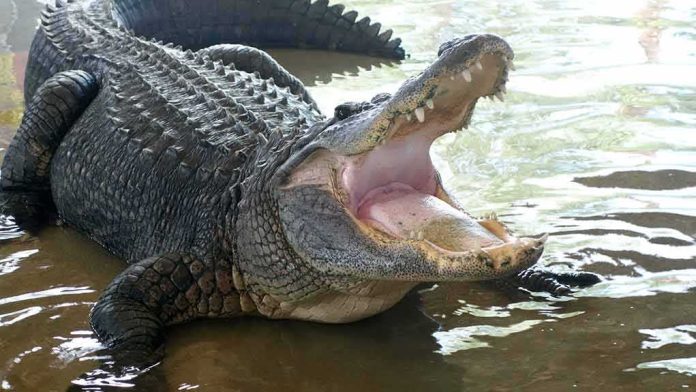
An alligator that tips the scales at 844 pounds is not simply a big reptile — it is an animal operating at the outer edge of what the species is physically capable of becoming, and the four-year campaign it took to land one tells you nearly everything about how wild, how patient, and how occasionally improbable modern alligator hunting still is.
Key Points
- An 844-pound, roughly 14-foot alligator nicknamed Snaggletooth was captured at Lake Moultrie, South Carolina, on the night of September 28, ending a pursuit that stretched four to five years.
- The catch is recognized as the second-largest alligator ever taken in South Carolina, landed by Renegade Bowfishing’s Cole Poplin and William Ard with clients Chris Webb and his father.
- The animal’s exact length shifted slightly between the dock and the scale — a routine quirk of how large carcasses settle and straighten, not a dispute over the catch itself.
- The hunt unfolded inside South Carolina’s tightly regulated, tag-based alligator season, a program that didn’t exist at all until 1995.
What Happened on Lake Moultrie
Around 11 p.m. on September 28, a four-man team hauled an 844-pound alligator out of Lake Moultrie in Berkeley County, roughly fifty miles north of Charleston. The crew — guides Cole Poplin and William Ard of Renegade Bowfishing, along with clients Chris Webb, who held the harvest tag, and his father — closed out a chase that had run since around 2020 or 2021, depending on which team member is telling it. The animal, nicknamed Snaggletooth for its distinctive, jagged front teeth, is now recognized as the second-largest alligator ever recorded taken in South Carolina, a state that has tracked organized alligator harvests for three decades.
Poplin, who guides hunts year-round and had scouted this particular animal for roughly four to five years, described a strange final act to the pursuit: after hundreds of unsuccessful attempts and only a handful of actual sightings, the team came upon a large alligator without immediately recognizing it as the one they had been chasing. It wasn’t until they regrouped and secured the animal that the identification clicked — the same four distinctive front teeth that had made Snaggletooth recognizable in scattered sightings and social-media posts over the years.
Why the Measurement Moved — and Why That’s Normal
In the hours after the catch, the team measured the alligator three separate times at roughly 14 feet. About eleven hours later, after the carcass had been iced down and transported, a subsequent measurement came in at 13 feet 8 inches. That is not a contradiction so much as a known feature of handling an animal this size: post-mortem curvature, cooling, and the way a carcass settles during transport routinely shave inches off an on-site estimate taken in the field versus one taken after the animal has straightened out. Hunters and biologists alike treat the first on-scene reading as provisional for exactly this reason, which is why South Carolina’s own harvest paperwork insists on precision over eyeballing.
That paperwork matters more than casual readers might assume. South Carolina’s official Public Alligator Harvest Report requires hunters to record carcass length in feet and inches and explicitly instructs them not to list an estimated weight — only a figure taken on a scale. The distinction between “measured” and “estimated” is the difference between a claim that holds up as a state record candidate and one that doesn’t. Snaggletooth’s 844 pounds came off a scale, which is why the figure has traveled, essentially unchanged, through every subsequent account of the catch.
How South Carolina’s Alligator Season Actually Works
None of this happened in a regulatory vacuum. South Carolina didn’t hold any alligator season at all for 31 years after the species was protected; the state’s modern harvest program only restarted in 1995, confined initially to four Lowcountry counties before gradually expanding statewide. Today the season operates on a tag system split into two broad categories: Slot Tag hunts, which restrict hunters to alligators between four and eight feet, with no exceptions, and other tag classes — like the one Chris Webb held — that carry no such cap. That distinction is the reason a legal, licensed hunter can end up standing next to a 14-foot animal at all; most of the alligators taken each season fall well within the modest slot-tag range, while the true giants come off a smaller number of unrestricted tags pursued by specialists who, like Poplin’s crew, spend years scouting a single known animal.
The scale of that specialization shows up in the numbers. South Carolina hunters reported harvesting 467 alligators during the 2025 season, a jump of 72 animals from the year before and the highest total recorded since at least 2013. Yet the average size of a harvested alligator statewide runs closer to nine feet, and in the 2023 season the single largest reported catch measured 13 feet 6 inches. Against that backdrop, an 844-pound, near-14-foot animal isn’t a modest improvement on a typical year’s best — it is a genuine outlier, the kind of alligator most guides spend an entire