

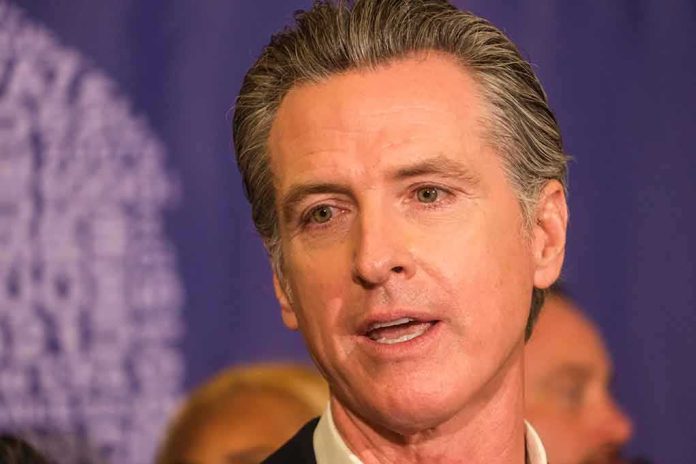
The simplest explanation for why Gavin Newsom didn’t run for president in 2024 is also the most durable in U.S. party politics: he calculated that a bid lacked both a compelling rationale and a viable coalition, especially against an incumbent president and, in a contingency, a history-making vice president with deep ties to a core Democratic constituency.
The Short Version
- Newsom publicly said he was “not ready” in 2024 and lacked a clear “why” to run; he also pledged not to challenge the sitting Democratic ticket.
- Joe Biden later argued Newsom also recognized that challenging Kamala Harris risked alienating Black voters and splintering the party.
- Both accounts fit modern nomination politics, where contenders avoid frontal challenges to incumbents or barrier‑breaking running mates.
- Conventions are ratifying bodies, not open brokered arenas; building a winning rationale and coalition before the convention is decisive.
The decision Newsom actually made — and how he explained it
When pressed on why he did not enter the 2024 race, Newsom offered a blunt, testable answer: he wasn’t ready and did not have a sufficiently compelling reason to run. In a high-visibility CNN interview, he said he would have been “crushed” because he lacked a big enough “why” — the kind of animating public purpose that justifies a grueling national campaign and distinguishes a challenger from a sitting president of his own party. Months earlier, he had publicly framed loyalty to the ticket as a principle, telling a NewsNation audience that Democrats should “have [Biden’s] back,” and signaling he would not mount an intraparty challenge for its own sake. These are not throwaway lines; they are the vocabulary of modern intra‑party restraint.
In strategic terms, “no compelling why” is less a confession of timidity than an acknowledgment that presidential nominations reward contrast with a plausible path to 50% in primaries and a unifying posture for the general election. Running against a sitting president without an obvious breach — policy, performance, or electability — is historically punishing. Even well‑known governors struggle to invent a mandate against an incumbent absent a crisis or a partywide clamor to replace the ticket.
Biden’s retrospective: the Harris factor and coalition risk
Joe Biden’s later account adds a coalition lens. In his memoir, he contends that Newsom recognized a second trapdoor: any move that sidelined Kamala Harris — the first Black woman to reach the vice presidency and later the party’s nominee — risked alienating Black voters and detonating a convention fight Democrats could ill afford. In Biden’s telling, Newsom understood the danger and stood down to avoid fracturing the party. That is motive attribution, not a signed memo from Newsom, but it is consistent with how coalitions are actually maintained: core constituencies have veto power over maneuvers perceived as dismissive of hard‑won representation.
These two explanations — readiness/rationale and coalition management — are not mutually exclusive. They describe different sides of the same decision tree. If you cannot articulate why you, why now, and with whom, a candidacy is definitionally weak. If, in addition, the path runs through a primary framed as blocking a barrier‑breaking vice president with strong ties to Black leaders, the “with whom” question becomes disqualifying even for a talented campaigner.
Mechanics matter: why open challenges rarely materialize
Since the reforms of the 1970s, primaries rather than party bosses allocate delegates; conventions mostly ratify a verdict reached in the states. The era of multi‑ballot, floor‑brokered deals effectively ended in 1952 for Democrats and 1948 for Republicans. That institutional reality dampens the romanticism of “jump in and let the convention decide.” The work happens months earlier: building a rationale, securing elite and grassroots endorsements, raising money at scale, and knitting together a coalition that can survive the calendar’s front‑loaded tests. Without that scaffolding, a would‑be challenger stalls before Super Tuesday. As Brookings and congressional research have chronicled, delegates today are largely bound products of primary outcomes; the convention is not a neutral arbiter waiting to be persuaded at the eleventh hour.
In 2024, those mechanics were even less forgiving. The Democratic Party navigated ballot deadlines and calendar pressures with a view toward unity; Ohio’s rules, for example, forced procedural adaptations that reinforced the ratifying character of the process, not its openness to late insurgency. Under such constraints, the difference between “I want it” and “I can marshal a majority” widens into a chasm. Candidates who misread that gap become cautionary tales.
Where the genuine disagreement lies — and how to weigh it
The only real dispute is not over what Newsom did, but why. His on‑record rationale emphasizes readiness and purpose. Biden’s memoir foregrounds the Harris backlash risk. The public record squarely supports Newsom’s statements — his own taped words — as the definitive account of what he chose to say about his decision at the time. Biden’s version is an informed reconstruction by a principal who had unique visibility into party stakeholders; it is credible as elite inference but remains secondhand relative to Newsom’s self‑explanation.
An expert reading does not force a binary. Politicians are rarely moved by a single cause. Readiness without a coalition is fantasy; a coalition that courts revolt is untenable. In 2024’s particular configuration — incumbent president, a vice president with high symbolic salience inside the party, and primary rules that reward pre‑built strength — both accounts describe constraints that would make any governor think twice. The overlap, not the conflict, is the story.
Comparative history: loyalty, timing, and the price of miscalculation
American nomination politics punishes poorly timed ambition and rewards patient coalition‑building. The McGovern‑Fraser reforms were designed to broaden participation, but they also disciplined hopefuls: you must prove your case to primary voters early, at scale, and without detonating your own coalition. That is why the strong pattern, across parties, is deference to incumbents and caution around challenges that could be framed as repudiating a coalition’s identity commitments. The symbolic firsts matter; party actors guard them. In 2024, Harris’s status as the first minority‑racial woman to secure a major‑party presidential nomination underscored the representational stakes inside Democratic politics. Even prior to that nomination, the possibility of appearing to nullify that ascent carried political costs that a rational actor would count.
By contrast, intraparty rebellions that succeed tend to pivot on systemic failure or a mobilized faction with a distinct program — think ideological realignment, not personality rivalry. Running against a sitting president of your own party without that groundswell invites a beating. Newsom’s “no big enough why” reads, in that light, as prudence rather than coyness.
What it means for future contenders
Three practical lessons endure. First, rationale is not messaging fluff; it is strategy. Without a programmatic “why” that segments the primary electorate in your favor, the map never materializes. Second, coalition veto points are real. Challenging a figure with strong identity resonance inside your party invites a legitimacy fight you are unlikely to win. Third, conventions will not save you. The modern system rewards months of invisible spadework; absent that infrastructure, late‑breaking ambition is performance art, not a pathway to the nomination.
Seen through that prism, Newsom’s 2024 non‑candidacy reflects the logic of the system he hopes to navigate in the future. The choice preserved optionality, avoided gratuitous fracture, and acknowledged the arithmetic of modern nominations. It was less a retreat than an acceptance of how power is actually accumulated now: one rationale, one coalition, one calendar at a time.
NYP: Joe Biden Reveals Why Gavin Newsom Didn’t Run in 2024
Gov. Gavin Newsom put his presidential ambitions on the back-burner in 2024 because challenging Kamala Harris for the Democratic nomination threatened to alienate Black voters and tear the party apart, according to Joe…
— Politics & Poll Tracker 📡 (@PollTracker2024) November 17, 2026
Sources:
redstate.com, cnn.com, us.cnn.com, nypost.com, ground.news, us.headtopics.com, transcripts.cnn.com, irishexaminer.com, congress.gov, organizations.ballotready.org