

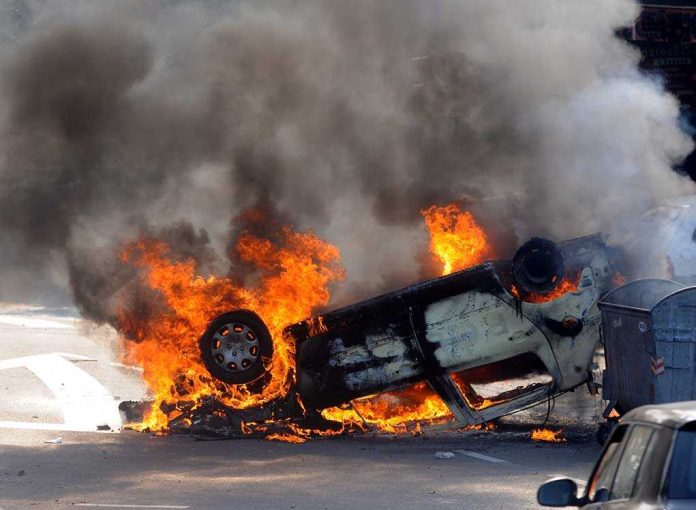
A fuel tanker flipped over during Wednesday evening rush hour on Cairo’s Ring Road, and the fire that followed killed at least 31 people in minutes.
Story Snapshot
- A fuel tanker crashed and overturned on Cairo’s Ring Road near the Warraq area of Giza, igniting a massive fire.
- Egypt’s Health Ministry says at least 31 people died and 21 more were injured.
- More than two dozen vehicles were caught in the blaze and burned.
- Prosecutors detained a 21-year-old driver suspected of clipping the tanker while speeding.
What Happened On The Ring Road
The crash happened Wednesday as the tanker moved through the Ring Road where it passes above a tunnel in Giza’s Warraq district. The truck was hauling petroleum products. When it flipped, the fuel spilled and caught fire, turning a packed rush-hour highway into a wall of flame in seconds. The Associated Press reported the blaze left more than two dozen vehicles charred and stranded drivers with almost no time to escape.
Egypt’s Health Ministry confirmed the death toll at 31, with 21 others hurt badly enough to need hospital care. Officials say identifying some of the victims took extra time because of how badly the fire damaged the vehicles and the people trapped inside them, forcing investigators to rely on the Ministry of Health and Population’s forensic teams to confirm names.
Prosecutors Detain A Young Driver
Egyptian prosecutors ordered the detention of a 21-year-old driver suspected of causing the crash by cutting too close to the tanker while speeding. The French news agency AFP reported the man admitted to speeding in the moments before the collision, giving investigators an early account of how the disaster unfolded on one of the capital’s busiest arteries.
The driver now faces questioning tied to the deaths and injuries, though Egyptian authorities have not announced formal charges. An arrest is a step in an investigation, not a finding of guilt, and the legal process in Egypt will determine what responsibility, if any, the driver ultimately bears for what happened that evening.
A Nation Grieving And Demanding Answers
Grief turned to anger fast. Egyptian lawmakers publicly demanded accountability on Thursday as families buried their dead, and Reuters described it as the deadliest in a string of recent accidents that have frustrated the public. Cairo residents, many of whom use the Ring Road daily for work and errands, are asking why a routine commute turned into a mass casualty event overnight.
That frustration is not happening in a vacuum. Egypt’s own statistics agency recorded 5,829 road deaths in 2025 alone, a jump of nearly 11 percent from the year before, according to figures cited by Reuters. Over the past seven years, road accidents nationwide have killed almost 45,000 people, a toll that dwarfs most disasters that make international headlines and rarely gets the same attention.
Why Fuel Tankers Turn Deadly So Fast
Researchers who study hazardous material crashes call them low-probability, high-consequence events. A fuel truck wreck is rare compared to ordinary traffic accidents, but when it goes wrong, it goes wrong violently. Studies of tanker crashes found that fire breaks out in a meaningful share of incidents, and explosion follows in a smaller but still dangerous slice of cases, turning a single collision into a mass-casualty fire.
That pattern fits what happened on the Ring Road. One overturned truck, one spark, and dozens of ordinary commuters trapped in cars never built to survive a fuel fire. It is a brutal reminder that heavy industrial cargo sharing the road with daily commuter traffic carries risks most drivers never think about until a night like this one happens.
A massive fire erupted on Cairo's Ring Road after a fuel tanker overturned following a collision, engulfing vehicles in flames and lighting up the night sky. Egyptian authorities said at least 31 people were killed and 26 others injured in the tragedy. More than two dozen cars… pic.twitter.com/bWty0hocyo
— NDTV World (@NDTVWorld) November 27, 2026
Egyptian officials have not yet announced broader safety changes for fuel transport on the capital’s highways. Given the scale of the loss and the public anger already building, pressure on the government to explain how tankers are routed, inspected, and regulated on roads packed with commuter traffic is likely to grow in the days ahead.
Sources:
masshalal.com, apnews.com, drm.news, iies.gusec.edu.in