

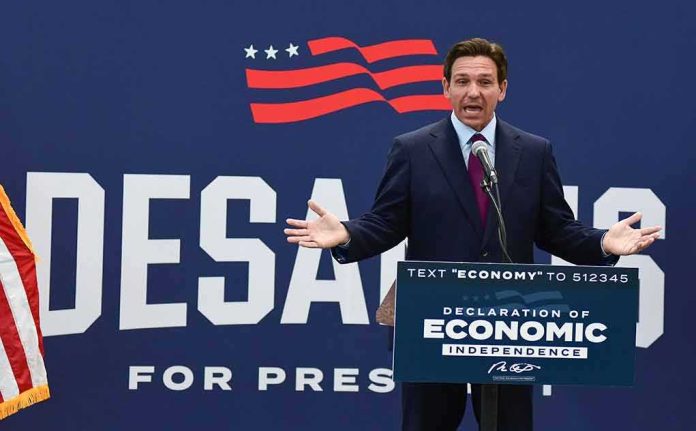
In American politics, a book is rarely just a book; it is a stage, a message architecture, and—when timed to a turning point in a politician’s career—the clearest signal of future ambition short of filing paperwork.
At a Glance
- Axios reports that Florida Gov. Ron DeSantis is quietly working on a new book, according to two sources; related outlets echoed the account.
- The timing aligns with DeSantis’s term-limited exit in January 2027 and positions him to shape a post-governorship agenda.
- DeSantis has a track record in political publishing, including 2011 and 2023 titles that doubled as ideological framing documents.
- In modern presidential politics, prospective candidates routinely publish books to define their platform and build national reach.
What’s been reported and why it matters
Two sources told Axios that Gov. Ron DeSantis is working on a new book, a project described as quiet and not yet publicly acknowledged by the governor. Mediaite and Political Wire summarized the Axios account soon after it published, reinforcing the core report while noting that details such as title, publisher, and release window have not been disclosed. The practical significance is straightforward: DeSantis leaves office in January 2027, and a well-timed book offers an uncluttered platform to define his governing philosophy, his record in Florida, and—if he chooses—his case for national leadership in the 2028 cycle.
DeSantis has used books as vehicles before. His 2011 volume, Dreams from Our Founding Fathers, established constitutionalist bona fides early in his career; The Courage to Be Free in 2023 translated his Florida agenda into a national argument—part memoir, part manifesto—consistent with the genre’s dual purpose of narrative and policy. The reported project would fit that pattern. While there has been no formal announcement of a campaign, Axios reports that DeSantis has left the door open to assessing a presidential run after leaving office, making a fresh book a logical instrument for reintroduction and agenda-setting.
How political books function in presidential positioning
For modern contenders, publication is infrastructure. Candidate literature typically comes in two flavors: an “introduction” that rounds out biography and temperament, and a “manifesto” that distills governing principles into a persuasive package for primary voters and opinion leaders. These titles serve as message discipline in hardcover form, building a stump-speech spine, generating cable hits and local-media coverage, and underwriting national travel through book-tour logistics. The practice is ubiquitous; across recent cycles, nearly every serious aspirant has turned to a book to sharpen message, expand list-building, and frame contrasts well before formal filings.
Publishers, for their part, understand the political calendar as a sales calendar. Conservative imprints, rapid-response non-fiction programs, and campaign-adjacent promotional strategies evolved in parallel with post-2016 demand for political titles and the expectations of a media ecosystem that rewards portable, excerptable argument. The net result is a predictable choreography: manuscript, rollout, interviews, excerpts, events—each reinforcing the author’s positioning while testing messages in the wild.
What the current reporting supports—and what it doesn’t claim
The present reporting supports a narrow but consequential point: sources say DeSantis is working on a book; multiple outlets have described the Axios scoop; and the timing aligns with his end of term and the speculative runway to 2028. It does not claim that a contract, publisher, or release date is public, nor that DeSantis has declared or formed a campaign. Those are distinct steps. Nevertheless, in the grammar of pre-campaign politics, a book project functions as a signal of intent to shape the conversation ahead—especially for a term-limited governor seeking to convert executive record into a national thesis.
This distinction matters because political books are not merely autobiographical exercises; they are argument containers designed to travel. Whether the new project skews memoir or manifesto, it would give DeSantis a disciplined venue to revisit Florida-era fights (pandemic policy, education, corporate governance, migration, redistricting), prune what didn’t work, and elevate what might resonate in a 2028 primary electorate that will judge on both record and rhetoric. Historically, even modest-selling titles can be effective if they supply a candidate with quotable language and an organizing frame for donors, activists, and media gatekeepers.
I'm sure it will be riveting.
Florida Gov. Ron DeSantis Is Writing a Book, Sources Say — Fueling 'Speculation' About 2028 – https://t.co/w66aLejnpH #GoogleAlerts— Florida Issues (@FloridaIssues) November 23, 2026
The strategic logic of the 2027–2028 window
Timing is the asset. A post-governorship book released in the first half of 2027 would hit the pre-season sweet spot—late enough to incorporate an end-of-term coda, early enough to seed message and relationships before the invisible primary hardens. It also spreads risk: a book can calibrate ideological distance or proximity to other Republican power centers without triggering campaign finance thresholds or the staffing commitments that narrow optionality. In practice, that means testing emphasis—federalism, culture fights, economic management, foreign policy hawkishness—against donor rooms and conservative media without the commitments of an exploratory committee.
From the party-system perspective, the book is a form of coalition brokerage. It allows the author to reassure one faction while signaling competence to another, especially in a field where multiple figures will argue they can channel the base, expand in the suburbs, and manage Washington’s machinery. A carefully structured table of contents can telegraph that coalition map better than a scattershot interview circuit.
How to read the next signals
If the project follows the well-worn path, expect a title that encapsulates a governing frame, a subtitle that makes the nationalization explicit, and a chapter architecture that marches through biography, record, and future agenda. Look for rights deals at major imprints with established conservative lists, ISBN registrations, or seasonal catalog placements. Excerpts in aligned outlets, a brisk radio-and-podcast swing, and state-party dinners framed as “book events” are all standard tells in the run-up to a presidential cycle.
On the political side, the complementary indicators are equally familiar: a lean policy staff drafting white papers that rhyme with the book’s chapters; donor briefings pegged to publication milestones; and early-state travel under the cover of bookstore events. None of these actions alone confirm a candidacy, but together they amount to the choreography of someone preparing to compete.
Bottom line
Based on current reporting, DeSantis is at work on a new book; he departs the governor’s office in January 2027; and he has not foreclosed a 2028 run. In the modern campaign playbook, those facts are not incidental—they are the architecture of pre-campaign positioning. If the manuscript moves to market, it will tell us as much about message and coalition as any poll. Watch the title, the chapter order, and the tour map. That is where the intent reveals itself.
Sources:
mediaite.com, politicalwire.com, newsbreak.com, 2028tracker.com, esquire.com, politico.com, theatlantic.com