

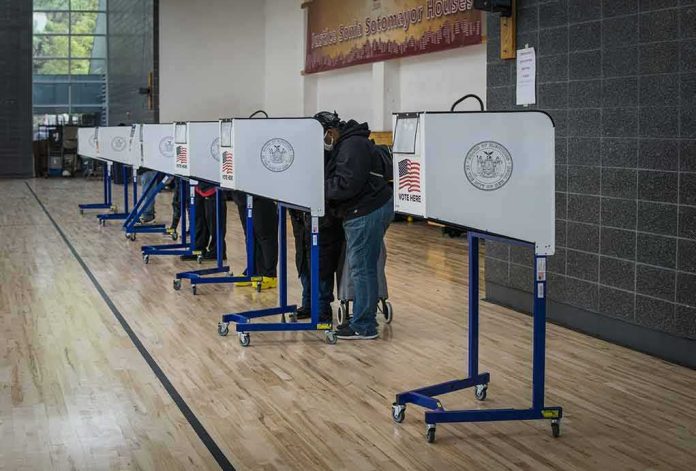
Most “election fraud” headlines are blunt instruments; this case is a scalpel. A San Luis Obispo County jury convicted Gaea Edde Powell on nine counts after a full trial, not for abstract conspiracies, but for concrete, repeated acts tied to residency, registration, candidate filings, and voting across two election cycles—exactly the category of offense that election law scrutinizes most closely because it goes to who is entitled to be on the ballot and which contests a person may lawfully vote in.
The Short Version
- A San Luis Obispo County jury found Powell guilty on nine counts spanning voter registration fraud, perjury by declaration, false nomination papers, Political Reform Act violations, and fraudulent voting.
- The verdict followed a 10-day trial and covered conduct during the 2022 and 2024 Arroyo Grande mayoral election cycles.
- Local reporting describes the prosecution’s core theory as false residency at an Arroyo Grande address while living outside city limits, including fraudulent voting in three elections.
- Cases like this are rare nationally; when they arise, they typically turn on the technical question of true residence, not systemwide malfeasance.
What the jury decided, and why it matters
The county’s charging theory was not a one-off filing error; it alleged a pattern that touched every stage of election participation: registration, nomination documents, disclosure, and actual voting. After a 10-day trial, a jury convicted Powell on all nine counts—eight felonies and one misdemeanor, according to the district attorney—covering acts dated July and August 2022; October 10 and November 8, 2022; March 5, 2024; July 16 and August 1, 2024; and November 5, 2024. Those dates map to registration and filing windows as well as three separate election days, reflecting repetition over time rather than a single lapse. The district attorney’s announcement names Powell, gives her date of birth, and states the convictions arose from the 2022 and 2024 Arroyo Grande mayoral cycles.
Local coverage aligns on the core conduct: prosecutors argued Powell falsely claimed residence at a condominium on James Way in Arroyo Grande while actually living outside city limits, then used that claimed address for candidacy and voting. Reporting also notes she represented herself at trial, which underscores, but does not alter, the central fact that the jury accepted the state’s residency and intent case beyond a reasonable doubt.
https://www.youtube.com/watch?v=NZ_vKoJmapc
How residency sits at the center of these statutes
Residency is the fulcrum in many election-fraud prosecutions. California’s election code ties both voter eligibility in a local contest and candidate qualification for city office to residence—a person’s “fixed habitation” with an intention to remain, not occasional presence or convenience use of an address. When the claimed domicile does not match the actual, the same misrepresentation can cascade: registration affidavits become false, nomination or declaration papers become false, and ballots cast in contests limited to city residents become illegal votes. That compounding is why one residency dispute can yield multiple charges across form types and election dates; it is also why juries often see a repeating pattern rather than an isolated misstatement. Coverage here reflects exactly that structure, including separate counts for three elections on November 8, 2022; March 5, 2024; and November 5, 2024.
Courts in analogous contexts draw a similar line. The legal test distinguishes a true home—where one actually lives and intends to remain—from a nominal or borrowed address leveraged for political eligibility. When a federal or state judge writes, as one did in a recent New York ballot case, that using a friend’s address while “barely stepping foot on the premises” does not constitute residency, it captures the same principle that often drives local prosecutions: eligibility follows real life, not paperwork.
What made this case stand out from routine paperwork mistakes
The verdict covers nine counts, tied to specific dates that track election administration events over two years. That timeline matters. Election offices run separate workflows for registration, candidate filings, disclosure obligations, and balloting. For a jury to convict across all four categories, prosecutors must typically show that the same false predicate—here, the Arroyo Grande residence claim—was asserted repeatedly and then used as the basis for voting in restricted contests. The district attorney describes eight felonies and one misdemeanor; some secondary outlets varied in their felony/misdemeanor counts, a common discrepancy until the verdict form is published, but all agree on nine convictions returned by a jury after full trial.
Local reports also indicate Powell conducted her own defense. Juries are instructed to decide on evidence, not style, and the outcome ultimately turns on whether the prosecution’s documents, witness testimony, and election records persuaded them that the claimed residence was not genuine. The jury’s unanimous verdict across nine counts indicates it did.
How rare is this, really?
Despite the punch of the phrase “election fraud,” the base rate of illegal voting and related offenses in the United States is extremely low. Syntheses by academic and nonpartisan organizations put incident rates in the range of roughly three to twenty-five thousandths of one percent, with only a small number of prosecutions arising out of the hundreds of millions of ballots cast over decades. That context cuts both ways: it cautions against generalizing from a single local case to the integrity of national elections, and it highlights the specific deterrent value when prosecutors do establish willful misrepresentation tied to residency and ballot access. Narrow doesn’t mean trivial; it means targeted.
Residency disputes, in particular, recur because they sit at the junction of mobility, property, and politics. People maintain multiple addresses, move between jurisdictions, or keep ties to a community they’ve left. The law, however, asks a crisp question: where, as a matter of fact and intent, is your home? When candidacies and votes are pegged to that answer, misstatements propagate through sworn declarations and, ultimately, through ballots. That is the terrain on which this case was charged and tried.
🚨🚨 BREAKING NEWS 🚨🚨
ANOTHER ELECTION FRAUD CONVICTION IN CALIFORNIA.
Former Arroyo Grande mayoral candidate Gaea Powell has been convicted on NINE election-related counts — eight felonies and one misdemeanor — including fraudulent voting in three separate elections.
And… pic.twitter.com/wMTcSn5bnE
— Mike Netter (@nettermike) September 23, 2026
What to watch after the verdict
Sentencing will translate nine convictions into a concrete penalty, bounded by California statute and any aggravating or mitigating findings presented to the court. Appeals—if filed—often focus on jury instructions, evidentiary rulings, or the sufficiency of the proof on residency and intent. Separate from courtroom outcomes, election administrators continue the mundane but essential work of record hygiene: cross-checking registrations, auditing candidate filings, and, when appropriate, referring potential violations for investigation. These back-office safeguards rarely make news; they are the reason cases like this remain the exception.
Sources:
feedpress.me, calcoastnews.com, ksby.com, sanluisobispo.com, x.com, yahoo.com, slocounty.ca.gov, ground.news