

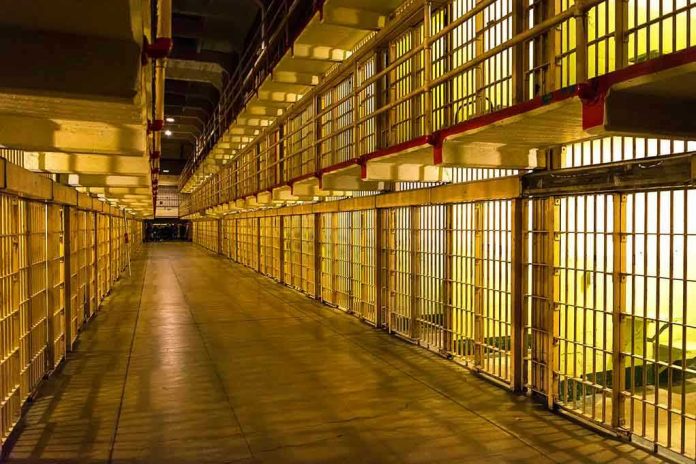
The most chilling part of the Barinas prison rooftop protest is not the burning mattresses, but the inmates’ calm claim that guards opened fire on an unarmed, peaceful crowd.
Story Snapshot
- Prisoners in Barinas, western Venezuela, climbed onto a prison roof to protest alleged beatings, shootings, and restrictions on family visits.
- Inmates say they were peacefully demonstrating when prison staff fired live rounds, injuring several men.[3]
- The protest echoes a wider pattern of torture, inhuman detention, and near-total impunity inside Venezuelan facilities.[4]
- For anyone who believes government power should be tightly restrained, this story is a warning shot about what happens when the walls close in and oversight disappears.
Rooftop revolt in Barinas: how a prison turned into a protest stage
Prisoners at the Barinas Judicial Boarding School in western Venezuela did something authorities never expect: they took their complaints literally to the roof.[3] Men in yellow vests and shorts climbed up, waved shirts, and burned mattresses where everyone could see the smoke. Videos and reports describe them demanding the removal of the prison director, naming him in connection with alleged torture and mistreatment, and accusing guards of shootings and beatings inside the facility.[4]
Witness accounts gathered by international media say the inmates’ core complaint was simple: they were tired of being abused, shot at, and cut off from their families.[3] Prisoners said they had been peacefully protesting when prison staff opened fire, and that several inmates were injured by gunshots.[3] The men also denounced strict limits on visits, which for many poor Venezuelan families mean loved ones effectively disappear behind walls that almost no independent monitor can enter.[3]
What we know, what we do not, and why the gaps matter
Available coverage clearly confirms the protest happened: men on the roof, burning mattresses, chanting demands, and accusing guards of violence.[2][3] What is much less clear is the official side of the story. Reports do not provide a detailed statement from prison authorities addressing whether staff fired live ammunition, who gave any such order, or how many inmates were injured.[3] That silence leaves outsiders with an asymmetry: detailed allegations on one side and vague, institutional shadows on the other.
For anyone who cares about rule of law, that gap is not a minor detail; it is the heart of the problem. A functioning justice system treats alleged shootings of unarmed prisoners as a crisis requiring transparent investigation, public reporting, and credible accountability. When authorities either deny and move on, or simply say nothing, they send a blunt message: the people on the inside do not count. That attitude contradicts the basic conservative idea that government power must answer to someone beyond itself.
A pattern of abuse, not an isolated story of “bad prisoners”
Context from human rights reports paints an even darker frame around Barinas. International groups describe a Venezuelan system where arbitrary detention, torture, incommunicado confinement, and lethal neglect recur, especially in politically sensitive or marginalized cases. Guards and special police units in other detention centers have been documented beating detainees, using stress positions, electric shocks, and threats of sexual violence, often with almost no legal consequence.[4] That record makes the Barinas allegations sadly plausible rather than sensational.
🔴 Inmates riot at Venezuelan prison over abuse; hundreds still detained post-Maduro
Violent clashes erupted at Injuba prison in Barinas state after inmates climbed the roof and burned mattresses in protest. Prisoners reported being shot at; footage shows a man displaying wounds… pic.twitter.com/ghiEB5XnSK
— NewsTongue (@NewsTongueX) May 25, 2026
Human Rights Watch has detailed how guards in a separate mega-prison beat people “constantly,” including with batons, and described the facility as a place where detainees “arrive in hell,” not in lawful custody.[4] Amnesty International reports that millions of Venezuelans have fled, while those left behind endure collapsing institutions and a culture of impunity. When a system treats human beings as disposable, rooftop protests are not shocking; they are predictable pressure valves in a closed, overheated environment.
Why this should bother anyone who distrusts unchecked power
Americans who lean conservative often assume that “law and order” means siding reflexively with guards over inmates. The Barinas case tests that reflex. Limited transparency, state-controlled courts, and a documented pattern of abuse create exactly the kind of unaccountable bureaucracy conservatives normally distrust. A government that can beat, isolate, or even shoot people after conviction can do the same before conviction, and then to dissidents, journalists, or anyone who gets in the way.[4]
Common sense says two things can be true at once: some of these men committed real crimes, and the state has no moral or legal license to brutalize them. The proper conservative instinct is not to excuse chaos inside prisons, but to insist that punishment remains bounded by law, supervised by outsiders, and constrained by clear rights. If Venezuela offers a preview of where unrestrained state power leads, the rooftop protesters are not just inmates in another country; they are a cautionary signal for anyone who expects government to stay in its lane.
Sources:
[2] Web – Venezuelan inmates take to prison roof to protest shootings, abuse
[3] YouTube – Venezuelan Inmates Take To Prison Roof To Protest Shootings, Abuse
[4] Web – Venezuelan inmates take to prison roof to protest shootings, abuse