

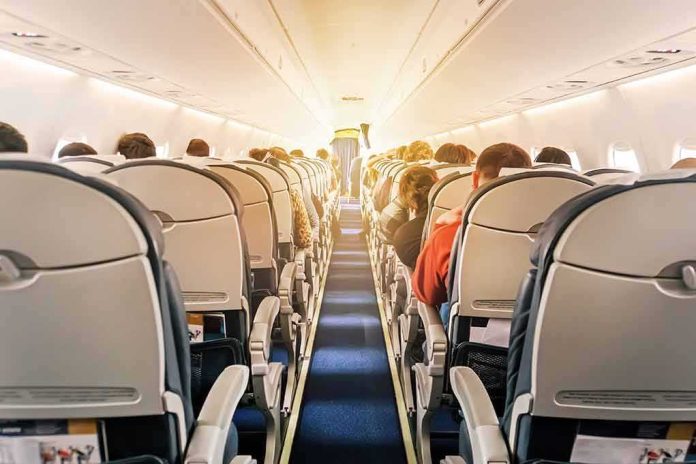
When a crew member sees the word “hijack” on a passenger’s phone at 30,000 feet, the question isn’t intent; it’s containment. That is why United Flight 1681 turned back to Las Vegas within minutes and why police met the aircraft at the gate—because commercial aviation treats explicit threats as operational problems to solve in real time, not philosophical puzzles to decode later.
At a Glance
- A flight attendant reported seeing a passenger’s text referencing hijacking and crashing; the cockpit locked down and returned to Las Vegas.
- Air traffic control audio captured the pilot relaying the crew’s observation to controllers in plain terms.
- Police arrested a 25-year-old passenger on a terrorism-related threat charge; the aircraft landed safely and later continued its mission.
- The episode illustrates modern aviation’s security logic: act decisively on explicit threat language, then sort criminal culpability through investigation.
What Happened Onboard United 1681
Shortly after United 1681 departed Las Vegas for Newark, a flight attendant reported seeing a passenger composing messages that explicitly referenced hijacking the aircraft. The captain notified air traffic control that a crew member “saw him texting that he was going to hijack the aircraft,” a direct statement captured on ATC audio. The cockpit executed standard security measures—lockdown procedures and a prompt return to the departure airport. The landing was uneventful; passengers and crew remained safe, and there was no reported attempt to breach the cockpit or interfere with flight controls. Airport police and federal agents met the aircraft upon arrival and took the passenger into custody for questioning and booking on a terrorism-related threat offense.
Reports citing a criminal complaint described the alleged messages as including “gonna hijack this” and “crash ur row only,” language that leaves little margin for ambiguity in an aviation setting. Law enforcement identified the passenger as 25-year-old Dante (also reported as Donte) Milne, who was arrested on suspicion of making a threat or conveying false information regarding an act of terrorism. The charge category—threats tied to terrorism—reflects how seriously the system treats explicit hijack language, even absent a weapon or overt attempt to seize control of the aircraft.
Why the Crew’s Response Was Immediate and Correct
Commercial aviation security is built to manage low-probability, high-consequence risk. The industry’s protocols assume that decisive action at the first credible indicator can prevent catastrophe, and that operational prudence on the flight deck does not require proof of capability or intent in the cabin. The trigger here was not a vague remark; it was a reported text that used the word “hijack,” in a context additionally associated with “crash.” Under those conditions, the correct playbook is to secure the cockpit, advise ATC, return to the nearest suitable airport, and hand the matter to law enforcement. The captain’s transmission, recorded by ATC feeds and reported by local outlets, shows the measures unfolding exactly as training prescribes.
United’s public statement labeled the event a “potential security concern,” a deliberately spare formulation consistent with airline practice during live or recently concluded security responses. The airline’s job in the moment is operational safety; communications widen only after authorities complete initial interviews and searches. That conservatism may frustrate curiosity, but it protects investigative integrity and avoids contaminating witness accounts. In parallel, flight operations ensured continuity: after the aircraft was cleared, the itinerary continued, underscoring that the safety system functioned as designed—contain the threat, stabilize the situation, and restore normal operations.
From Cabin Report to Criminal Charge
The legal path that begins with a cockpit report and an ATC notification is straightforward. Airport police board the aircraft, isolate the subject, and secure the device or other potential evidence. The reported charge here—making a threat or conveying false information about an act of terrorism—sits within a family of statutes that criminalize threats to aviation even when no physical attempt occurs. Prosecutors do not need to show an actual hijacking was underway; the issue is the threat itself and its disruptive, dangerous implications for an aircraft in flight. Local reporting indicated a booking at the Clark County Detention Center and referenced bond and a court date, standard steps in the early phase of such cases.
One point to separate cleanly: the return-to-airport decision is about immediate risk management; the criminal case is about evidence and elements of the charged offense. Flight crews make prudent decisions rapidly, based on what they can observe and report. Prosecutors decide later whether the messages, their authorship, their context, and any corroborating material meet the legal threshold for conviction. Those are distinct questions, and the system is designed to answer them in order—first safety, then law.
How Aviation Got Here: The Security Logic Behind Zero Ambiguity
There is hard history behind contemporary caution. In the 1960s and early 1970s, the United States saw an extraordinary run of aircraft hijackings—more than a hundred over a little more than a decade—during a period of comparatively light preboarding security and open cockpits. That era ended only after procedural and physical hardening: comprehensive screening, reinforced cockpit doors, behavioral training for crews, and continuous coordination with law enforcement. The lesson security professionals took away was not academic. Plain-language threats about hijacking are treated as warnings that demand immediate control measures, precisely because the historical cost of ambiguity proved too high.
The result is a modern posture that treats certain phrases as operational tripwires. “Hijack” and “crash,” used together in a cabin context, are among them. Airlines and regulators also track unruly passenger trends and enforce strict interference rules; diversion, return-to-gate, and law enforcement meet-and-greets are the tools that keep small risks from compounding. The safe, orderly return of United 1681, followed by a law enforcement handoff and a resumed schedule, is a case study in that doctrine at work.
“Passenger disturbance.” That’s how Vegas local news described a potential hijacking in Las Vegas.
Here’s what happened. 👇
A flight attendant reportedly saw a passenger texting that he was going to HIJACK the plane—while they were already airborne. 😳
United 1681 was headed…
— Jedi Rich (@jedirich_) October 27, 2026
What Matters Next
For passengers, the takeaway is simple: words have operational consequences on an airplane. Jokes, hypotheticals, or theatrics that invoke hijacking or crashing are processed not as speech acts to be debated, but as potential triggers to be contained. For crews, this episode validates recurrent training and interlocks between cabin, cockpit, and controllers—communication that is crisp enough to collapse delay and decisively return the aircraft. For law enforcement and prosecutors, the next steps are routine: secure digital evidence, establish authorship and context, and test the facts against the elements of the charged offense.
Sources:
cbsnews.com, 8newsnow.com, balleralert.com, ground.news