

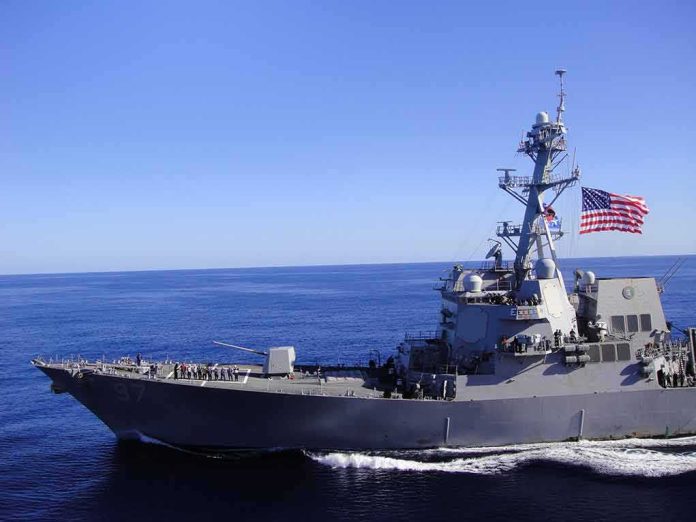
U.S. strikes on Iran stretched into a 13th straight night, with Central Command saying the campaign was meant to protect shipping in the Strait of Hormuz.
Quick Take
- U.S. Central Command said the strikes answered Iranian attacks on commercial shipping and U.S. forces.
- The military said it hit command centers, drone sites, missile assets, and coastal surveillance facilities.
- Reporting shows a repeated pattern of strikes over many nights, not a single raid.
- The public record still leaves key legal and factual questions about the opening trigger and broader decision-making.
Strikes Focused on Military Targets
U.S. Central Command said its forces completed the 13th straight night of strikes on July 23. The command said the attacks hit Iranian military command centers, drone storage sites, communication networks, coastal surveillance posts, and maritime capabilities. It said the goal was to reduce the threat Iran posed to civilian mariners and commercial vessels crossing the Strait of Hormuz. The waterway remained open for transit, according to the same statement.
Reuters reported that the U.S. military framed the first strikes as a response to Iranian attacks on commercial ships in the strait. Reuters also said the stated aim was to keep the waterway open to shipping. That framing placed the operation inside a long pattern in which Washington describes Iran-related strikes as self-defense, while critics often question whether the facts meet that legal test. The sources provided do not include the full legal memo or war powers notice.
A Campaign Built Night by Night
Reporting from Reuters, the Associated Press, National Public Radio, and Cable News Network shows the same campaign unfolding over many consecutive nights. By mid-July, outlets were already describing a second night, a seventh night, an eleventh night, and then a 13th night of attacks. That pattern matters because it suggests an ongoing military effort, not a one-time punishment strike. It also shows how quickly a fast-moving war can become normalized through repeated official updates.
Centcom said the later strikes stayed focused on military infrastructure tied to maritime threats. Its releases named military command centers, missile and drone launch sites, air defense systems, logistics sites, and maritime capabilities. Reuters reported on July 23 that the command said the strikes were meant to “further diminish” the threat to civilian mariners and commercial vessels. That language puts shipping security at the center of the operation, not broad punishment of the Iranian economy or civilian life.
What the Public Record Still Does Not Show
The supplied record is strong on what the military says it hit, but weaker on the first triggering event. The sources refer to attacks on commercial vessels and U.S. forces, yet they do not give a full incident file for the opening strike package. They also do not show a public legal memo, a detailed necessity review, or a proportionality analysis. That leaves room for later fights over whether the strikes were lawful, even if the facts on the ground are clear.
Iran launched five ballistic missiles towards Jordan's Muwaffaq Salti Air Base following US strikes, but Jordan says every missile was intercepted.
The latest exchange raises fears of a wider regional conflict as military tensions continue to escalate. pic.twitter.com/lijZhQBJKm
— Ticker (@tickercotweets) July 30, 2026
This is why the story is bigger than one battlefield. The immediate issue is U.S. force against Iran, but the deeper issue is trust. Many readers on both the left and the right already doubt that federal leaders give full answers before using power. In this case, the government’s own releases dominate the record, while outside reporting mainly repeats those claims. That can fuel a familiar sense that major war decisions move faster than public accountability.
Sources:
townhall.com, centcom.mil, npr.org, aljazeera.com, cnn.com, reuters.com, youtube.com, theguardian.com