

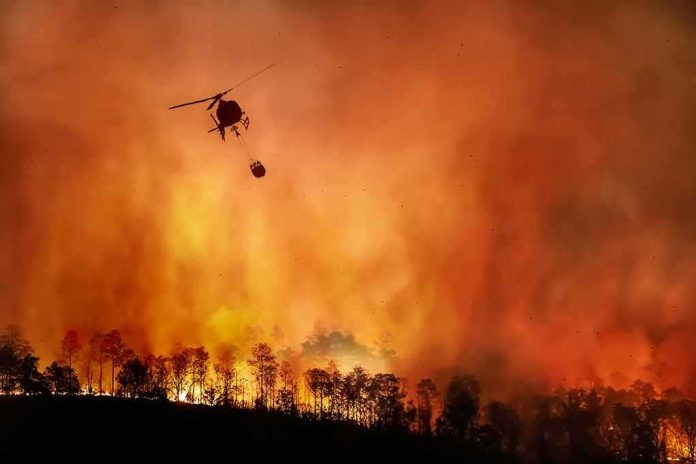
As Utah’s Cottonwood Fire explodes into the nation’s largest blaze and officials blame “human causes” without naming who or what, many Americans see yet another disaster where the truth feels filtered and the system looks broken.
Story Snapshot
- The Cottonwood Fire in southern Utah has burned over 92,000 acres with 0% containment and destroyed major properties, including a ski resort.
- Officials say the fire is “human-caused,” but they have not released the exact ignition source, feeding public doubt and speculation.
- Governor Spencer Cox calls it the most destructive wildfire in Utah history for property loss and has declared a state of emergency.
- Confusing, shifting acreage numbers and mix-ups with another “Cottonwood Fire” in Nebraska highlight how public information often breaks down in a crisis.
An Uncontained Fire That Became the Largest in the Nation
The Cottonwood Fire is burning in Fishlake National Forest near Beaver in southern Utah and has now scorched more than 92,000 acres, making it the largest active wildfire in the United States and Utah’s most destructive fire for property loss.[1][12] Officials say the blaze started on June 22 and remains at 0% containment as strong winds keep pushing flames toward nearby communities, with gusts reported around 35 miles per hour on key days of fire growth.[1][8]
Fire crews report that the blaze has already burned through Eagle Point Resort, a southern Utah ski destination, along with multiple homes and other structures, yet they still do not have a full count of how many buildings are gone or how much damage has been done in dollars.[1][12] Governor Spencer Cox has said the Cottonwood Fire is Utah’s most destructive wildfire in state history when it comes to property loss, and state officials warn the final bill could set cost records once full assessments are done.[12]
“Human-Caused” — But What Does That Really Mean?
Utah fire officials have labeled the Cottonwood Fire as “human-caused,” which means it was not started by lightning or some other natural trigger, but they also admit the exact cause is still under investigation and has not been released to the public.[11] That gap leaves a wide space between the headline and the hard proof, and it is in that space that anger, rumor, and mistrust are growing among people who already think government hides more than it shares.
Some online comments and local chatter have mentioned target shooting as a possible cause, but that idea has not been confirmed by any official source and stands as speculation, not evidence.[7] At the same time, Utah leaders often stress how many fires are blamed on people: past state numbers show that in one recent year 270 out of 367 fires were officially tagged as human-caused, and more than 75 percent of Utah wildfires are usually counted that way.[14][18] For many citizens, that pattern feels less like careful science and more like a default script that shifts fault to the public while leaving powerful actors and questionable land policies out of the spotlight.
Historic Destruction, Dangerous Winds, and a Strained Firefighting System
Fire behavior on the Cottonwood blaze has been described by Governor Cox and incident teams as unlike other fires, with intense winds and dry fuels making it extremely hard to protect buildings and infrastructure even when crews are on the ground in force.[8][13] Strong winds in the canyons have caused the fire to run fast uphill, leap over fire lines, and throw embers far ahead, which means people can lose homes even when firefighters have done almost everything by the book to prepare and defend.
I’m back home after a weekend in California. The news of the fires spreading in Utah stayed with me and I even caught a glimpse of the Cottonwood Fire as I flew south Thursday. pic.twitter.com/pJEwlqDq3d
— Kristen McPeek KUTV (@KristenMcPeekTV) June 29, 2026
Despite all this destruction, there have been no reported deaths directly tied to the Cottonwood Fire itself, and state officials credit fast evacuations and constant alerts for getting people out in time.[9][13] Still, families in several small communities have faced rolling evacuation orders, some leaving their homes more than once, which adds fear, stress, and real financial strain even for those whose houses are still standing when they finally return.[8]
Mixed Messages, Media Confusion, and the Trust Gap
One of the most frustrating parts of this disaster for many people is the messy and sometimes conflicting information about what is happening on the ground, including basic facts like how big the fire is and even where it is.[1][3] Some outlets first reported sizes around 27,000 acres, others said 70,000, then 92,000, and some now round up toward 100,000 acres, with little clear explanation for the jumps beyond “updated mapping.”[1][10][13]
The confusion is made worse by the fact that there is also another major blaze called the Cottonwood Fire burning in Nebraska, which has its own acreage, containment level, and news coverage, and some reports have mixed details between the two fires.[2][4] For regular people trying to make sense of it all from a phone screen, this kind of information fog reinforces a feeling many already have: that during big crises, the media rushes headlines, officials protect themselves with vague language, and the public is left to sort truth from spin with little real help.
Why This Fire Hits a Nerve on Both Left and Right
The Cottonwood Fire comes at a time when many Americans across the political spectrum are losing patience with how disasters are handled, not just how they start. Conservatives see another example of failure to manage forests, federal workforce cuts, and what they view as misplaced focus on climate talk over on-the-ground prevention and local control, especially when they hear that federal wildland agencies have shed thousands of workers in recent years.[10][15]
Liberals, meanwhile, see a human-caused mega-fire as more proof that the country is not taking long-term climate risk and land-use change seriously, even as science agencies warn that “fire weather” in the American West is becoming more common because of human-driven climate change.[19] Both sides look at the same smoke-choked sky and come to a similar core judgment: leaders in Washington and in state capitals knew the risks, had the data, and still left communities exposed while money flowed to other priorities, from foreign wars to pet projects that benefit well-connected interests.
Shared Concerns: Accountability, Prevention, and Who Pays the Price
Behind the political noise, the Cottonwood Fire raises simple but hard questions that many Americans, left and right, keep asking. Who, if anyone, will be held personally accountable if investigators eventually trace the spark to careless behavior, faulty equipment, or bad decisions by a company or agency?[11][22] Will the final “human-caused” label point to a real person and a real act, or will it stay vague, spreading blame across everyone and no one at the same time?
People in Utah and across the country also want to know what will change before the next fire season, not just what will be rebuilt afterward. Research on Utah fires shows that large, destructive burns are becoming more likely as hot, dry, and windy conditions line up more often, yet fire suppression, land management, and public communication systems remain stuck in old patterns.[21] For families watching their homes, power, and savings sit in the path of the next blaze, the deeper fear is that when the smoke clears, officials will hold press conferences, issue reports, and then return to business as usual until the next “unprecedented” disaster strikes.
Sources:
[1] Web – The largest active wildfire in the U.S. has now exploded to more than …
[2] Web – Human-Caused Fire | Investigation Ongoing Utah The Cottonwood …
[3] Web – Cottonwood and Morrill Fires Update – March 22, 2026
[4] Web – CottonwoodFire MIDDAY UPDATE, June 24,2026 The fire is …
[7] Web – The Cottonwood Fire burned through structures as it exploded in …
[8] Web – The Cottonwood Fire burned through structures as it exploded in …
[9] Web – Human-Caused Fire | Investigation Ongoing Utah The Cottonwood …
[10] YouTube – Cottonwood Fire expands to over 27,000 acres, determined as …
[11] Web – Cottonwood Fire might set cost records after destroying southern …
[12] Web – Uncontained Cottonwood Fire burns 92,000 acres in Southern Utah
[13] Web – ‘It’s End-of-Days-Type Stuff’: Wildfires Rage in Utah’s Mountains
[14] Web – Cottonwood Fire Map – Watch Duty
[15] Web – July-August human-caused wildfire comparisons: 159 in 2021 471 …
[18] Web – [PDF] All About Wildfires – Natural History Museum of Utah
[19] Web – More than 75% of Utah’s wildfires are human-caused, which means …
[21] Web – Wildfires | Our World in Data
[22] Web – [PDF] Large projected increases in area burned and wildfire frequency …