

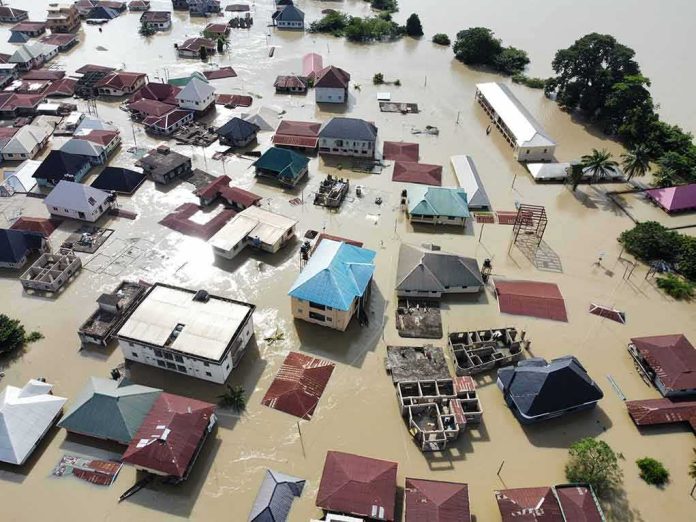
Historic floodwaters have killed at least five people across Indiana and forced hundreds of residents from their homes as rescue crews raced through neighborhoods in boats.
Story Snapshot
- State officials confirmed at least five storm-related deaths from flooding and high winds this week.
- Gov. Mike Braun declared a statewide disaster emergency and activated the Indiana National Guard.
- President Trump approved a federal emergency declaration, unlocking disaster aid for the state.
- Indianapolis crews carried out more than 50 water rescues in a single day near flooded neighborhoods.
- The White River in Noblesville hit 23.9 feet, breaking a flood record set in 1913.
Deaths Confirmed Across Multiple Counties
Jonathan Whitham, executive director of the Indiana Department of Homeland Security, said at an August 15 news conference that “at least five people have died in the storms that swept through Indiana this week.” He said the deaths came from both flooding in central Indiana and high winds in the northwest part of the state. Reports counted one death each in Jennings, Lake, Porter, and LaPorte counties, plus two in Delaware County.
Governor Declares Emergency, Requests Federal Help
Governor Braun moved fast as the storm system tore through the state. “I have mobilized state and local resources, declared a Statewide Disaster Emergency and deployed the Indiana National Guard,” he said. “Now, I am requesting immediate federal assistance”. President Trump approved the request the same day. The Federal Emergency Management Agency then confirmed that “federal disaster assistance is available to the state of Indiana”.
The declaration lets state and local agencies tap federal money and resources to support rescue and recovery work. Under federal law, a president can approve an emergency declaration whenever he decides federal help is needed to protect lives and property, even before damage totals are fully counted.
Rescue Crews Pull Dozens From Rising Water
In Indianapolis, fire crews carried out 51 water rescues, pulling 95 people and 45 pets to safety. Boat teams kept searching flooded streets near 78th Street and Keystone Avenue as water levels climbed. Mayor Joe Hogsett urged residents in danger zones to act quickly. “If you are in an area that is vulnerable, please leave now,” he said. “That helps us help you”.
Record River Levels Swamp Noblesville
Some areas got 10 to 12 inches of rain in just days. In Noblesville, the White River rose to 23.9 feet, topping a record set back in 1913. Noblesville Mayor Chris Jensen warned drivers to stay away from closed roads. “If roads are closed, we are serious,” he said. “That road is closed. Stay off that road, stay out of the water”. Officials there confirmed 170 people and six animals left voluntarily as the river kept rising.
Shelters Open as Utilities Shut Down
Emergency shelters opened at the Washington Township Adult Center, Broad Ripple Park Family Center, and the Hamilton County Fairgrounds. Citizens Energy Group shut down the White River North Water Treatment Plant to protect it from floodwater damage. Around 500 Duke Energy customers lost power, and assisted-living residents were moved out of harm’s way as travel advisories spread across several counties.
[Take 13/15 · 𝕏-3]
### 𝕏-3. Midwest flash floods worsen; Indiana requests federal aid as storms continue
*(as of 2026-08-16)***1. The Frame**
**What people think this is about:** A worsening natural disaster crisis in the Midwest, with deadly flash floods in Indiana…
— GrumpyNews, emotionally clean news. (@GrumpyNews_) August 16, 2026
One of the deaths carried a painful search-and-recovery story. Crews recovered the body of 18-year-old Matthew Morey from the Mississinewa River after using boats, drones, K-9 teams, and aircraft. Officials said he was one of four teens seen entering the river before the search began. Officials said they were still checking whether a few other deaths were directly tied to the storm system, a normal part of early disaster response.
Why Early Numbers Often Shift
Casualty and rescue counts commonly change during the first days of a major flood, and Indiana’s numbers moved as officials gathered more reports. That does not mean the underlying disaster is in question, only that agencies are still confirming details county by county. Research on past U.S. floods shows most flood deaths involve vehicles caught in rising water, not building collapses, which matches early accounts from Indiana.
Sources:
aljazeera.com, indystar.com, reuters.com, cfjctoday.com, ipm.org, abcnews.com, x.com