

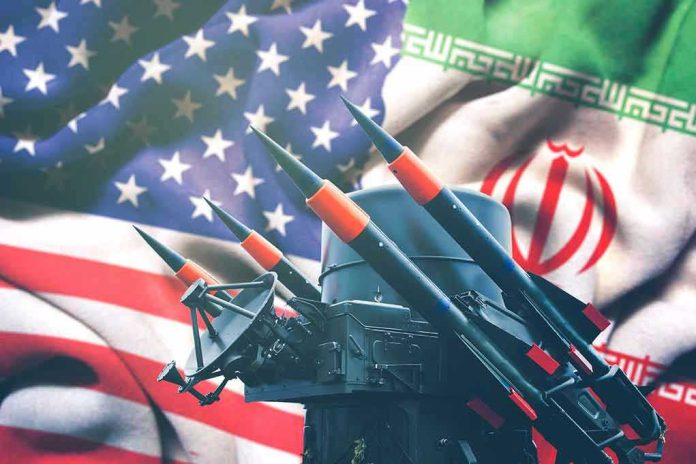
President Trump revealed that U.S. forces deliberately avoided striking Iran’s military leadership and infrastructure — a calculated restraint strategy aimed at preventing the chaos that followed the Iraq War, even as American strikes targeted other Iranian assets.
Story Snapshot
- Trump publicly stated the U.S. would avoid striking Iranian military leaders to prevent a repeat of the post-Iraq War power vacuum.
- U.S. and Iran largely refrained from striking each other following a temporary ceasefire that began in early April 2026.
- Trump acknowledged being just one hour away from ordering a major Iran strike before pulling back, citing nuclear war prevention as the reason.
- The administration was actively preparing additional military strikes against Iran even as ceasefire and deal negotiations continued.
Trump’s Deliberate Restraint on Iran’s Military
President Trump confirmed that U.S. forces deliberately avoided targeting Iranian military leaders during the conflict, citing lessons learned from the Iraq War. After the United States toppled Saddam Hussein’s government, the resulting power vacuum fueled years of insurgency, sectarian violence, and regional instability. Trump’s stated goal was to strike Iran’s nuclear and strategic assets without dismantling the military structure entirely — a strategy designed to avoid repeating that costly mistake.
Trump described the U.S. strikes on Iran as having prevented a “nuclear war that would have evolved into World War III,” framing the military action as both necessary and measured. At the same time, both sides had largely refrained from striking each other following a temporary ceasefire that began in early April, according to reporting from CBS News. That partial restraint on both sides created a fragile but real pause in hostilities while diplomatic channels remained open. [1]
An Hour Away — Then the Phone Rang
Trump revealed that he came within one hour of ordering a major strike against Iran before calling off the operation. The decision illustrated the high-stakes nature of the administration’s approach: maintaining credible military pressure while preserving space for a negotiated resolution. Trump left a Situation Room meeting without issuing a final strike decision, as his team continued to weigh military options alongside a potential deal framework. [2] [3]
The administration’s posture reflected a dual-track strategy — keeping Iran off balance with demonstrated willingness to strike while simultaneously signaling openness to diplomacy. Trump said plainly, “Iran is dying to make a deal,” suggesting confidence that sustained pressure was working. [1] Whether that pressure would translate into a durable agreement or escalate into broader conflict remained the central question hanging over the region.
Strike Planning Continued Even During Talks
Even as ceasefire language dominated headlines, CBS News reported that the U.S. was actively preparing for a fresh round of military strikes against Iran, with no final decision reached as of late May. [1] That planning confirmed the administration was not operating from a position of categorical restraint. American forces had already shot down Iranian one-way attack drones during the conflict, and Iran continued to pose an active drone threat throughout the engagement. [5]
🛑 TRUMP: the United States would avoid striking all Iranian military leaders to prevent a repeat of the Iraq war.
— jck✨ (@Alea_) May 29, 2026
Analysts have noted that U.S. Iran policy in this period fits a familiar pattern: ceasefire language, implied strike readiness, and off-ramp diplomacy operating simultaneously. Some observers pointed to weapons stockpile concerns as an additional factor shaping the pace of U.S. military action, noting that replenishing precision munitions takes time. [6] The Emirates Policy Center similarly described U.S. Iran policy as recurring “deterrence without occupation,” a posture that preserves leverage without committing to full regime removal. [12]
Strategy Built on Avoiding Iraq’s Mistakes
Trump’s explicit warning against striking Iranian military leaders reflected a broader strategic calculation: removing Iran’s command structure entirely could produce the same ungovernable aftermath that plagued Iraq after 2003. That concern was bipartisan in origin but has taken on new urgency given the scale of Iranian proxy networks across the Middle East. A decapitated Iranian military could fragment into competing armed factions far harder to deter than a centralized force. [7]
The administration’s approach — targeted strikes on nuclear and strategic assets, deliberate restraint on military leadership, and active diplomatic pressure — represented a coherent if risky framework. It demanded precision both militarily and politically. Trump’s willingness to walk to the edge of a major strike and pull back, combined with his public confidence that Iran wanted a deal, suggested the White House believed maximum pressure was achieving results without requiring full-scale war. Whether Tehran ultimately agreed would define the legacy of this chapter in U.S. foreign policy.
Sources:
[1] Web – “We’ve actually left their military alone — people would be surprised …
[2] Web – U.S. prepares for new military strikes against Iran – CBS News
[3] YouTube – Trump says he was ‘an Hour Away’ from Planned Iran Strike Before …
[5] Web – Trump says US strikes on Iran prevented ‘nuclear war that would …
[6] YouTube – Trump Launches Second Strike on Iran | US IRAN WAR
[7] Web – The Troubling Reason Trump Is Avoiding Another Strike On Iran
[12] Web – Four Reasons why the United States Should Not Attack Iran: Part II