

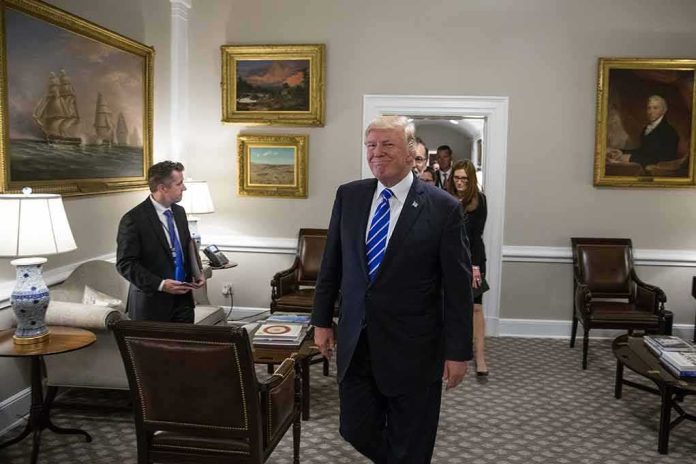
President Trump’s latest burst of executive orders shows just how much power Washington now wields with the stroke of a pen.
Story Snapshot
- President Trump has signed a large number of executive orders in his second term, reshaping major parts of American policy.
- Recent Oval Office signing events highlight how decisions on tariffs, immigration, energy, and regulation are made quickly, with little input from Congress or the public.
- Legal and policy trackers show a flood of orders across 2025–2026, raising shared worries about power concentrated in the presidency.
- Both conservatives and liberals now question whether any part of the federal government is truly working for ordinary Americans.
Trump’s Executive Orders: A Governing By Pen
Since returning to the White House in 2025, President Trump has relied heavily on executive orders to move his agenda. An executive order is a formal directive from the president to federal agencies; it does not go through Congress like a law, but it can still reshape policy in big ways. The official White House archive lists dozens of second-term orders, covering issues from trade and immigration to national security and domestic programs. For citizens watching on television, each Oval Office signing marks another change made from the top down.
Independent trackers run by law firms and policy groups confirm the pace and reach of these actions. They show orders on topics such as strengthening customs enforcement, altering retirement savings rules through TrumpIRA.gov, and shifting rules for foreign tech platforms like TikTok. These summaries focus on legal details, but they also reveal a pattern: when normal lawmaking stalls, the White House turns to executive orders instead. That lets presidents act fast, but it also sidesteps the slower, more open debate many people expect in a republic.
What These Orders Are Changing In Everyday Life
The impact of Trump’s executive orders is not just inside the Beltway; it reaches into everyday life for workers, families, and small businesses. Orders imposing tariffs on countries like China, Mexico, and Canada can raise prices at the store and shift jobs in factories and farms. Moves to roll back diversity, equity, and inclusion programs or restrict what the government calls “gender ideology” change rules in schools, the military, and federal workplaces. At the same time, orders that boost retirement savings access or tighten customs enforcement change how people save money and how goods enter the country.
For conservatives frustrated with globalism, illegal immigration, and rising costs, some of these actions look like overdue corrections to past policies they see as harmful. Orders that clamp down on what they view as “woke” rules or that make it harder for questionable imports to reach American shelves can feel like wins for national sovereignty and common sense. But even on the right, many worry that major changes now depend on one leader’s signature rather than on clear, stable laws. When the next president can undo these same orders just as quickly, long-term planning for families and businesses becomes almost impossible.
Shared Concerns About Power And The ‘Deep State’
Many liberals, meanwhile, see Trump’s executive orders as proof of “America First” power used without enough checks, often hurting minorities and the poor. They point to orders that target immigration or pull back climate and equity efforts as deepening the divide between the haves and have-nots. Yet liberals also watched past Democratic presidents use executive orders to get around Republican gridlock. That history makes it harder to argue that only one side is guilty; both parties have leaned on rule by pen when Congress fails to act.
Trump signs executive orders yet most have not been passed. Chances are, by the time he’s finished, they will be gone. It’s all more fake bs. His whole presidency is a lie.
— Sue Milani (@SueMilani) August 4, 2026
This is where a rare point of agreement appears. Across the spectrum, more Americans now feel the federal government is failing them. Executive orders, whether they advance conservative or liberal goals, highlight how much power sits in the hands of presidents, their lawyers, and agency staff. Ordinary citizens see major decisions made in staged Oval Office ceremonies, backed by thick legal memos, but with little chance for public input. For many, that looks less like self-government and more like a permanent class of insiders running the show.
Why The Volume Of Orders Feeds Distrust
The sheer number of Trump’s second-term executive orders has become a story in itself. Media outlets and trackers count each new order, compare totals to past presidents, and frame the surge either as bold action or reckless overreach. For citizens already suspicious of a “deep state,” this constant flow of unilateral directives reinforces the idea that government rules change faster than they can be understood. When people cannot follow what is being signed, or how it affects them, trust in any branch of government drops even further.
Data sets from places like the American Presidency Project and the Federal Register show that heavy use of executive orders is now a normal part of modern presidencies. Trump’s first term saw 220 orders; his second is on track to surpass that total. The problem, for many on both left and right, is not only what any single order does. It is the feeling that the system itself runs on autopilot, with insiders trading complex orders back and forth while ordinary families struggle with high living costs, unstable jobs, and fading trust. Each new signing event becomes another symbol of a government that speaks often, acts quickly, but rarely listens.
Sources:
whitehouse.gov, executiveorderdigest.com, akingump.com, cnn.com, nafsa.org, en.wikipedia.org, omar.house.gov, trumpwhitehouse.archives.gov, vice.com