

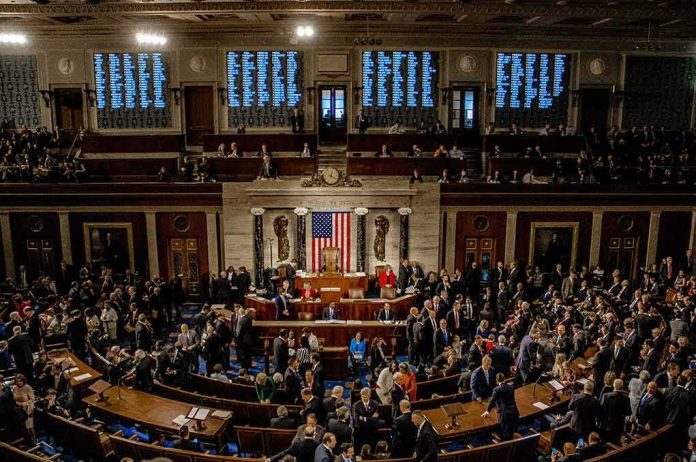
When party leaders disavow a marquee policy, they are not just answering a policy question; they are redrawing the coalition’s boundaries. Representative Hakeem Jeffries’ on-air rejection of Medicare for All and the Democratic Socialists of America’s agenda was exactly that kind of boundary-setting—an explicit signal about where House Democratic leadership intends to plant its flag on health care and intraparty identity.
At a Glance
- Jeffries said on Meet the Press that Medicare for All is not legislation he currently supports and that he does not back the DSA agenda as articulated by the organization itself.
- The remarks mark a break from Jeffries’ prior period of alignment with single-payer proponents and a return to a leadership message centered on affordability and protecting existing programs.
- Progressives, led publicly by Rep. Ro Khanna, continue to argue Medicare for All should be a central Democratic priority on cost, coverage, and wage grounds.
- The dispute reflects a durable fault line in Democratic health policy: universal public insurance versus incremental, ACA- and Medicaid-based affordability strategies.
What Jeffries actually said—and why it matters
In a televised interview, Jeffries was asked directly about Medicare for All and his posture toward the Democratic Socialists of America. His answer left little room for strategic ambiguity: he has not co-sponsored recent Medicare for All bills and does not support that legislation at present; he also rejects the DSA agenda as the DSA articulates it. Multiple outlets captured the same core quotes in real time, reinforcing that this was not a stray paraphrase but a deliberate, public distancing from the single-payer frame and the DSA brand.
The significance lies less in the performative left–right tug-of-war and more in leadership signaling. Jeffries’ official materials and floor rhetoric emphasize “affordability,” “expanding access,” and defending Medicaid, Medicare, and the ACA—priorities that presuppose the current mixed system and aim to mitigate its costs, not replace it with a single public payer. Taken together, the interview and the leadership messaging indicate a stable lane: defend existing pillars, press incremental cost relief, and avoid making single-payer a litmus test.
The policy mechanics behind the divide
Medicare for All, in its flagship House and Senate versions, is single-payer national health insurance: one public program that covers everyone with minimal or no cost-sharing, financed by taxes, replacing most private insurance. Its proponents argue the model eliminates administrative waste, strengthens bargaining power over prices, and guarantees universal access. The alternative family of approaches—ACA subsidy expansions, enhanced Medicaid, Medicare add-ons, and public-option designs—retains a plural payer landscape while trying to broaden coverage and suppress premiums and out-of-pocket costs through targeted levers.
Jeffries’ recent remarks square with that latter architecture. His conference has fought to extend ACA premium tax credits and to block Medicaid cuts, framing these fights as immediate defenses against premium spikes and coverage losses—classic incrementalism that accepts the mixed market–public hybrid and leans on affordability interventions rather than structural replacement.
A reversal with a paper trail
The interview is notable because it is not Jeffries’ first time in this policy arena. Earlier in his career, he aligned at points with single-payer advocates; in 2019, reporting described him announcing support for Medicare for All while serving in leadership, and local coverage in 2020 detailed activist pressure campaigns around his posture and co-sponsorship choices. That history gives the current statement more weight: it is not an agnostic “not yet,” it is an explicit “not now, not that bill,” from a leader who has lived on both sides of the fence. For observers of congressional dynamics, that reads as a considered repositioning rather than a stray line.
Critics will seize on inconsistency. But congressional leaders often recalibrate as they move from representing a district to shepherding a national caucus. In that role, Jeffries’ incentives are to protect vulnerable members, maintain message discipline, and keep fights trained on the opposition, not on intraparty litmus tests. His health-care page’s emphasis on strengthening existing programs and making care “affordable for every single American” fits that posture and avoids a single-payer referendum.
The progressive countercase: cost, wages, and clarity
Progressives have not retreated. Representative Ro Khanna defended Medicare for All in the same broadcast ecosystem, calling it “arguably the most important priority,” with the straightforward claim that a single public plan would save money and lives while relieving wage suppression linked to employer-sponsored insurance costs. The political case is equally blunt: a clean, universal guarantee is easier to message than an alphabet soup of subsidies, waivers, and marketplaces. Advocates point to sustained enthusiasm among Democratic primary voters and the energy Medicare for All brings to organizing, especially as costs continue to outpace wages.
That progressive posture has real organizing muscle. In New York, DSA-linked activists documented pressure campaigns—calls, petitions, coalition work—intended to move Jeffries during earlier cycles, one reason the current break lands as symbolic as well as substantive. The left’s wager is that clarity beats caution: present the guarantee, define the funding, and dare the opposition to defend a costlier status quo.
Where the disagreement is substantive, not just strategic
Beneath the branding skirmishes sit real policy tradeoffs. Single-payer consolidates purchasing power and eliminates duplicative billing infrastructure; it also requires extinguishing or severely curtailing a vast private insurance market and retooling provider payment at national scale. That transition risk—financing, phase-in, network stability, labor displacement in private administration—is exactly what centrist Democrats highlight when they argue for a sturdier ACA-plus path. By contrast, subsidy extensions, Medicaid expansions, drug price negotiation, and capped out-of-pocket costs deliver quantifiable, near-term relief without near-term systemic disruption—but they leave administrative complexity and multi-payer pricing power intact.
Jeffries’ lane therefore looks like a bet on viability and coalition breadth: defend Medicaid, protect Medicare, keep ACA coverage from backsliding, and push on price—measures with legislative antecedents and clearer whip counts. The progressive lane is a bet on political realignment through policy ambition: convert diffuse cost anxiety into support for a universal public plan that simplifies the system and tames prices by fiat.
Leadership calculus and caucus management
Why make the break now, and this explicitly? Leadership statements serve three audiences. Donors and business-aligned stakeholders listen for whether private insurance remains in the picture. Activists listen for whether the universal guarantee is non-negotiable. Swing-district incumbents listen for what they will be asked to defend on local TV. Jeffries’ articulation—no to Medicare for All legislation, yes to affordability and program defense—answers all three: reassurance that the mixed model persists, room for cost-of-living fights, and insulation from a single-payer referendum that Republicans are eager to prosecute in competitive districts.
The risk is motivational: progressive organizers read the move as a retreat and will test its electoral costs in primaries and turnout operations. Data pointing to Democratic-base disapproval of opposing Medicare for All gives that threat some bite, at least inside the party’s nominating electorate. The countervailing risk of embracing single-payer—exposure in general elections where private coverage remains the default—has long anchored leadership caution. Jeffries has chosen his risk.
Hakeem Jeffries’ Betrayal Shows Why Democratic Voters Are So Enraged
House Dems’ leader declared his opposition to Medicare For All on the same day a new poll shows almost all Democratic voters support it. https://t.co/Jk5WYX6OHD
— Sam Adams ~ #NotMeUs (@CapaTosta122) August 17, 2026
What to watch next: substance beneath the stance
Two follow-throughs will determine whether this moment hardens into doctrine or remains a media flashpoint. First, policy detail: if leadership pairs its “not Medicare for All” stance with a concrete affordability package—permanent ACA tax credits, out-of-pocket caps, faster drug negotiations, Medicaid coverage protections—the contrast becomes a matter of mechanism rather than intent, and members gain something affirmative to sell. Jeffries’ Buffalo remarks and caucus focus on affordability imply that is the plan; codifying it would convert posture into program.
Second, procedural openness: allowing hearings, markups, or even messaging votes on Medicare for All lets progressives mobilize without turning the floor into a referendum. Khanna has argued for a vote even absent leadership support; that is a familiar accommodation in eras when party factions need release valves. If the leadership denies process entirely, expect the conflict to bleed into primaries and outside spending.
Bottom line
Jeffries drew a bright line: no to Medicare for All legislation now, no to the DSA agenda as DSA defines it. That line aligns with an affordability-first, protect-the-pillars strategy and reflects the institutional incentives of House leadership. The left’s countercase remains potent on costs, clarity, and moral claim. This is not a skirmish over slogans; it is a choice between restructuring the financing system root and branch or extracting affordability wins from within it. Voters, donors, and members will recognize the difference. So will the whip count.
Sources:
nypost.com, newsweek.com, youtube.com, jeffries.house.gov, politicsny.com, nbcnews.com, rev.com, thehill.com, tnholler.com