

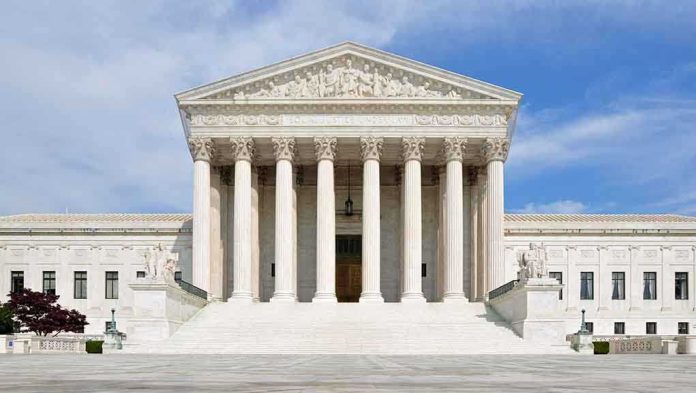
The Supreme Court just left in place blue‑state policies that let non‑citizen truckers onto America’s highways, even after a deadly crash tied to an immigrant driver licensed in California and Washington.
Story Snapshot
- The Supreme Court refused to hear Florida’s lawsuit against California and Washington over commercial driver licenses for non‑citizens.[1][3][6]
- Florida tied its case to a triple‑fatal crash in Florida involving an immigrant driver holding California and Washington licenses.[3][5][6]
- Florida argued those states’ policies violate federal safety and immigration rules and create a public nuisance.[1][2][6]
- Justices Clarence Thomas and Samuel Alito said the Court should have taken the case, warning states have no other forum to challenge each other.[1][3]
What Florida Tried To Stop — And Why It Matters For Your Roads
Florida went straight to the Supreme Court of the United States, arguing that California and Washington are issuing commercial driver licenses to immigrants who are not authorized to be in the country and who may not meet federal English-language requirements.[1][3][6] Florida asked for an injunction to stop those states from issuing commercial permits and licenses to non‑citizens or people lacking proof of lawful status, tying the issue directly to federal rules that govern commercial trucking nationwide.[1][2][6] Florida’s lawsuit framed these licensing practices as both a violation of federal law and a public nuisance threatening the safety of drivers across state lines.[1][2] According to coverage, Florida contended that federal law requires commercial drivers to be proficient in English and lawfully present, and that states cannot hide behind “sanctuary”-style rules that prevent their own agencies from checking immigration status when issuing licenses.[1][2][6]
Reports explain that Florida’s move followed a horrific crash on the Florida Turnpike involving a truck driver described as a 28‑year‑old immigrant from India who allegedly was in the country illegally and held commercial driver licenses from both California and Washington.[3][5][6] That driver is accused of making an unsafe U‑turn that led to a triple‑fatal collision, which Florida officials cited as evidence that lax licensing policies in other states can have deadly consequences far beyond their borders.[3][5] Coverage notes that Florida highlighted claims that the driver lacked proper English proficiency, which federal rules require for commercial license holders, though underlying test data and records are not included in the reporting.[3][5] The key point for many Floridians is that their families were put at risk on a Florida highway by a driver vetted and licensed under other states’ more permissive rules, raising deep questions about how one state’s political choices can endanger citizens thousands of miles away.[3][5][6]
How The Supreme Court Closed The Door — For Now
The Supreme Court declined Florida’s request to file its lawsuit directly against California and Washington, using what is called the Court’s “original jurisdiction” for disputes between states.[1][2][3] By denying permission to file and offering no explanation, the majority left California’s and Washington’s policies in place, without addressing whether their licensing systems actually comply with federal law.[1][2][3][6] The decision does not vindicate those states on the merits, but it does mean Florida cannot use the nation’s highest court right now to force changes to their commercial licensing rules.[1][2] Justice Clarence Thomas, joined by Justice Samuel Alito, issued a sharp dissent, arguing that the Constitution gives the Supreme Court exclusive authority over state‑against‑state disputes and that the Court “cannot legally refuse” to hear them.[1][3] Florida’s attorney general’s office told one outlet that the Court’s refusal leaves Floridians with “no avenue” to hold California accountable for putting “dangerous, illegal alien truck drivers” on American roads, despite Congress’s directives about interstate controversies.[1]
California and Washington, for their part, publicly expressed satisfaction that the Supreme Court rejected Florida’s bid and indicated that they view their commercial licensing programs as consistent with federal regulations.[1][6] Coverage notes that commercial driver licenses are part of a federally regulated system overseen by the Federal Motor Carrier Safety Administration, which sets baseline safety and qualification standards for drivers nationwide.[1][2] Florida argued that California’s and Washington’s sanctuary‑style laws, which reportedly limit their agencies from inquiring into immigration status, conflict with those federal mandates and therefore should be struck down as preempted.[1][2] The Court’s silence does not resolve that legal clash; it simply keeps the status quo, in which individual states can experiment with more permissive rules, while other states have to live with the safety and immigration consequences when those license holders cross their borders.[1][2][6] For many conservative readers, the outcome underscores how procedural decisions in Washington can shield blue‑state policies from timely scrutiny, even when human lives and basic border security are at stake.[1][3]
What This Means For Border Security, Federalism, And Everyday Drivers
This fight sits at the crossroads of three core issues for constitutional conservatives: immigration enforcement, roadway safety, and the balance of power between the federal government and the states.[1][2][3] Florida’s theory is that when states like California and Washington refuse to check lawful status or English proficiency for commercial licenses, they effectively undermine federal immigration law and endanger drivers in every other state through a form of regulatory “export.”[1][2][6] Opponents can argue, and some coverage implies, that the crash at the center of this case is a tragic but isolated criminal event rather than proof of a systemic licensing failure.[2][3][5] The reporting available does not conclusively show that different licensing procedures would have prevented this specific crash, or that examiners ignored clear red flags, which leaves some causal questions open.[2][5] What is clear is that the Supreme Court’s refusal to step in leaves these disagreements to fester, while truck traffic and migrant flows continue across state lines, with ordinary families bearing the risk on crowded interstates.[1][2][3][6]
Florida tried another route in the non-domiciled CDL mess by trying to take California and Washington’s sanctuary laws to court. The Supreme Court is not buying it.
Senior Editor Mark Schremmer has the details.
🔗 https://t.co/Os7ChBKHnv pic.twitter.com/QxVukHWxr8— Land Line Magazine (@Land_Line_Mag) May 27, 2026
For readers who care about limited government and the rule of law, the case highlights how deeply immigration policy now penetrates everyday life, from who shares the road with your grandchildren to whether your own state can challenge another’s choices in court.[1][2][3] Justice Thomas’s and Justice Alito’s dissent signals that at least some members of the Court believe state‑versus‑state disputes over these issues must be heard, especially when Congress has created a detailed federal framework for commercial driver licensing.[1][3] Until the Court agrees to take up a similar case, states like Florida will be forced to rely on their own enforcement powers at their borders and on political pressure rather than judicial relief to push back against sanctuary‑style policies in other jurisdictions.[1][2][6] The broader lesson is that personnel and procedure at the Supreme Court matter just as much as the written law: when the Court refuses to hear a case, it can leave conservative states and their citizens exposed to policies they never voted for, decided hundreds or thousands of miles away.[1][3][6]
Sources:
[1] YouTube – Supreme Court Rejects Florida’s Lawsuit over Illegal Alien Truck …
[2] Web – Supreme Court tosses Florida CDL lawsuit for undocumented …
[3] Web – Supreme Court denies Florida’s lawsuit against California …
[5] YouTube – Supreme Court dismisses Florida lawsuit over CDL licenses for …
[6] YouTube – Supreme Court rejects Florida’s bid to sue 2 states over …