

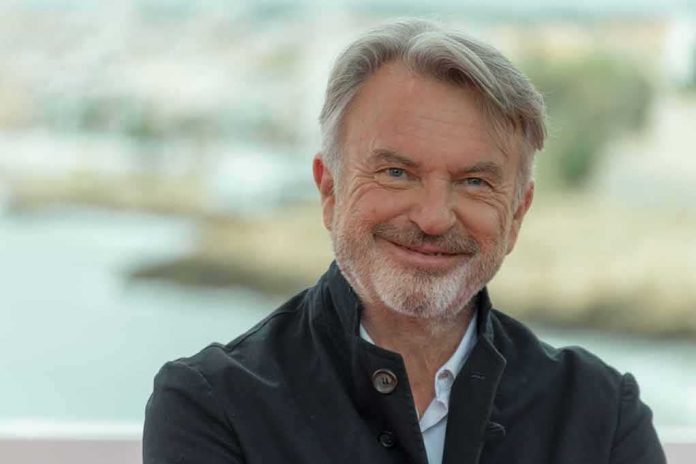
The sudden, peaceful death of Sam Neill at 78 closes one of film’s most quietly powerful careers while raising hard questions about how we remember men like him.
Story Snapshot
- Sam Neill died suddenly and peacefully in Sydney at age 78, surrounded by family
- He was born Nigel John Dermot Neill in Northern Ireland and moved to New Zealand at age seven
- His five-decade career stretched from art-house dramas to Jurassic Park’s blockbuster fame
- Family says he was cancer-free after beating a rare blood cancer before his unexpected death
A confirmed death, a quiet passing, and a global wave of grief
Sam Neill’s family announced that the New Zealand actor died on July 13, 2026, in Sydney, New South Wales, Australia, at age 78. Their statement described his passing as sudden, peaceful, and marked by the dignity that defined his life, saying he died surrounded by family who had gathered at his side. Within hours, major outlets across the world echoed the same core facts, and fans who grew up with Jurassic Park felt as if a steady voice from their youth had gone silent.
The family’s announcement stressed one detail that caught many eyes: they said Neill was “blessed” to be cancer-free when he died, after years of fighting a rare blood cancer. Reports note he had recently shared that he was in remission and that he felt grateful for more time with his children and grandchildren. No cause of death has yet been made public, and they asked for privacy, a choice that fits how he handled fame for five decades—firm, polite, and focused on the work, not the drama.
From Northern Ireland boy to New Zealand leading man
Neill was born Nigel John Dermot Neill on September 14, 1947, in Omagh, County Tyrone, Northern Ireland, to an English mother and New Zealand father. His family moved to Christchurch, New Zealand, when he was seven, trading a postwar Irish town for a young country where his father worked in the wine trade. He later joked that he stopped using “Nigel” because there were simply too many Nigels at school, and “Sam” felt easier for classmates and film credits.
He never attended drama school, but he joined a university drama club and fell in love with acting. New Zealand’s small film industry offered few chances, yet Neill turned that into an advantage. His breakout came with the 1977 thriller Sleeping Dogs, one of New Zealand’s first color feature films, where he showed the tense, watchful presence that would define his screen style. That role opened doors in Australia and Europe, and before long he was working with directors who saw him as a natural leading man.
A five-decade career that balanced art and blockbuster fame
Across more than fifty years, Neill built a career many actors quietly envy: steady, varied work without being trapped in one type. He starred in My Brilliant Career, played complex men in films like Possession and The Piano, and moved between television and movies with ease. His performances often carried the same core blend: calm on the surface, tension underneath, a man who thinks before he speaks but feels more than he lets on.
Jurassic Park changed his public image forever. As Dr. Alan Grant, the dinosaur expert who hates kids but learns to protect them, Neill became part of global pop culture in 1993. He later returned to the role in Jurassic Park III and Jurassic World Dominion, giving older viewers a sense of continuity as the franchise grew louder and bigger. Yet he kept saying he did not want to be only “the dinosaur guy,” and his choices—Peaky Blinders, indie films, New Zealand projects—backed up that quiet stand.
Cancer fight, unanswered questions, and how media moves on
In 2023, Neill revealed he had been diagnosed with angioimmunoblastic T-cell lymphoma, a rare blood cancer, and had undergone aggressive treatment. He later told interviewers his cancer was in remission and that he was “cancer-free,” a relief his family repeated in their death announcement. What they have not shared yet is the specific medical cause or exact circumstances of his death, beyond calling it sudden and unexpected, and noting he was with loved ones.
Cillian Murphy speaks out after death of Peaky Blinders co-star Sam Neill with touching tributehttps://t.co/C2w2l6RRbe
— GB News (@GBNEWS) July 13, 2026
From a common-sense, conservative view, the family’s privacy request should be respected unless a clear public interest demands more detail. At the same time, media has a duty not to turn “sudden and unexpected” into wild guesses. Guidelines for covering celebrity deaths warn against speculation and remind reporters to focus on confirmed facts and public-interest context, not clicks. In Neill’s case, the core story stands solid: a respected actor, long open about illness, died peacefully after beating cancer.
A legacy of steadiness in an age of noise
Tributes from co-stars and directors highlight the same traits again and again: kindness on set, professionalism, and a refusal to chase scandal for attention. For many viewers now in their forties, fifties, and sixties, Neill was part of the cultural furniture—a face you trusted in thrillers, dramas, and big studio films. Research on public memory of famous figures shows that artists who die later in life often see a softer, longer-lasting rise in attention, built on affection more than shock.
That pattern fits Sam Neill. His death does not spark the dark, noisy frenzy that follows a young star’s overdose or suicide; it instead brings a quieter flood of stories about fathers and daughters who watched Jurassic Park together and then found his smaller films. For a man who spent decades doing the work without begging for the spotlight, that may be the most fitting final act: not mystery, not scandal, just a long career, sudden goodbye, and millions of people realizing how much that calm voice on screen meant to them.
Sources:
townhall.com, kvpr.org, itv.com, abcnews.com, en.wikipedia.org, republicworld.com, cbsnews.com, ynetnews.com, mindframe.org.au, pmc.ncbi.nlm.nih.gov