

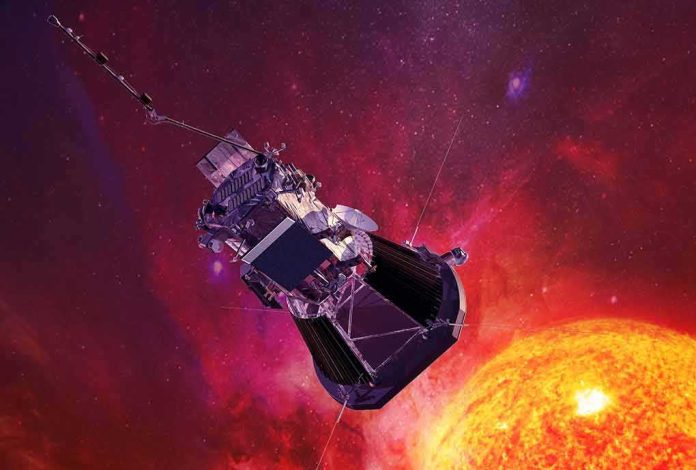
A U.S. “satellite mechanic” with twin robotic arms is now in orbit, and its life‑extension tools could also give Washington a quiet way to reach out and grab, damage, or even disable other nations’ spacecraft.
Story Snapshot
- Northrop Grumman’s Mission Robotic Vehicle (MRV) uses twin robotic arms to dock with and repair satellites in high Earth orbit.
- Those same arms and close‑approach skills could be repurposed to tamper with or attack foreign satellites, raising “dual‑use” fears.
- Company leaders openly say whether there is an “attack version” is up to the U.S. government, not just commercial customers.
- The launch highlights growing concern that powerful space tools are being shaped by elites and defense officials with little public debate.
Robot satellite mechanic or quiet space weapon?
Northrop Grumman’s Mission Robotic Vehicle is billed as a private “space mechanic” that will use two robotic arms to repair, relocate, and service satellites in geosynchronous orbit about 22,000 miles above Earth. The spacecraft just rode a SpaceX Falcon 9 rocket into space along with three “jetpack” Mission Extension Pods that can extend a satellite’s life by as much as eight years. The arms are part of a government‑developed payload called Robotic Servicing of Geosynchronous Satellites, built with the U.S. Naval Research Laboratory and the Defense Advanced Research Projects Agency.
The MRV’s job sounds simple and helpful: pick up a Mission Extension Pod, fly over to an aging communications satellite, and use its 10‑foot arms to bolt the pod on. Unlike older space tugs that stay attached for years, MRV is designed to move from one customer to another, using advanced sensors, propulsion, and docking systems to grab many satellites over its lifetime. Northrop Grumman says future versions could also inspect, repair, upgrade, tow, and even remove dead spacecraft from busy orbits.
Why robotic arms in space worry both allies and rivals
Robotic arms are powerful tools because they let a spacecraft get very close, grab onto another satellite, and physically move or change it. That same ability that makes MRV a handy repair robot also makes it inherently “dual‑use” — useful for peaceful service but also able to damage, disable, or drag a satellite into a bad orbit. Analysts have warned for years that space arms could knock out solar panels, bend antennas, or tow a satellite into a path where it eventually falls into the atmosphere and burns up. In policy reports, robotic grappling systems are cited as classic examples of technology that can slide from helpful to hostile without changing hardware.
This is not just about one U.S. spacecraft. Research shows Russia and China are also working on on‑orbit robots that can inspect or move other satellites. Governments routinely view such vehicles as possible anti‑satellite tools, even when their stated job is debris cleanup or life extension. Legal studies on satellite servicing warn that close‑approach and rendezvous technology can support spying or counter‑space missions as easily as repairs. In short, once a robot can quietly dock with someone else’s space asset, the line between service and sabotage is thin and mostly decided by secret orders, not by the hardware itself.
What Northrop and the Pentagon are — and are not — saying
Northrop Grumman’s public materials stress the commercial side: a privately owned, multi‑mission robotic craft that will give satellite owners more years of service and cut waste in orbit. But the Robotic Servicing of Geosynchronous Satellites payload at the heart of MRV was funded and developed with the U.S. defense research agency and the Naval Research Laboratory, and the vehicle is expected to serve both government and private clients. In a recent earnings call, when an analyst asked if there might be a market for an “attack version” that could cripple rival satellites, Chief Executive Officer Kathy Warden did not dismiss the idea. She said that question should be left to the U.S. government and that the company’s job is to offer “technical options.”
Foreign outlets quickly picked up reporting from The War Zone, a U.S. defense magazine, noting its warning that MRV’s arms could be used “for direct attacks on space satellites.” Russian and other media framed the spacecraft as able to destroy satellites even though its official mission is repair and refueling. Neither the company nor U.S. officials have announced any plan to use MRV as a weapon. But at the same time, U.S. military documents openly treat on‑orbit robotic systems as part of a broader set of dual‑use space tools that could support future anti‑satellite operations. That mix of public silence and insider signals feeds mistrust abroad and unease at home.
Shared worries about elites, secrecy, and space power
For many Americans on both the right and the left, this story hits familiar nerves. People see a large defense contractor, backed by powerful government science agencies, launching a sophisticated robot whose peaceful mission is clear — but whose more aggressive uses will likely be decided behind closed doors. Legal and policy studies note that current international space law barely addresses dual‑use systems and gives citizens little say over how they are used in national security plans. That gap lets well‑connected “space economy” players shape the rules while taxpayers and ordinary satellite users live with the risks.
A SpaceX Falcon 9 rocket has successfully launched Northrop Grumman's Mission Robotic Vehicle (MRV) from Cape Canaveral, marking the debut of a first-of-its-kind commercial satellite-servicing mission. Built to operate in geostationary orbit (GEO), the MRV is equipped with two… pic.twitter.com/x6Nolu7qIi
— Stellarix (@Stellarixorine) July 23, 2026
Conservatives worried about a growing “deep state” see yet another high‑tech program where unelected officials and defense insiders play with tools that could trigger conflict far above Earth’s surface. Liberals worried about global militarization see a private company selling services worldwide while leaving key choices about possible attacks to national security elites. Both sides share a basic concern: powerful technology is racing ahead of open rules, and the people paying for it are not the ones deciding whether a helpful robot becomes a quiet space weapon.
Sources:
realcleardefense.com, twz.com, satnews.com, satellitetoday.com, iz.ru, vesti.ru, northropgrumman.com, space.com, doncio.navy.mil, spacenews.com, supercluster.com, nextspaceflight.com, linkedin.com, btlj.org, documents.unoda.org, studocu.com, escholarship.org, lawfaremedia.org, static1.squarespace.com, publications.jrc.ec.europa.eu, webthesis.biblio.polito.it, lawjournal.digital