

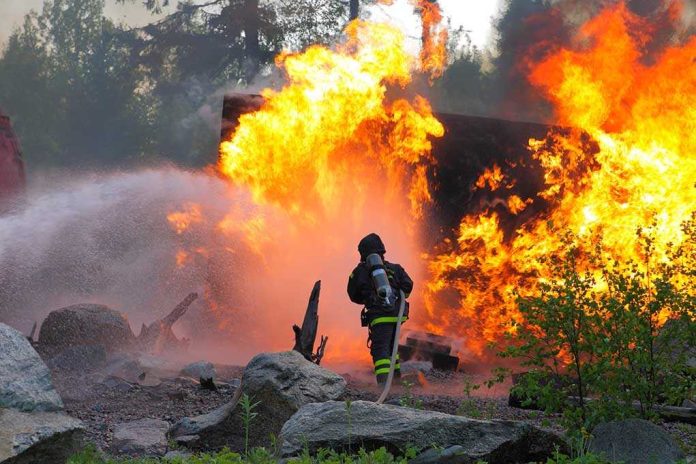
The nation’s largest active wildfire is tearing through southern Utah, and officials say people — not nature — lit the match.
Story Snapshot
- The Cottonwood Fire in Utah has exploded past 92,000 acres, with **0% containment** and heavy winds pushing flames toward communities.[8]
- State officials have already labeled it a **human-caused** disaster, even though investigators still do not know the exact spark.[11]
- Utah’s governor calls it the **most destructive wildfire in state history for property loss**, as homes, cabins, and a ski resort lie in ruins.[12]
- Confusing and conflicting reports from media and government echo a bigger fear on left and right: the system managing these crises is broken.[1]
An Unstoppable Wall of Fire in Southern Utah
The Cottonwood Fire is burning in southwestern Utah and has grown beyond 92,000 acres, making it the largest active wildfire in the United States right now.[6] Strong, shifting winds keep driving the flames toward small communities like Marysvale and North Creek, and fire crews still report zero percent containment after days of nonstop work.[8] Governor Spencer Cox visited the burn area and said this fire “did not act like other fires,” calling it almost impossible to defend homes and buildings in its path.[13]
Local video shows entire hillsides lighting up in minutes as the fire races through dry grass, brush, and timber.[6] Residents on the eastern and western flanks have faced repeated evacuation orders, sometimes being told to leave, return, and prepare to leave again as conditions change.[8] Despite the chaos, state officials say there have been no confirmed fatalities in the Cottonwood Fire itself, crediting fast evacuations and aggressive alerts during the most dangerous early hours of the blaze.[13]
Human-Caused – Even Before the Cause Is Known
Utah fire authorities have already classified the Cottonwood Fire as **human-caused**, meaning they believe people — not lightning — started it.[11] At the same time, those same officials say the exact cause is still under investigation, and they have not released details about what activity or negligence led to the initial spark.[11] On social media, some residents mention target shooting as a possible cause, but that idea remains unconfirmed and is not part of any official statement.[7]
This quick “human-caused” label fits a larger pattern in Utah wildfire policy. State leaders have often stressed that most fires are started by people, and recent data showed roughly 270 of 367 Utah fires in one season were human-caused.[14] Utah Governor Spencer Cox has previously said more than 75 percent of the state’s wildfires come from human actions.[18] That framing supports new bans and restrictions, like his statewide order limiting fireworks around July 4th to reduce the risk of more blazes during a dangerous fire weather stretch.[4]
The Most Destructive in Utah History – With Many Unknowns
Governor Cox has called the Cottonwood Fire the most destructive wildfire in Utah history in terms of property damage, pointing to burned homes, cabins, and a popular southern Utah ski resort that may set new records for insured losses.[12] Video and photographs show neighborhoods reduced to foundations and ash as the fire jumped roads and ran through defensible space that normally slows flames.[6] Yet state and local officials admit they still do not know exactly how many structures are gone or the total dollar cost because crews cannot safely access many burn areas.[12]
Even basic facts like the fire’s size have shifted across outlets. Reports have mentioned 59,000 acres, 70,000 acres, more than 92,000 acres, and nearly 100,000 acres, depending on the day and source.[6] Some coverage has also mixed details from a different Cottonwood Fire in Nebraska, which burned more than 130,000 acres, adding to public confusion.[2] That jumble of numbers and locations feeds a growing suspicion shared by many conservatives and liberals: information during major crises often feels incomplete, inconsistent, or filtered through political talking points rather than straight answers.
Stress on a Thinning Firefighting System
The Cottonwood Fire is not burning in isolation. At least a dozen new wildfires have erupted across Utah in the past day, all under red flag warnings that signal hot, dry, and windy conditions ideal for fast fire spread.[10] Meteorologists warn about “dry thunderstorms,” where lightning can ignite new fires but rain evaporates before it hits the ground, especially across parts of the Four Corners region.[10] Satellite views show smoke and soot drifting along interstate corridors, raising health concerns for people with asthma and other breathing problems even far from the flames.[10]
I’m back home after a weekend in California. The news of the fires spreading in Utah stayed with me and I even caught a glimpse of the Cottonwood Fire as I flew south Thursday. pic.twitter.com/pJEwlqDq3d
— Kristen McPeek KUTV (@KristenMcPeekTV) June 29, 2026
Behind the scenes, the national wildfire workforce is under strain. The United States Forest Service has cut thousands of positions in recent years, and Western land officials say leadership in complex incident management teams has grown weaker.[10] That means fewer seasoned crews to handle huge, fast-moving fires like Cottonwood. Power companies are also making hard choices: Rocky Mountain Power has shut off electricity in places like North Creek to prevent sparking new fires, leaving some towns in the dark while others nearby stay fully powered.[8] For many citizens, these uneven impacts look less like careful planning and more like a system stretched past its limits.
What This Fire Reveals About a Failing System
The Cottonwood Fire exposes deeper tensions in how the country handles disasters. People on the right see another human-caused blaze turning into a crisis while government still struggles to police risky behavior, secure forests, and hold anyone accountable. People on the left see climate-driven fire weather getting worse while leaders lean on simple slogans like “human-caused” and “prevention” instead of investing in stronger social safety nets, health protections, and long-term planning.[19]
Both sides increasingly agree on one thing: the system is not working. Confused numbers, rushed labels, workforce cuts, and patchwork evacuation and power decisions suggest a wildfire response machine that cannot keep up with the danger. As the Cottonwood Fire keeps burning, many Utahns are not just asking how this fire started. They are asking why, after years of warnings, the richest and most powerful levels of government still leave ordinary families and towns to face the flames with so little clarity and trust.
Sources:
[1] Web – The largest active wildfire in the U.S. has now exploded to more than …
[2] Web – Human-Caused Fire | Investigation Ongoing Utah The Cottonwood …
[4] Web – CottonwoodFire MIDDAY UPDATE, June 24,2026 The fire is …
[6] Web – Investigations | Cottonwood, AZ
[7] Web – The Cottonwood Fire burned through structures as it exploded in …
[8] Web – The Cottonwood Fire burned through structures as it exploded in …
[10] YouTube – Cottonwood Fire expands to over 27,000 acres, determined as …
[11] Web – Cottonwood Fire might set cost records after destroying southern …
[12] Web – Uncontained Cottonwood Fire burns 92,000 acres in Southern Utah
[13] Web – ‘It’s End-of-Days-Type Stuff’: Wildfires Rage in Utah’s Mountains
[14] Web – Cottonwood Fire Map – Watch Duty
[18] Web – [PDF] All About Wildfires – Natural History Museum of Utah
[19] Web – More than 75% of Utah’s wildfires are human-caused, which means …